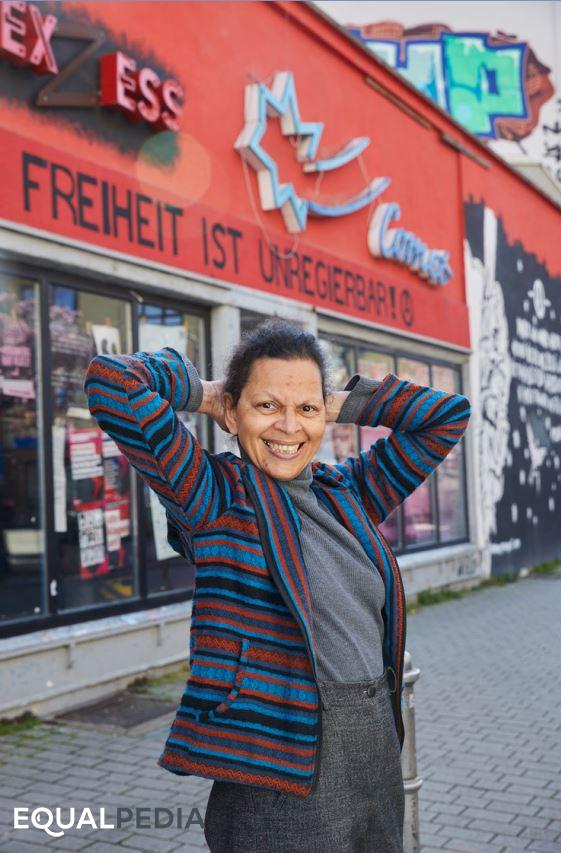
Eleonore Wiedenroth-Coulibaly (* 1955 in Wiesbaden) is an Afro-German translator, speaker, teacher and anti-racist and feminist activist. She is one of the founders of the Initiative Schwarze Menschen in Deutschland (Initiative of Black People in Germany).1Deutsche Nationalbibliothek (n.d.): Elisabeth Wiedenroth-Coulibaly. Datensatz der Deutschen Nationalbibliothek. In: Website of the Deutsche Nationalbibliothek. Available online at: https://d-nb.info/gnd/1084641135 (accessed on 16 October 2022).2Frauenreferat der Stadt Frankfurt am Main (ed.) (2020): This is what a feminist looks like – Frankfurter Porträts in Zusammenarbeit mit der Fotografin Katharina Dubno. In: Frauen. Macht. Politik. Available online at: http://frauen-macht-politik-ffm.de/frankfurter-portraits/ (accessed on 16 October 2022).
Career
Eleonore Wiedenroth-Coulibaly was born in Wiesbaden in 1955, the child of a German mother and a Black US soldier.3Weidenroth-Coulibaly, Eleonore (2015): Deutschland: Ein Frühlingsmärchen. In: Kraft, Marion (ed.): Kinder der Befreiung. Transatlantische Erfahrungen und Perspektiven Schwarzer Deutscher der Nachkriegsgeneration. In cooperation with Ika Hügel-Marshall. Münster: Unrast Verlag, ISBN 978-3-89771-592-9, pp. 182–190, here p. 182. Her childhood and youth in Wiesbaden were marked by everyday racism and exclusion; as an adult, she increasingly thought about emigrating. She travelled to Tunisia, Ghana and Liberia4Adomako, Abenaa Agyeiwaa/Eding, Jasmin (2021): Siraad Wiedenroth & Eleonore Wiedenroth-Coulibaly (Tochter & Mutter) / 80er Schwarze Bewegung. In: YouTube, video of 23 October. Available online at: https://www.youtube.com/watch?v=6os6EOnEC8o (accessed on 16 October 2022). in search of an adopted home, but realised that “her home does not lie outside Europe, but that she has to fight ‘to have my place here’.”5Jürgs, Alexander (2022): Diese Frau kämpft. In: Frankfurter Allgemeine Zeitung, article of 13 October. Available online at: https://www.faz.net/aktuell/rhein-main/frankfurt/eleonore-wiedenroth-coulibaly-diese-frau-kaempft-18362815.html (accessed on 16 October 2022). She found support in English-language songs by Black artists such as Harry Belafonte and Miriam Makeba and, through them, in anti-racist Black literature. From 1974 to 1979 she studied applied linguistics and ethnology in Mainz and became an interpreter and translator.6Koch, Yvonne/Fouraté (2022): Sie macht Schwarze Menschen sichtbar – seit Jahrzehnten. In: hessenschau.de, article of 13 October. Available online at: https://www.hessenschau.de/kultur/tony-sender-preistraegerin-wiedenroth-coulibaly-sie-macht-schwarze-menschen-sichtbar—seit-jahrzehnten,tony-sender-preis-wiedenroth-coulibaly-100.html (accessed on 16 October 2022).7n.a. (n.d.): Eleonore Wiedenroth-Coulibaly. Präsentation. In: Website of the City of Frankfurt am Main. Available online at: https://frankfurt.de/-/media/frankfurtde/global/aktuelles-meldungen/aktuelles/pdf/2022/august/kw-31/lebenslauf-von-eleonore-wiedenroth-coulibaly.ashx (accessed on 16 October 2022).8Jürgs, Alexander (2022): Diese Frau kämpft. In: Frankfurter Allgemeine Zeitung, article of 13 October. Available online at: https://www.faz.net/aktuell/rhein-main/frankfurt/eleonore-wiedenroth-coulibaly-diese-frau-kaempft-18362815.html (accessed on 16 October 2022).
Founding of the Initiative Schwarze Deutsche (Initiative of Black Germans)
In the mid-1980s, Wiedenroth-Coulibaly was interviewed by a white German journalist for a film about Black Germans. She asked for the list of interviewees and began phoning them with the aim of bringing these people together: “It can’t be that people only talk about us; we have to meet and talk to each other.”9Adeoso, Marie-Sophie (2015): Sich sichere Räume schaffen. In: Frankfurter Rundschau, article of 21 September. Available online at: https://www.fr.de/rhein-main/sich-sichere-raeume-schaffen-11140637.html (accessed on 16 October 2022). Together with Helga Emde and other fellow campaigners, including the Wiesbaden pastor Sunny Panitz, Wiedenroth-Coulibaly organised private meetings in Wiesbaden, Frankfurt and Mainz.10Adomako, Abenaa Agyeiwaa/Eding, Jasmin (2021): Siraad Wiedenroth & Eleonore Wiedenroth-Coulibaly (Tochter & Mutter) / 80er Schwarze Bewegung. In: YouTube, video of 23 October. Available online at: https://www.youtube.com/watch?v=6os6EOnEC8o (accessed on 16 October 2022).
At around the same time, May Ayim, Dagmar Schultz and Katharina Oguntoye initiated the book project Farbe bekennen. Afro-deutsche Frauen auf den Spuren ihrer Geschichte (published in English as “Showing Our Colors: Afro-German Women Speak Out”), which is today a classic of the Afro-German movement. Ayim, Schultz, Oguntoye and other women were inspired by the Caribbean-American feminist theorist, poet and activist Audre Lorde to found ADEFRA – Schwarze Frauen in Deutschland (Black Women in Germany).11ADEFRA (n.d.): Welcome. In: Website of Adefra. Available online at: http://www.adefra.com/index.php (accessed on 16 October 2022). Emde and Wiedenroth-Coulibaly were asked whether they wanted to write contributions for the book. The book laid one of the foundation stones of the more recent Black movement in Germany.12Wiedenroth-Coulibaly, Eleonore/Haruna-Oelker, Hadija (n.d.): Geschichte. In: Website of the ISD. Available online at: https://isdonline.de/ueber-uns/#geschichte (accessed on 16 October 2022). At the same time, this established a connection between Wiedenroth-Coulibaly, the Black activists from the Rhine-Main region and ADEFRA. In December 1985, a first nationwide meeting took place in a church in Wiesbaden, which Wiedenroth-Coulibaly had co-initiated.13Adomako, Abenaa Agyeiwaa/Eding, Jasmin (2021): Siraad Wiedenroth & Eleonore Wiedenroth-Coulibaly (Tochter & Mutter) / 80er Schwarze Bewegung. In: YouTube, video of 23 October. Available online at: https://www.youtube.com/watch?v=6os6EOnEC8o (accessed on 16 October 2022). This gave rise to the Initiative Schwarze Deutsche (ISD), today the Initiative Schwarze Menschen in Deutschland (Initiative of Black People in Germany). Wiedenroth-Coulibaly’s aim was to find a Black community in Germany and to build one herself.14n.a. (2022): Tony-Sender-Preis verliehen. In: Frankfurter Rundschau, article of 14 October. Available online at: https://www.fr.de/frankfurt/tony-sender-preis-verliehen-91852248.html (accessed on 16 October 2022). Numerous ISD groups across Germany emerged from the meetings Wiedenroth-Coulibaly organised in the Rhine-Main region and from those in Berlin. The ISD campaigns against racial profiling, police violence and racist stereotypes in school textbooks. The ISD’s goals are to promote the political participation of Black people and to improve their living conditions in Germany.15ISD (n.d.): Über uns. In: Website of the ISD. Available online at: https://isdonline.de/ueber-uns/ (accessed on 16 October 2022). Through the ISD, Wiedenroth-Coulibaly also got to know, for example, the actor, journalist and Federal Intelligence Service (Bundesnachrichtendienst) official Theodor Wonja Michael, the singer and actress Marie Nejar, the journalist and writer Hans-Jürgen Massaquoi and the songwriter and peace activist Fasia Jansen, all of them Black contemporary witnesses of National Socialism.16Jürgs, Alexander (2022): Diese Frau kämpft. In: Frankfurter Allgemeine Zeitung, article of 13 October. Available online at: https://www.faz.net/aktuell/rhein-main/frankfurt/eleonore-wiedenroth-coulibaly-diese-frau-kaempft-18362815.html (accessed on 16 October 2022).
From 1996 to 2006, Wiedenroth-Coulibaly was a board member of the Initiative Schwarze Menschen in Deutschland Bund e. V. Today her daughter Siraad Rosina Wiedenroth is managing director of the ISD (as of October 2022).17ISD (n.d.): Team. In: Website of the ISD. Available online at: https://isdonline.de/ueber-uns/#team (accessed on 16 October 2022).18Adomako, Abenaa Agyeiwaa/Eding, Jasmin (2021): Siraad Wiedenroth & Eleonore Wiedenroth-Coulibaly (Tochter & Mutter) / 80er Schwarze Bewegung. In: YouTube, video of 23 October. Available online at: https://www.youtube.com/watch?v=6os6EOnEC8o (accessed on 16 October 2022).
In 2006, Wiedenroth-Coulibaly, together with Kabasia Chuwa, Nadine Golly, Nicola Lauré al-Samarai and Victoria B. Robinson, curated the exhibition “Homestory Deutschland. Schwarze Biografien in Geschichte und Gegenwart” (Homestory Germany. Black Biographies in History and the Present), which from 2006 to 2014 showed 27 portraits of Black men and women from three centuries in various German cities and also internationally (in cooperation with the Goethe-Institut, also in South Africa, Tanzania, Uganda, Madagascar, Mozambique, Namibia, Zimbabwe, Malawi, Côte d’Ivoire, Togo and Senegal). The exhibition was accompanied by a staged reading entitled “Homestory Deutschland – Gelebt-erlebte Schwarze Deutsche Geschichte(n)”; the multimedia stage piece was written by ManuEla Ritz and Sharon Dodua Otoo.19Initiative Schwarze Menschen in Deutschland e. V. (n.d.): Ausstellung. In: Exhibition website. Available online at: http://www.homestory-deutschland.de/kontakt-impressum.html (accessed on 16 October 2022).20Initiative Schwarze Menschen in Deutschland e. V. (n.d.): Kontakt/Impressum. In: Exhibition website. Available online at: http://www.homestory-deutschland.de/ausstellung.html (accessed on 16 October 2022).21Initiative Schwarze Menschen in Deutschland e. V. (n.d.): Homestory Deutschland. Blog zur Ausstellung und szenischen Lesung. Available online at: http://homestorydeutschland.blogspot.com/ (accessed on 16 October 2022).
Other activities, memberships and voluntary work

Photo: Katharina Dubno
From 1990 to 1998, Wiedenroth-Coulibaly headed the Stadtteilfrauenprojekt Gallus (Gallus neighbourhood women’s project) of the Lehrerkooperative e. V. in Frankfurt am Main, founded in 1987, which she had helped to build up.22n.a. (n.d.): Eleonore Wiedenroth-Coulibaly. Präsentation. In: Website of the City of Frankfurt am Main. Available online at: https://frankfurt.de/-/media/frankfurtde/global/aktuelles-meldungen/aktuelles/pdf/2022/august/kw-31/lebenslauf-von-eleonore-wiedenroth-coulibaly.ashx (accessed on 16 October 2022).23Jürgs, Alexander (2022): Diese Frau kämpft. In: Frankfurter Allgemeine Zeitung, article of 13 October. Available online at: https://www.faz.net/aktuell/rhein-main/frankfurt/eleonore-wiedenroth-coulibaly-diese-frau-kaempft-18362815.html (accessed on 16 October 2022). The Gallus project offers neighbourhood-based education, exchange and counselling for foreign and German women, as well as German and literacy courses, sewing courses and migration counselling for adult immigrants, with childcare provided in parallel to the courses.24ASB Lehrerkooperative (n.d.): Frauenprojekt Gallus. In: Website of the Lehrerkooperative. Available online at: https://lehrerkooperative.de/tag/gallus.html (accessed on 16 October 2022).
From 1996 to 2001, Wiedenroth-Coulibaly was a board member of agisra e. V. “Neue Wege für Migrantinnen” (New Paths for Migrant Women) in Frankfurt am Main.25n.a. (n.d.): Eleonore Wiedenroth-Coulibaly. Präsentation. In: Website of the City of Frankfurt am Main. Available online at: https://frankfurt.de/-/media/frankfurtde/global/aktuelles-meldungen/aktuelles/pdf/2022/august/kw-31/lebenslauf-von-eleonore-wiedenroth-coulibaly.ashx (accessed on 16 October 2022). From 2007 to 2009, she was a board member of the Feministisches Frauengesundheitszentrum (Feminist Women’s Health Centre) in Frankfurt am Main.26n.a. (n.d.): Eleonore Wiedenroth-Coulibaly. Präsentation. In: Website of the City of Frankfurt am Main. Available online at: https://frankfurt.de/-/media/frankfurtde/global/aktuelles-meldungen/aktuelles/pdf/2022/august/kw-31/lebenslauf-von-eleonore-wiedenroth-coulibaly.ashx (accessed on 16 October 2022).
From 2008 to 2014, Wiedenroth-Coulibaly worked as a language teacher and teaching expert for the Goethe-Institut in Côte d’Ivoire and Togo, supporting teachers there in their work. To this day she works as a lecturer in German as a foreign language at the Volkshochschule (adult education centre) and at the Frauenprojekt Gallus in Frankfurt am Main (as of October 2022).27Jürgs, Alexander (2022): Diese Frau kämpft. In: Frankfurter Allgemeine Zeitung, article of 13 October. Available online at: https://www.faz.net/aktuell/rhein-main/frankfurt/eleonore-wiedenroth-coulibaly-diese-frau-kaempft-18362815.html (accessed on 16 October 2022).28n.a. (n.d.): Eleonore Wiedenroth-Coulibaly. Präsentation. In: Website of the City of Frankfurt am Main. Available online at: https://frankfurt.de/-/media/frankfurtde/global/aktuelles-meldungen/aktuelles/pdf/2022/august/kw-31/lebenslauf-von-eleonore-wiedenroth-coulibaly.ashx (accessed on 16 October 2022).
In January 2024, Eleonore Wiedenroth-Coulibaly, together with Hadija Haruna-Oelker, spoke in front of Frankfurt’s Römer at the large rally against the far right, in which more than 35,000 people took part to demonstrate against the AfD and right-wing extremism.29Haruna-Oelker, Hadija/Wiedenroth-Coulibaly (2024): Nie wieder leise. Zusammen gegen rechts. In: Faust-Kultur, article of 21 January. Available online at: https://faustkultur.de/gesellschaft-essay-reportage/nie-wieder-leise/ (accessed on 31 January 2024) Her speech can be read here.
Awards
In October 2022, Wiedenroth-Coulibaly received the Tony-Sender-Preis (Tony Sender Prize) of the City of Frankfurt am Main for her “combination of anti-racist and feminist work”. She was honoured as an “initiator, fellow campaigner, companion and role model for many women and girls”.30dpa (2022): Stadt Frankfurt ehrt Antirassistin Wiedenroth-Coulibaly. In: Süddeutsche Zeitung, article of 1 August. Available online at: https://www.sueddeutsche.de/panorama/kommunen-frankfurt-am-main-stadt-frankfurt-ehrt-antirassistin-wiedenroth-coulibaly-dpa.urn-newsml-dpa-com-20090101-220801-99-237367 (accessed on 16 October 2022).31n.a. (2022): Tony-Sender-Preis verliehen. In: Frankfurter Rundschau, article of 14 October. Available online at: https://www.fr.de/frankfurt/tony-sender-preis-verliehen-91852248.html (accessed on 16 October 2022).
Publications
Essays and contributions (selection)
- Wiedenroth, Eleonore (1986): Was macht mich so anders in den Augen der anderen. In: Ayim, May/Oguntoye, Katharina/Schultz, Dagmar (eds.): Farbe bekennen. Afro-deutsche Frauen auf den Spuren ihrer Geschichte. Berlin: Orlanda Frauenverlag, ISBN 978-3-922166-21-4, pp. 217–231.
- Wiedenroth, Eleonore/Reyes, Azarel/Uysal, Jale/Kornblum, Petra/Piesche Esan, Peggy/Konuk, Kader/Gonzales Romeo, Maria Virginia/Popoola, Olumide/Hamzei, Modjgan/Caliskan, Selmin/Willbold, Gabriela/Sezen, Beldan/Laermann, Barbara/El-Tayeb, Fatima/St. Louis, Guy (1999): Talking Home. Heimat aus unserer eigenen Feder. Amsterdam: blue moon press, ISBN 9090124470.
- Chuwa, Kabasia/Golly, Nadine/Lauré al-Samarai, Nicola/Robinson, Victoria B./Wiedenroth-Coulibaly, Eleonore (2006): Homestory Deutschland. Schwarze Biografien in Geschichte und Gegenwart. Exhibition catalogue. Münster: edition assemblage, ISBN 978-3-942885-66-9 (on the exhibition: http://www.homestory-deutschland.de/ausstellung.html).
- Weidenroth-Coulibaly, Eleonore (2007): Zwanzig Jahre Schwarzer Widerstand in bewegten Räumen. Was sich im Kleinen abspielt und aus dem Verborgenen erwächst. In: Kien, Nghi Ha/Lauré al-Samarai, Nicola/Mysorekar, Sheila (eds.): re/visionen. Postkoloniale Perspektiven von People of Color auf Rassismus, Kulturpolitik und Widerstand in Deutschland. Münster: Unrast Verlag, ISBN 978-3-95405-039-0, pp. 401–422.
- Weidenroth-Coulibaly, Eleonore (2015): Deutschland: Ein Frühlingsmärchen. In: Kraft, Marion (ed.): Kinder der Befreiung. Transatlantische Erfahrungen und Perspektiven Schwarzer Deutscher der Nachkriegsgeneration. In cooperation with Ika Hügel-Marshall. Münster: Unrast Verlag, ISBN 978-3-89771-592-9, pp. 182–190.
- Weidenroth-Coulibaly, Eleonore (2015): Macht der Worte–Erstarken. In: Kraft, Marion (ed.): Kinder der Befreiung. Transatlantische Erfahrungen und Perspektiven Schwarzer Deutscher der Nachkriegsgeneration. In cooperation with Ika Hügel-Marshall. Münster: Unrast Verlag, ISBN 978-3-89771-592-9, p. 359.
- Ridha, Camilla/Wiedenroth-Coulibaly, Eleonore (2015): Impressionen vom Black History Month in Frankfurt am Main. In: Bergold-Caldwell, Denise/Digoh, Laura/Haruna-Oelker, Hadija/Nkwendja-Ngnoubamdjum, Cellehrist/Ridha, Camilla (eds.): Spiegelblicke. Perspektiven Schwarzer Bewegung in Deutschland. Berlin: Orlanda Frauenverlag, ISBN 978-3-944666-23-5, pp. 51–55.
- Weidenroth-Coulibaly, Eleonore (2015): Die multiplen Anfänge der ISD. In: Bergold-Caldwell, Denise/Digoh, Laura/Haruna-Oelker, Hadija/Nkwendja-Ngnoubamdjum, Cellehrist/Ridha, Camilla (eds.): Spiegelblicke. Perspektiven Schwarzer Bewegung in Deutschland. Berlin: Orlanda Frauenverlag, ISBN 978-3-944666-23-5, pp. 28–32.
- Wiedenroth-Coulibaly, Eleonore/Haruna-Oelker, Hadija (2015): Mit der Vergangenheit im Rücken in die Zukunft blicken. Gesammelte Erinnerungen. In: Bergold-Caldwell, Denise/Digoh, Laura/Haruna-Oelker, Hadija/Nkwendja-Ngnoubamdjum, Cellehrist/Ridha, Camilla (eds.): Spiegelblicke. Perspektiven Schwarzer Bewegung in Deutschland. Berlin: Orlanda Frauenverlag, ISBN 978-3-944666-23-5, pp. 266–271.
- Wiedenroth-Coulibaly, Eleonore (2018): emPOWERment heißt erMACHTigung. In: Projekt girls act! – antirassistische Bildungsarbeit (ed.): Dokumentation. Tagung – Transkulturelle Teams. Ein Qualitätsstandard in der sozialen Arbeit?! pp. 10–14. Available online at: http://www.maedchentreff-bielefeld.de/wp-content/uploads/2018/11/doku_transkulturelle_teams.pdf (accessed on 16 October 2022).
- Kaur Cholia, Harpreet/Jänicke, Christin (eds.) (2021): Feministische Solidarität gegen Rassismus. Perspektiven aus Ost- und Westdeutschland. Interview mit Madeleine Mawamba und Eleonore Wiedenroth-Coulibaly. In: Kaur Cholia, Harpreet/Jänicke, Christin (eds.): Unentbehrlich. Solidarität mit Betroffenen rechter, rassistischer und antisemitischer Gewalt. Münster: edition assemblage, ISBN 978-3-96042-105-4, pp. 137–145.
Translations (selection)
- Lovelace, Earl (1984): Der Drachentanz. A novel from Trinidad. Translated from English by Eleonore Wiedenroth. Bornheim-Merten: Lamuv-Verlag, ISBN 978-3-88977-012-7.
- Thelwell, Michael (1984): Jamaica-Kid. Translated from American English by Pociao and Eleonore Wiedenroth. Augsburg: MaroVerlag, ISBN 978-3-87512-058-5.
- Thelwell, Michael (1986): Sag Babylon, es wird noch von mir hören. Translated from American English by Pociao and Eleonore Wiedenroth. Reinbek bei Hamburg: Rowohlt, ISBN 978-3-499-15782-0.
- Lenz, Ilse/Luig, Ute (eds.) (1990): Frauenmacht ohne Herrschaft: Geschlechterverhältnisse in nichtpatriarchalischen Gesellschaften. The translations from American English were done by Eleonore Wiedenroth. Berlin: Orlanda Frauenverlag, ISBN 978-3-922166-65-8.
- Eding, Jasmin (2015): “It is not our differences that divide us.” Translated from English by Eleonore Wiedenroth-Coulibaly. In: Bergold-Caldwell, Denise/Digoh, Laura/Haruna-Oelker, Hadija/Nkwendja-Ngnoubamdjum, Cellehrist/Ridha, Camilla (eds.): Spiegelblicke. Perspektiven Schwarzer Bewegung in Deutschland. Berlin: Orlanda Frauenverlag, ISBN 978-3-944666-23-5, pp. 86–87.
- Morgenrath, Christa/Wernecke, Eva (eds.) (2023): Neue Töchter Afrikas. 30 Stimmen. A selection from New Daughters of Africa. Edited by Margaret Busby. Translated from English by Aminata Cissé Schleicher & Eleonore Wiedenroth-Coulibaly. With a foreword by Marion Kraft. Münster: Unrats Verlag, ISBN 978-3-89771-616-2.
- Kendi, Ibram X./Blain, Keisha N. (2024): 400 Seelen. Die Geschichte des Afrikanischen Amerika 1619–2019. Translated from American English by Sylvia Bieker, Aminata Cissé Schleicher, Bernd Gockel, Dominique Haensell, Ruth Keen, Marion Kraft, Andrea Kunstmann, Melody Makeda Ledwon, Elke Link, Felix Mayer, Mirjam Nuenning, Anna von Rath, Jacob Thomas, Alexander Wagner, Eleonore Wiedenroth-Coulibaly, Henriette Zeltner-Shane. München: btb, ISBN 978-3-442-75986-6.
External links
- Literature by and about Eleonore Wiedenroth-Coulibaly in the Deutsche Nationalbibliothek (German National Library)
Machine translation: This article was translated automatically from the German original.
- 1Deutsche Nationalbibliothek (n.d.): Elisabeth Wiedenroth-Coulibaly. Datensatz der Deutschen Nationalbibliothek. In: Website of the Deutsche Nationalbibliothek. Available online at: https://d-nb.info/gnd/1084641135 (accessed on 16 October 2022). ↩︎
- 2Frauenreferat der Stadt Frankfurt am Main (ed.) (2020): This is what a feminist looks like – Frankfurter Porträts in Zusammenarbeit mit der Fotografin Katharina Dubno. In: Frauen. Macht. Politik. Available online at: http://frauen-macht-politik-ffm.de/frankfurter-portraits/ (accessed on 16 October 2022). ↩︎
- 3Weidenroth-Coulibaly, Eleonore (2015): Deutschland: Ein Frühlingsmärchen. In: Kraft, Marion (ed.): Kinder der Befreiung. Transatlantische Erfahrungen und Perspektiven Schwarzer Deutscher der Nachkriegsgeneration. In cooperation with Ika Hügel-Marshall. Münster: Unrast Verlag, ISBN 978-3-89771-592-9, pp. 182–190, here p. 182. ↩︎
- 4Adomako, Abenaa Agyeiwaa/Eding, Jasmin (2021): Siraad Wiedenroth & Eleonore Wiedenroth-Coulibaly (Tochter & Mutter) / 80er Schwarze Bewegung. In: YouTube, video of 23 October. Available online at: https://www.youtube.com/watch?v=6os6EOnEC8o (accessed on 16 October 2022). ↩︎
- 5Jürgs, Alexander (2022): Diese Frau kämpft. In: Frankfurter Allgemeine Zeitung, article of 13 October. Available online at: https://www.faz.net/aktuell/rhein-main/frankfurt/eleonore-wiedenroth-coulibaly-diese-frau-kaempft-18362815.html (accessed on 16 October 2022). ↩︎
- 6Koch, Yvonne/Fouraté (2022): Sie macht Schwarze Menschen sichtbar – seit Jahrzehnten. In: hessenschau.de, article of 13 October. Available online at: https://www.hessenschau.de/kultur/tony-sender-preistraegerin-wiedenroth-coulibaly-sie-macht-schwarze-menschen-sichtbar—seit-jahrzehnten,tony-sender-preis-wiedenroth-coulibaly-100.html (accessed on 16 October 2022). ↩︎
- 7n.a. (n.d.): Eleonore Wiedenroth-Coulibaly. Präsentation. In: Website of the City of Frankfurt am Main. Available online at: https://frankfurt.de/-/media/frankfurtde/global/aktuelles-meldungen/aktuelles/pdf/2022/august/kw-31/lebenslauf-von-eleonore-wiedenroth-coulibaly.ashx (accessed on 16 October 2022). ↩︎
- 8Jürgs, Alexander (2022): Diese Frau kämpft. In: Frankfurter Allgemeine Zeitung, article of 13 October. Available online at: https://www.faz.net/aktuell/rhein-main/frankfurt/eleonore-wiedenroth-coulibaly-diese-frau-kaempft-18362815.html (accessed on 16 October 2022). ↩︎
- 9Adeoso, Marie-Sophie (2015): Sich sichere Räume schaffen. In: Frankfurter Rundschau, article of 21 September. Available online at: https://www.fr.de/rhein-main/sich-sichere-raeume-schaffen-11140637.html (accessed on 16 October 2022). ↩︎
- 10Adomako, Abenaa Agyeiwaa/Eding, Jasmin (2021): Siraad Wiedenroth & Eleonore Wiedenroth-Coulibaly (Tochter & Mutter) / 80er Schwarze Bewegung. In: YouTube, video of 23 October. Available online at: https://www.youtube.com/watch?v=6os6EOnEC8o (accessed on 16 October 2022). ↩︎
- 11ADEFRA (n.d.): Welcome. In: Website of Adefra. Available online at: http://www.adefra.com/index.php (accessed on 16 October 2022). ↩︎
- 12Wiedenroth-Coulibaly, Eleonore/Haruna-Oelker, Hadija (n.d.): Geschichte. In: Website of the ISD. Available online at: https://isdonline.de/ueber-uns/#geschichte (accessed on 16 October 2022). ↩︎
- 13Adomako, Abenaa Agyeiwaa/Eding, Jasmin (2021): Siraad Wiedenroth & Eleonore Wiedenroth-Coulibaly (Tochter & Mutter) / 80er Schwarze Bewegung. In: YouTube, video of 23 October. Available online at: https://www.youtube.com/watch?v=6os6EOnEC8o (accessed on 16 October 2022). ↩︎
- 14n.a. (2022): Tony-Sender-Preis verliehen. In: Frankfurter Rundschau, article of 14 October. Available online at: https://www.fr.de/frankfurt/tony-sender-preis-verliehen-91852248.html (accessed on 16 October 2022). ↩︎
- 15ISD (n.d.): Über uns. In: Website of the ISD. Available online at: https://isdonline.de/ueber-uns/ (accessed on 16 October 2022). ↩︎
- 16Jürgs, Alexander (2022): Diese Frau kämpft. In: Frankfurter Allgemeine Zeitung, article of 13 October. Available online at: https://www.faz.net/aktuell/rhein-main/frankfurt/eleonore-wiedenroth-coulibaly-diese-frau-kaempft-18362815.html (accessed on 16 October 2022). ↩︎
- 17ISD (n.d.): Team. In: Website of the ISD. Available online at: https://isdonline.de/ueber-uns/#team (accessed on 16 October 2022). ↩︎
- 18Adomako, Abenaa Agyeiwaa/Eding, Jasmin (2021): Siraad Wiedenroth & Eleonore Wiedenroth-Coulibaly (Tochter & Mutter) / 80er Schwarze Bewegung. In: YouTube, video of 23 October. Available online at: https://www.youtube.com/watch?v=6os6EOnEC8o (accessed on 16 October 2022). ↩︎
- 19Initiative Schwarze Menschen in Deutschland e. V. (n.d.): Ausstellung. In: Exhibition website. Available online at: http://www.homestory-deutschland.de/kontakt-impressum.html (accessed on 16 October 2022). ↩︎
- 20Initiative Schwarze Menschen in Deutschland e. V. (n.d.): Kontakt/Impressum. In: Exhibition website. Available online at: http://www.homestory-deutschland.de/ausstellung.html (accessed on 16 October 2022). ↩︎
- 21Initiative Schwarze Menschen in Deutschland e. V. (n.d.): Homestory Deutschland. Blog zur Ausstellung und szenischen Lesung. Available online at: http://homestorydeutschland.blogspot.com/ (accessed on 16 October 2022). ↩︎
- 22n.a. (n.d.): Eleonore Wiedenroth-Coulibaly. Präsentation. In: Website of the City of Frankfurt am Main. Available online at: https://frankfurt.de/-/media/frankfurtde/global/aktuelles-meldungen/aktuelles/pdf/2022/august/kw-31/lebenslauf-von-eleonore-wiedenroth-coulibaly.ashx (accessed on 16 October 2022). ↩︎
- 23Jürgs, Alexander (2022): Diese Frau kämpft. In: Frankfurter Allgemeine Zeitung, article of 13 October. Available online at: https://www.faz.net/aktuell/rhein-main/frankfurt/eleonore-wiedenroth-coulibaly-diese-frau-kaempft-18362815.html (accessed on 16 October 2022). ↩︎
- 24ASB Lehrerkooperative (n.d.): Frauenprojekt Gallus. In: Website of the Lehrerkooperative. Available online at: https://lehrerkooperative.de/tag/gallus.html (accessed on 16 October 2022). ↩︎
- 25n.a. (n.d.): Eleonore Wiedenroth-Coulibaly. Präsentation. In: Website of the City of Frankfurt am Main. Available online at: https://frankfurt.de/-/media/frankfurtde/global/aktuelles-meldungen/aktuelles/pdf/2022/august/kw-31/lebenslauf-von-eleonore-wiedenroth-coulibaly.ashx (accessed on 16 October 2022). ↩︎
- 26n.a. (n.d.): Eleonore Wiedenroth-Coulibaly. Präsentation. In: Website of the City of Frankfurt am Main. Available online at: https://frankfurt.de/-/media/frankfurtde/global/aktuelles-meldungen/aktuelles/pdf/2022/august/kw-31/lebenslauf-von-eleonore-wiedenroth-coulibaly.ashx (accessed on 16 October 2022). ↩︎
- 27Jürgs, Alexander (2022): Diese Frau kämpft. In: Frankfurter Allgemeine Zeitung, article of 13 October. Available online at: https://www.faz.net/aktuell/rhein-main/frankfurt/eleonore-wiedenroth-coulibaly-diese-frau-kaempft-18362815.html (accessed on 16 October 2022). ↩︎
- 28n.a. (n.d.): Eleonore Wiedenroth-Coulibaly. Präsentation. In: Website of the City of Frankfurt am Main. Available online at: https://frankfurt.de/-/media/frankfurtde/global/aktuelles-meldungen/aktuelles/pdf/2022/august/kw-31/lebenslauf-von-eleonore-wiedenroth-coulibaly.ashx (accessed on 16 October 2022). ↩︎
- 29Haruna-Oelker, Hadija/Wiedenroth-Coulibaly (2024): Nie wieder leise. Zusammen gegen rechts. In: Faust-Kultur, article of 21 January. Available online at: https://faustkultur.de/gesellschaft-essay-reportage/nie-wieder-leise/ (accessed on 31 January 2024) ↩︎
- 30dpa (2022): Stadt Frankfurt ehrt Antirassistin Wiedenroth-Coulibaly. In: Süddeutsche Zeitung, article of 1 August. Available online at: https://www.sueddeutsche.de/panorama/kommunen-frankfurt-am-main-stadt-frankfurt-ehrt-antirassistin-wiedenroth-coulibaly-dpa.urn-newsml-dpa-com-20090101-220801-99-237367 (accessed on 16 October 2022). ↩︎
- 31n.a. (2022): Tony-Sender-Preis verliehen. In: Frankfurter Rundschau, article of 14 October. Available online at: https://www.fr.de/frankfurt/tony-sender-preis-verliehen-91852248.html (accessed on 16 October 2022). ↩︎