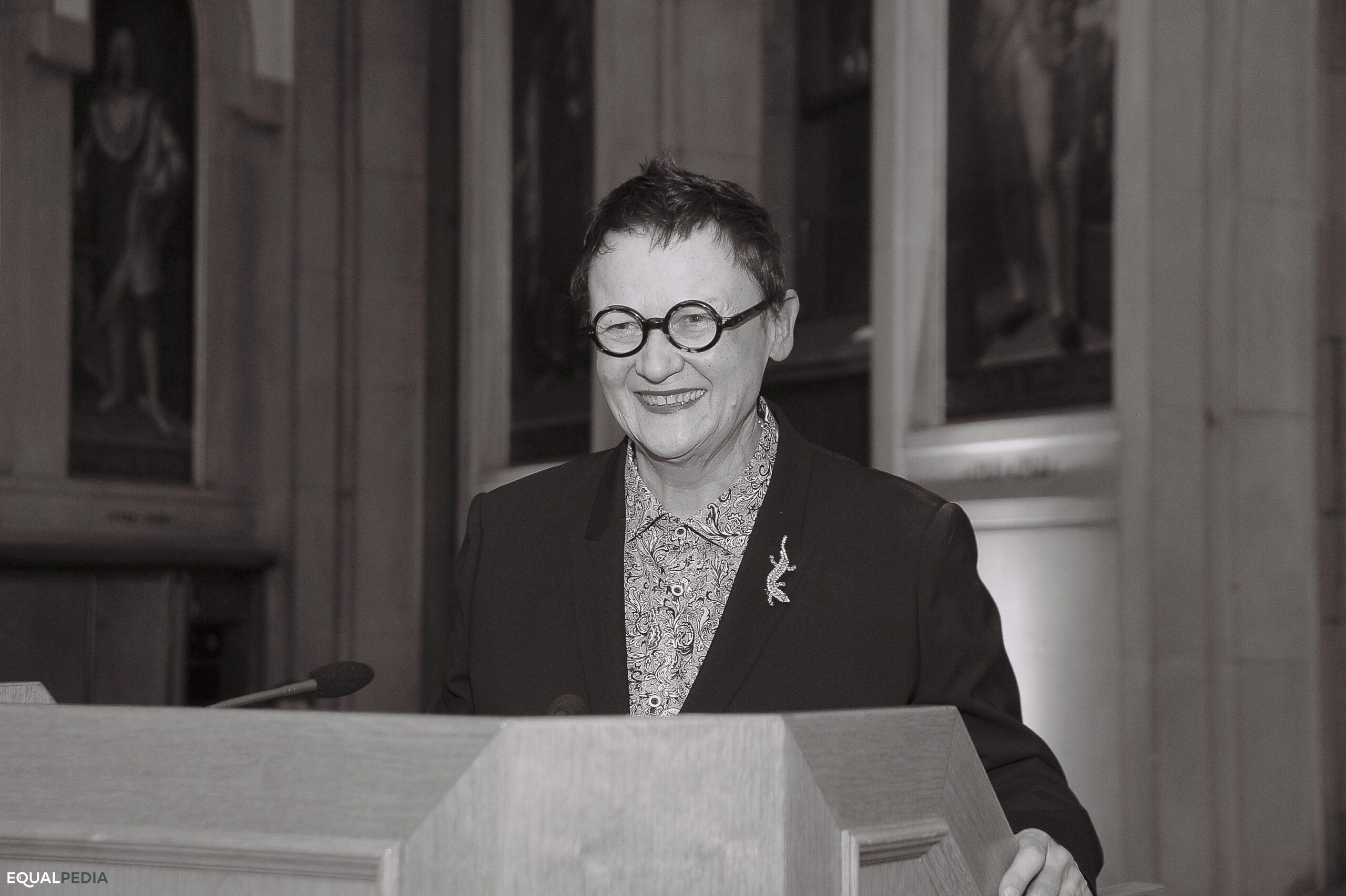
Karola Gramann (born in 1948 in Gerolzhofen, Lower Franconia) is a German film scholar and film curator. From 2006 to 2019, she was artistic director of Kinothek Asta Nielsen e. V.
Biography
Karola Gramann was born in Gerolzhofen in 1948 and grew up in Würzburg. In the 1960s, she moved to Frankfurt am Main to train as a book production specialist. There, she first completed a traineeship at Suhrkamp Verlag and later moved to S. Fischer Verlag as a production assistant.1Magel, Eva-Maria (2014): Frankfurter Gesichter: Karola Gramann. In: Frankfurter Allgemeine Zeitung, September. She obtained her Abitur through second-chance education and studied English studies, American studies and modern German literature in Frankfurt am Main and London from 1975 to 1983.2Magel, Eva-Maria (2014): Frankfurter Gesichter: Karola Gramann. In: Frankfurter Allgemeine Zeitung, September.3Frauenreferat der Stadt Frankfurt (2015): Pressemappe zur Vergabe des Tony-Sender-Preises 2015 an Karola Gramann.
Feminist film and cinema work
Karola Gramann has worked with film and cinema since the mid-1970s. Alongside her studies, Gramann began her career as a film curator, for which there were no institutionalized training paths in the 1970s. During a period of study in England, she took courses at the British Film Institute (BFI) Summerschool in Stirling in 1975/76. In lectures by, among others, Laura Mulvey, Claire Johnston, Richard Dyer, Stuart Hall and Angela Martin, Gramann focused on subjects such as feminist film theory, the avant-gardes’ engagement with Marxist positions, Hollywood cinema and the beginnings of gay and lesbian criticism of mainstream cinema. In 1977/78, she continued her studies in London at the Polytechnic of Central London, now the University of Westminster, while also attending evening classes at the BFI with Richard Dyer. Further film studies followed in Frankfurt am Main with pioneers of German-language feminist and critical film scholarship: Christine Noll Brinckmann, Gertrud Koch, Karsten Witte and Heide Schlüpmann.4Gramann, Karola (2008): „Man nehme…“ Ein Gespräch mit Heide Schlüpmann. In: Klippel, Heike (Hg.): The Art of Programming. Film, Programm und Kontext. Münster: Lit Verlag, ISBN 978-3-8258-1323-9, S. 127–140. Online unter: http://nuetzliche-bilder.de/bilder/wp-content/uploads/2014/11/Klippel_Programm_Onlinversion.pdf (Zugriff am 12.08.2021).5Stadt Frankfurt am Main (2015): Dokumentation Tony-Sender-Preis 2015: Karola Gramann. In: frankfurt.de. Online unter: https://frankfurt.de/service-und-rathaus/verwaltung/aemter-und-institutionen/frauenreferat/tony-sender-preis/preistraegerin-2015 (Zugriff am 08.07.2021). Her work focuses on feminist, lesbian and queer perspectives, gender relations as represented in films, and women and LGBTQIA+ people as actors in film history. Other areas of emphasis are experimental films, the materiality of film and the history of cinema.
Since 1975, Karola Gramann has published essays and books about film; she curates films and presents screenings herself, always oriented towards resistant, hidden cinema:6Lueken, Verena (2017): Jägerinnen des verborgenen Kinos. In: Frankfurter Allgemeine Zeitung, Artikel vom 05.09. Online unter: https://www.faz.net/aktuell/feuilleton/kino/frankfurter-kinothek-rede-zur-verleihung-des-binding-kulturpreises-2017-15181570.html (Zugriff am 08.07.2021). During her studies, for example, she translated Laura Mulvey’s key text of feminist film theory, “Visual Pleasure and Narrative Cinema” (1975), into German.7Gramann, Karola (1980): Visuelle Lust und narratives Kino. Dt. Übersetzung von Laura Mulvey: „Visual Pleasure and Narrative Cinema“. In: Nabakowski, Gislind/Sander, Helke/Gorsen, Peter (Hg.): Frauen in der Kunst. Bd.1. Frankfurt/M.: Suhrkamp Verlag, ISBN 978-3-518-10952-6. As an independent film curator, she worked internationally, including for the Frauenfilmtage in der Schweiz (Die Frau mit der Kamera, 1985) and for the German Goethe-Institut: she also presented the short-film programme Seeking, Finding, Remembering (1987), featuring films produced in the Federal Republic of Germany between 1948 and 1984, in Southeast Asia, Southeast Europe and the United States.8Gramann, Karola (2008): „Man nehme…“ Ein Gespräch mit Heide Schlüpmann. In: Klippel, Heike (Hg.): The Art of Programming. Film, Programm und Kontext. Münster: Lit Verlag, ISBN 978-3-8258-1323-9, S. 127–140. Online unter: http://nuetzliche-bilder.de/bilder/wp-content/uploads/2014/11/Klippel_Programm_Onlinversion.pdf (Zugriff am 12.08.2021).
Karola Gramann was an editorial board member until 1983 of the feminist film journal Frauen und Film, founded in Berlin in 1974 by filmmaker Helke Sander. Since then, she has contributed to and written for this internationally significant publication, the only European periodical devoted to feminism and film. She was also among the founding editors of Feministischen Studien (De Gruyter Verlag, Berlin). The first issue edited by Karola Gramann and Heide Schlüpmann appeared in 1982 under the title “In den Brüchen der Zeit”.9Feministische Studien e. V. (Hg.): Feministische Studien. Zeitschrift für interdisziplinäre Frauen- und Geschlechterforschung.
From 1985 to 1989, she directed the International Short Film Festival Oberhausen. During this period, Gramann was also responsible for selecting film productions from socialist countries for the programme and established a video section.10Lueken, Verena (2017): Jägerinnen des verborgenen Kinos. In: Frankfurter Allgemeine Zeitung, Artikel vom 05.09. Online unter: https://www.faz.net/aktuell/feuilleton/kino/frankfurter-kinothek-rede-zur-verleihung-des-binding-kulturpreises-2017-15181570.html (Zugriff am 08.07.2021).
Since 1990, Karola Gramann has lived in Frankfurt am Main and worked as an independent curator in Germany and abroad. In Frankfurt, she was co-director of the Frankfurter Filmschau from 1990 to 1993. From 1999, Karola Gramann was an adviser on art and culture at the Frauenreferat der Stadt Frankfurt am Main. During this time, together with the city councillor responsible for women’s affairs, Sylvia Schenk, and department head Renate Krauß-Pötz, she was responsible, among other things, for designing and organizing a survey of women experts at round-table discussions and a concluding hearing in 1999 on municipal support for equal opportunities for women in the arts and cultural sector.11Magistrat der Stadt Frankfurt am Main/Frauenreferat (Hg.)/Gramann, Karola (Red.): die weiberwirtschaft. frauen in kunst und kultur. Dokumentation der Anhörung vom 17. Mai 1999 und der Runden Tische von November 1998 bis März 1999. Frankfurt/M. Online unter: https://frankfurt.de/service-und-rathaus/verwaltung/aemter-und-institutionen/frauenreferat/wir-ueber-uns/chronik-des-frauenreferats (Zugriff am 19.08.2021).
From 1995 to 2005, Karola Gramann was a research associate and lecturer at the Institute of Theatre, Film and Media Studies at the University of Frankfurt am Main.
Kinothek Asta Nielsen
Together with film professor Heide Schlüpmann and others, Gramann initiated and founded Kinothek Asta Nielsen in 2000. Its aim was to revive the film and cinema work of the New Women’s Movement and the productions of women directors from the early history of film, make them visible and place them in the context of the 21st century.12Kinothek Asta Nielsen (o. J.): Gründung Kinothek Asta Nielsen e. V. Archiv. In: Webseite der Kinothek Asta Nielsen e. V. Online unter: http://kinothek-asta-nielsen.de/archiv/ (Zugriff am 08.07.2021). From 2006, Karola Gramann was artistic director of Kinothek Asta Nielsen, the only archive and research institute in Europe devoted to feminist and queer film work. From 2018 until the end of 2019, she co-directed the Kinothek with film scholar and curator Gaby Babić.13Müller, Jochen (2017): Gaby Babic übernimmt Ko-Leitung der Kinothek Asta Nielsen. In: Blickpunkt:Film, Artikel vom 24.11. Online unter: https://beta.blickpunktfilm.de/details/424345 (Zugriff am 12.08.2021). Since the beginning of 2020, she has worked as a research associate in the Kinothek’s archive.14Kinothek Asta Nielsen e. V. (o. J.): Verein . In: Webseite der Kinothek Asta Nielsen e. V. Online unter: http://kinothek-asta-nielsen.de/verein/ (Zugriff am 08.07.2021)
Within Kinothek Asta Nielsen and in collaboration with Heide Schlüpmann, Gramann organized numerous film series and retrospectives, including the following:
A film retrospective accompanied by the international symposium L’Invitation au Voyage – Germaine Dulac made the work of French director, producer and film theorist Germaine Dulac (1882–1942) accessible again in 2002. The name Die Einladung zur Reise refers to the title of one of Dulac’s films. In collaboration with the Deutsche Kinemathek Berlin, Kinothek Asta Nielsen published issue no. 93 in the Kinemathek series on this occasion.15Freunde der Deutschen Kinemathek e. V./Kinothek Asta Nielsen e. V. (Hg.) (2002): L’invitation au voyage: Germaine Dulac (Reihe Kinemathek, Heft 93). Berlin: Freunde der Deutschen Kinemathek, ISBN 3-927876-17-8.
In 2007, the Frankfurt Kinothek devoted a comprehensive film retrospective to its namesake, Danish film star Asta Nielsen (1881–1972), with further presentations in Berlin, Vienna, Zurich, Bologna and Amsterdam. In 2009, the two-volume publication edited by Karola Gramann, Heide Schlüpmann and others appeared: Unmögliche Liebe. Asta Nielsen, ihr Kino and Nachtfalter. Asta Nielsen, ihre Filme.
In 2012, in collaboration with the Deutsches Filmmuseum e. V. (DIF), the Kinothek introduced Frankfurt audiences to the work of French film pioneer Alice Guy (1873–1968) in the symposium and film programme Erste unter Gleichen.16Bickmann, Isa (2012): Die Wiederentdeckung der Filmpionierin Alice Guy. Ein Gespräch mit Karola Gramann und Heide Schlüpmann. In: Faust Kultur, Artikel vom 20.09. Online unter: http://archiv.faustkultur.de/852-0-Die-Filmpionierin-Alice-Guy.html#.YTtR1H1CRPY (Zugriff am 12.08.2021). The same year saw EXTRA TROUBLE. Jack Smith in Frankfurt, a programme curated by Gramann and Schlüpmann on one of the first American directors of underground film.17Initiative Kultur und Homosexualität e. V./Kinothek Asta Nielsen e. V./Lehrstuhl für Filmwissenschaft der Goethe-Universität (Hg.) (2012): Extra Trouble – Jack Smith in Frankfurt. Programmheft Filmfestival und Symposion. Kuratiert von Karola Gramann und Heide Schlüpmann. Online unter: https://issuu.com/sabinehartung/docs/extratrouble (Zugriff am 12.08.2021).
Karola Gramann and Heide Schlüpmann presented another rediscovery from film history in 2017. In a retrospective accompanied by music, the Kinothek showed early neorealist silent films by the pioneer of Italian cinema Elvira Notari (1875–1946).18Kothenschulte, Daniel (2017): Die erste Neorealistin. In: Frankfurter Rundschau, Artikel vom 14.12. Online unter: https://www.fr.de/kultur/tv-kino/erste-neorealistin-11087183.html (Zugriff am 12.08.2021).19Magel, Eva-Maria (2015): Sexismus im Film. Frauen, Film, Frankfurt. In: Frankfurter Allgemeine Zeitung, Artikel vom 28.08. The multi-day film festival Transito. Elvira Notari – Kino der Passage took place in cooperation with ZDF/ARTE, the Institute of Theatre, Film and Media Studies and the Pupille cinema at the University of Frankfurt.
Karola Gramann, Heide Schlüpmann and Gaby Babić also conceived the film festival Remake. Frankfurter Frauen Film Tage, which was held for the first time in November 2018 and focused on 100 years of women’s suffrage and 50 years of feminist film work. The programme of the first Remake festival included the history of feminist film festivals, such as Women’s Event Edinburgh ’72, and films produced by women and LGBTQIA+ people from outside white Central European and American cultures.20Weber, Sylvia Meilin (2018): 50 Jahre feministische Filmarbeit. In: Schirn Kunsthalle Frankfurt: Schirn Mag, Beitrag vom 30.10. Online unter: https://www.schirn.de/magazin/schirn_tipps/2018/schirn_tipp_remake_festival/ (Zugriff am 12.08.2021).21Kinothek Asta Nielsen e. V. (o. J.): Remake. Über das Festival. In: Webseite des Festivals. Online unter: https://www.remake-festival.de/remake/ueber-das-festival/ (Zugriff am 12.08.2021).
On 29 February 2024, Karola Gramann ended her institutional work as an adviser, curator and archivist at Kinothek Asta Nielsen. She nevertheless wishes to remain connected to the Kinothek and to film work. 22o. A. (2024): Karola Gramann verabschiedet sich von der Kinothek Asta Nielsen. In: Stummfilm Magazin, Mitteilung vom 01.03. Online unter: https://www.stummfilm-magazin.de/aktuelles/artikel/karola-gramann-verabschiedet-sich-von-der-kinothek-asta-nielsen (Zugriff am 01.03.2024). 23Bauschmann, Bernd (2024): Karola Gramann verabschiedet sich von der Kinothek Asta Nielsen. In: Frankfurt-Live, Artikel vom 05.03. Online unter: https://www.frankfurt-live.com/karola-gramann-verabschiedet-sich-von-der-kinothek-asta-nielsen-163554.html (Zugriff am 01.03.2024). 24o. A. (2024): Kinothek ohne Gramann. In: Frankfurter Allgemeine Zeitung, Artikel vom 01.03., S. 52. In September 2024, Karola Gramann said farewell to the Kinothek with the four-day film festival “Hello Goodbye”.25Magel, Eva-Maria (2024): Niemals geht man so ganz. In: Frankfurter Allgemeine Zeitung, Artikel vom 11.09., S. 12.
Memberships
Karola Gramann is a member of the Verband der deutschen Filmkritik, the Film- und Kinobüro Hessen and Initiative Kultur und Homosexualität e. V.26Frauenreferat der Stadt Frankfurt (2015): Pressemappe zur Vergabe des Tony-Sender-Preises 2015 an Karola Gramann.
Awards
- In 2015, Karola Gramann received the City of Frankfurt am Main’s Tony-Sender-Preis for her lifelong political and critical commitment to film and media culture.27Stadt Frankfurt am Main (2015): Dokumentation Tony-Sender-Preis 2015: Karola Gramann. In: frankfurt.de. Online unter: https://frankfurt.de/service-und-rathaus/verwaltung/aemter-und-institutionen/frauenreferat/tony-sender-preis/preistraegerin-2015 (Zugriff am 08.07.2021).
- In 2017, the Kinothek received the Binding-Kulturpreis, worth €50,000, which was presented to Karola Gramann and Heide Schlüpmann.28Binding-Brauerei AG (o. J.): Binding-Kulturpreis. In: binding.de. Online unter: https://binding.de/aktivitaeten/binding-kulturpreis/ (Zugriff am 08.07.2021).
- In 2018, the Hessian state government honoured Karola Gramann and Heide Schlüpmann at Kinothek Asta Nielsen as “Menschen des Respekts”.29Prinz, Claudia (2020): Doyenne der feministischen Filmarbeit
Über die Frankfurter Filmwissenschaftlerin und Kuratorin Karola Gramann. In: GRIP, Nr. 60,5. Online unter: https://www.filmhaus-frankfurt.de/Publikationen/GRIP-Archiv/GRIP-605/Doyenne-der-feministischen-Filmarbeit (Zugriff am16.11.2021).
Publications (selection)
- Gramann, Karola (1980): Visuelle Lust und narratives Kino. Dt. Übersetzung von Laura Mulvey: „Visual Pleasure and Narrative Cinema“. In: Nabakowski, Gislind/Sander, Helke/Gorsen, Peter (Hg.): Frauen in der Kunst. Bd.1. Frankfurt/M.: Suhrkamp Verlag, ISBN 978-3-518-10952-6, S. 30–46.
- Bunz, Rainer/Gramann, Karola (Red.) (1976): Handbuch Jury der evangelischen Filmarbeit ’76. Hg. vom Gemeinschaftswerk der Evangelischen Filmpublizistik e. V. Frankfurt/M.
- Gramann, Karola/Schlüpmann, Heide (1979): raus aus den prokrustesbetten! In: Frauen und Film, Heft 22, S. 36–47. Online unter: http://www.frauenundfilm.de/img/article/main/article_22_36-47.pdf (Zugriff am 12.08.2021).
- Gramann, Karola/Koch, Gertrud/Schlüpmann, Heide (1981): Lust an Bildern, Bilder ohne Lust – Erfahrungen der Diskrepanz. In: Frauen und Film, Heft 30, S. 6–12. Online unter: http://www.frauenundfilm.de/img/article/main/article_30_6-12.pdf (Zugriff am 12.08.2021).
- Gramann, Karola/Koch, Gertrud/Pfletschinger, Bernhard et al. (1981): Lust und Elend: Das erotische Kino. München/Luzern: Bucher, ISBN 978-3-7658-0369-7.
- Gramann, Karola/Schlüpmann, Heide/Jacobsen, Wolfgang (1983): Hertha Thiele. Berlin: Stiftung Deutsche Kinemathek.
- Gramann, Karola (Red.) (1984): The Atomic Cinema: Fiktion und Wirklichkeit nuklearer Bedrohung, Arnoldshainer Filmgespräche 1. Frankfurt/M.: Haag und Herchen, ISBN 978-3-88129-839-1.
- Gramann, Karola (Red.) (1985): Widerstand im Film – Film als Widerstand. Frankfurt/M.: Haag und Herchen, ISBN 978-3-88129-908-4.
- Gramann, Karola (1987): Seeking, finding, remembering: short films from the Federal Republic of Germany, Transl. J. S. Roth, Mayr, Miesbach.
- Gramann, Karola (Red.) (1999): „die weiberwirtschaft. frauen in kunst und kultur.“ Dokumentation der Anhörung vom 17. Mai 1999 und den Runden Tischen vom November 1998 bis März 1999. Frankfurt/M.: Frauenreferat der Stadt Frankfurt am Main.
- Aretz, Bernd/Nenno, Rosita/Rathke, Christian/Weiermair, Peter/Bucher, Gudrun/Dannecker, Martin/Fleischmann-Heck, Isa/Gramann, Karola/Hesse, Raymond/Schrödl, Barbara (2008): Macht Leder Lust – Verborgene Codes der Lederbekleidung im 20. Jahrhundert, Ausstellungskatalog und Audio-CD zur gleichnamigen Ausstellung im Deutschen Ledermuseum, Offenbach: DLM, ISBN 978-3-00-024422-3.
- Schlüpmann, Heide/Gramann, Karola (Hg.) (2010): Nachtfalter. Asta Nielsen, ihre Filme. Band 2. Wien: Filmarchiv Austria, ISBN 978-3-902531-83-4.
- Schlüpmann, Heide/Gramann, Karola/de Kruyper, Eric/Nessel, Sabine/Wedel, Michael (Hg.) (2010): Unmögliche Liebe. Asta Nielsen, ihr Kino. Band 1. Wien: Filmarchiv Austria, ISBN 978-3-902531-82-7.
External links
- Literature by and about Karola Gramann in the catalogue of the German National Library
- Website of Kinothek Asta Nielsen e. V.
Machine translation: This article was translated automatically from the German original.
- 1Magel, Eva-Maria (2014): Frankfurter Gesichter: Karola Gramann. In: Frankfurter Allgemeine Zeitung, September. ↩︎
- 2Magel, Eva-Maria (2014): Frankfurter Gesichter: Karola Gramann. In: Frankfurter Allgemeine Zeitung, September. ↩︎
- 3Frauenreferat der Stadt Frankfurt (2015): Pressemappe zur Vergabe des Tony-Sender-Preises 2015 an Karola Gramann. ↩︎
- 4Gramann, Karola (2008): „Man nehme…“ Ein Gespräch mit Heide Schlüpmann. In: Klippel, Heike (Hg.): The Art of Programming. Film, Programm und Kontext. Münster: Lit Verlag, ISBN 978-3-8258-1323-9, S. 127–140. Online unter: http://nuetzliche-bilder.de/bilder/wp-content/uploads/2014/11/Klippel_Programm_Onlinversion.pdf (Zugriff am 12.08.2021). ↩︎
- 5Stadt Frankfurt am Main (2015): Dokumentation Tony-Sender-Preis 2015: Karola Gramann. In: frankfurt.de. Online unter: https://frankfurt.de/service-und-rathaus/verwaltung/aemter-und-institutionen/frauenreferat/tony-sender-preis/preistraegerin-2015 (Zugriff am 08.07.2021). ↩︎
- 6Lueken, Verena (2017): Jägerinnen des verborgenen Kinos. In: Frankfurter Allgemeine Zeitung, Artikel vom 05.09. Online unter: https://www.faz.net/aktuell/feuilleton/kino/frankfurter-kinothek-rede-zur-verleihung-des-binding-kulturpreises-2017-15181570.html (Zugriff am 08.07.2021). ↩︎
- 7Gramann, Karola (1980): Visuelle Lust und narratives Kino. Dt. Übersetzung von Laura Mulvey: „Visual Pleasure and Narrative Cinema“. In: Nabakowski, Gislind/Sander, Helke/Gorsen, Peter (Hg.): Frauen in der Kunst. Bd.1. Frankfurt/M.: Suhrkamp Verlag, ISBN 978-3-518-10952-6. ↩︎
- 8Gramann, Karola (2008): „Man nehme…“ Ein Gespräch mit Heide Schlüpmann. In: Klippel, Heike (Hg.): The Art of Programming. Film, Programm und Kontext. Münster: Lit Verlag, ISBN 978-3-8258-1323-9, S. 127–140. Online unter: http://nuetzliche-bilder.de/bilder/wp-content/uploads/2014/11/Klippel_Programm_Onlinversion.pdf (Zugriff am 12.08.2021). ↩︎
- 9Feministische Studien e. V. (Hg.): Feministische Studien. Zeitschrift für interdisziplinäre Frauen- und Geschlechterforschung. ↩︎
- 10Lueken, Verena (2017): Jägerinnen des verborgenen Kinos. In: Frankfurter Allgemeine Zeitung, Artikel vom 05.09. Online unter: https://www.faz.net/aktuell/feuilleton/kino/frankfurter-kinothek-rede-zur-verleihung-des-binding-kulturpreises-2017-15181570.html (Zugriff am 08.07.2021). ↩︎
- 11Magistrat der Stadt Frankfurt am Main/Frauenreferat (Hg.)/Gramann, Karola (Red.): die weiberwirtschaft. frauen in kunst und kultur. Dokumentation der Anhörung vom 17. Mai 1999 und der Runden Tische von November 1998 bis März 1999. Frankfurt/M. Online unter: https://frankfurt.de/service-und-rathaus/verwaltung/aemter-und-institutionen/frauenreferat/wir-ueber-uns/chronik-des-frauenreferats (Zugriff am 19.08.2021). ↩︎
- 12Kinothek Asta Nielsen (o. J.): Gründung Kinothek Asta Nielsen e. V. Archiv. In: Webseite der Kinothek Asta Nielsen e. V. Online unter: http://kinothek-asta-nielsen.de/archiv/ (Zugriff am 08.07.2021). ↩︎
- 13Müller, Jochen (2017): Gaby Babic übernimmt Ko-Leitung der Kinothek Asta Nielsen. In: Blickpunkt:Film, Artikel vom 24.11. Online unter: https://beta.blickpunktfilm.de/details/424345 (Zugriff am 12.08.2021). ↩︎
- 14Kinothek Asta Nielsen e. V. (o. J.): Verein . In: Webseite der Kinothek Asta Nielsen e. V. Online unter: http://kinothek-asta-nielsen.de/verein/ (Zugriff am 08.07.2021) ↩︎
- 15Freunde der Deutschen Kinemathek e. V./Kinothek Asta Nielsen e. V. (Hg.) (2002): L’invitation au voyage: Germaine Dulac (Reihe Kinemathek, Heft 93). Berlin: Freunde der Deutschen Kinemathek, ISBN 3-927876-17-8. ↩︎
- 16Bickmann, Isa (2012): Die Wiederentdeckung der Filmpionierin Alice Guy. Ein Gespräch mit Karola Gramann und Heide Schlüpmann. In: Faust Kultur, Artikel vom 20.09. Online unter: http://archiv.faustkultur.de/852-0-Die-Filmpionierin-Alice-Guy.html#.YTtR1H1CRPY (Zugriff am 12.08.2021). ↩︎
- 17Initiative Kultur und Homosexualität e. V./Kinothek Asta Nielsen e. V./Lehrstuhl für Filmwissenschaft der Goethe-Universität (Hg.) (2012): Extra Trouble – Jack Smith in Frankfurt. Programmheft Filmfestival und Symposion. Kuratiert von Karola Gramann und Heide Schlüpmann. Online unter: https://issuu.com/sabinehartung/docs/extratrouble (Zugriff am 12.08.2021). ↩︎
- 18Kothenschulte, Daniel (2017): Die erste Neorealistin. In: Frankfurter Rundschau, Artikel vom 14.12. Online unter: https://www.fr.de/kultur/tv-kino/erste-neorealistin-11087183.html (Zugriff am 12.08.2021). ↩︎
- 19Magel, Eva-Maria (2015): Sexismus im Film. Frauen, Film, Frankfurt. In: Frankfurter Allgemeine Zeitung, Artikel vom 28.08. ↩︎
- 20Weber, Sylvia Meilin (2018): 50 Jahre feministische Filmarbeit. In: Schirn Kunsthalle Frankfurt: Schirn Mag, Beitrag vom 30.10. Online unter: https://www.schirn.de/magazin/schirn_tipps/2018/schirn_tipp_remake_festival/ (Zugriff am 12.08.2021). ↩︎
- 21Kinothek Asta Nielsen e. V. (o. J.): Remake. Über das Festival. In: Webseite des Festivals. Online unter: https://www.remake-festival.de/remake/ueber-das-festival/ (Zugriff am 12.08.2021). ↩︎
- 22o. A. (2024): Karola Gramann verabschiedet sich von der Kinothek Asta Nielsen. In: Stummfilm Magazin, Mitteilung vom 01.03. Online unter: https://www.stummfilm-magazin.de/aktuelles/artikel/karola-gramann-verabschiedet-sich-von-der-kinothek-asta-nielsen (Zugriff am 01.03.2024). ↩︎
- 23Bauschmann, Bernd (2024): Karola Gramann verabschiedet sich von der Kinothek Asta Nielsen. In: Frankfurt-Live, Artikel vom 05.03. Online unter: https://www.frankfurt-live.com/karola-gramann-verabschiedet-sich-von-der-kinothek-asta-nielsen-163554.html (Zugriff am 01.03.2024). ↩︎
- 24o. A. (2024): Kinothek ohne Gramann. In: Frankfurter Allgemeine Zeitung, Artikel vom 01.03., S. 52. ↩︎
- 25Magel, Eva-Maria (2024): Niemals geht man so ganz. In: Frankfurter Allgemeine Zeitung, Artikel vom 11.09., S. 12. ↩︎
- 26Frauenreferat der Stadt Frankfurt (2015): Pressemappe zur Vergabe des Tony-Sender-Preises 2015 an Karola Gramann. ↩︎
- 27Stadt Frankfurt am Main (2015): Dokumentation Tony-Sender-Preis 2015: Karola Gramann. In: frankfurt.de. Online unter: https://frankfurt.de/service-und-rathaus/verwaltung/aemter-und-institutionen/frauenreferat/tony-sender-preis/preistraegerin-2015 (Zugriff am 08.07.2021). ↩︎
- 28Binding-Brauerei AG (o. J.): Binding-Kulturpreis. In: binding.de. Online unter: https://binding.de/aktivitaeten/binding-kulturpreis/ (Zugriff am 08.07.2021). ↩︎
- 29Prinz, Claudia (2020): Doyenne der feministischen Filmarbeit
Über die Frankfurter Filmwissenschaftlerin und Kuratorin Karola Gramann. In: GRIP, Nr. 60,5. Online unter: https://www.filmhaus-frankfurt.de/Publikationen/GRIP-Archiv/GRIP-605/Doyenne-der-feministischen-Filmarbeit (Zugriff am16.11.2021). ↩︎