
Theresa Weber (b. 1996 in Düsseldorf) is a German artist with a Jamaican-Greek-German family background.1n.a. (2023): WDR-Kultursommer 2023: Theresa Weber. In: WDR, article of 12 July. Available online at: https://www1.wdr.de/fernsehen/hier-und-heute/kultursommer/kultursommer-theresa-weber-100.html (accessed on 26 February 2025). She has lived and worked in North Rhine-Westphalia and London.2Weber, Theresa (n.d.): About. In: Website of Theresa Weber. Available online at: https://www.theresaweber.de/about/ (accessed on 26 February 2025). 3n.a. (2024): Theresa Weber. CHAOSMOS. In: Kunstmuseum Bochum. Available online at: https://www.kunstmuseumbochum.de/ausstellung-veranstaltung/details/theresa-weberchaosmos/ (accessed on 26 February 2025). Today she lives and works in Berlin.
Career
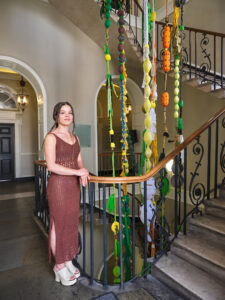
Photo: Reinis Lismanis
Weber studied at the Kunstakademie Düsseldorf (Düsseldorf Art Academy), where her teachers included Ellen Gallagher and Katharina Grosse.4n.a. (2024): Theresa Weber. CHAOSMOS. In: Kunstmuseum Bochum. Available online at: https://www.kunstmuseumbochum.de/ausstellung-veranstaltung/details/theresa-weberchaosmos/ (accessed on 26 February 2025). In 2018, together with the German artist Carolin Israel, she spent an artist residency in Bogotá, Colombia, and took part in two exhibitions there.5Redaktion (2018): Residency in Bogotá – Carolin Israel und Theresa Weber. In: Kunstbar Contemporary Art, article of 3 May. Available online at: https://www.kunstbar.de/home/2018/5/3/residency-in-bogota-carolin-israel-und-theresa-weber (accessed on 26 February 2025). Her works are held in numerous important collections, including the Bundeskunstsammlung (Federal Art Collection of Germany), the collection of the Kunstmuseum Bochum, the collection of the London School of Economics and the Morgan Stanley Collection.6Weber, Theresa (n.d.): CV. In: Website of Theresa Weber. Available online at: https://www.theresaweber.de/wp-content/uploads/2024/06/CV-English-2024.pdf (accessed on 26 February 2025).
Artistic work
For her sculptural and three-dimensional works, Weber draws, among other things, on traditionally female cultural techniques such as braiding and weaving, which originate in communal practices and for a long time were not recognised as art.7On these traditionally female cultural techniques, see also Gipson, Ferren (2022): Kunst von Frauen: Vom weiblichen Kunsthandwerk zur feministischen Avantgarde. München/London/New York: Prestel, ISBN 978-3-7913-7700-1. She uses a wide variety of materials to create textile sculptures as well as large-format pictures and collaborative performances; in doing so, her works engage critically with social structures and question existing power relations, Eurocentric historiography and confinement to rigid categories.8n.a. (2024): Theresa Weber. CHAOSMOS. In: Kunstmuseum Bochum. Available online at: https://www.kunstmuseumbochum.de/ausstellung-veranstaltung/details/theresa-weberchaosmos/ (accessed on 26 February 2025).
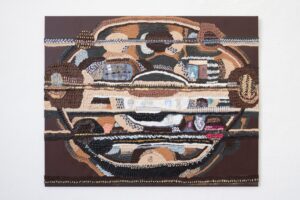
Photo: Bernhard Adams
Weber’s works are characterised by a pronounced feminist and anti-colonial perspective, which is reflected both in her choice of materials and in the themes of her works. A recurring motif associated with femininity in her collages is artificial fingernails, which Weber places in a new, explicitly feminist context. While artificial fingernails are often not perceived as feminist in Germany, in the Caribbean, according to Weber, they are regarded as a sign of prestige: they symbolise prosperity and a way of life that is independent of hard physical labour.9In some cases, however, wearing artificial nails is also seen as a form of cultural appropriation: “Just like cornrows, wigs, lip fillers and big booties, long, colourful acrylic nails are the next step in the series of once negatively judged attributes of a marginalised group becoming mainstream. Another example of the middle class appropriating Black culture without bearing the same negative consequences,” says Akesha Reid, beauty broadcaster at refinery29, quoted in Cosmo (2024): „Gel-Nägel tragen Schwarze Kultur“, in: Instagram, 13 August. Available online at: https://www.instagram.com/cosmo/p/C-m99pssj4S/?img_index=1 (accessed on 23 February 2025). Weber therefore interprets the nails as an expression of empowerment and strength, particularly with regard to the colonial past, and thus raises the question of how femininity and ideals of beauty are perceived and valued in different cultures. In her art, Weber deliberately places the artificial nails in a new context. They not only become an integral part of her works but also stand for a collective identity that is linked to her own highly individual fingerprint – likewise a recurring element of her works.10n.a. (2023): WDR-Kultursommer 2023: Theresa Weber. In: WDR, article of 12 July. Available online at: https://www1.wdr.de/fernsehen/hier-und-heute/kultursommer/kultursommer-theresa-weber-100.html (accessed on 26 February 2025).
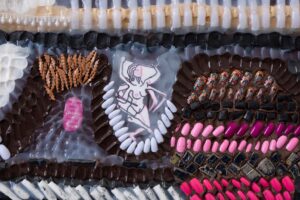
Photo: Bernhard Adams
Weber describes her work with the materials she selects as follows:
“I am developing an organically growing body of work from socially charged materials that are liquefied, interlaced and woven. With an offensive aesthetic, cultural hybridisation is addressed in combination with artificial ideals of beauty. Prosthetic elements appear repeatedly. Artificial nails, synthetic hair, push-ups, silicone and jewellery are such extensions. They are appropriated by the social body, shape it and express identity and belonging. In this, I above all represent female and Afro-diasporic identity. In my work, body extensions exist as a cultural, organic trace and a disembodied remnant. These elements are painterly archived in synthetic resin or implanted in silicone. On the paintings they create an organic tactility and complex, interconnected patterns. At its core, I ask myself through which social system we classify what we see. I recombine and decode the associations inscribed in the materials. In the process, the boundaries of our culturally shaped aesthetic perception are explored.”11n.a. (n.d.): Theresa Weber. In: kunst + tonic. Available online at: https://kunstundtonic.de/theresa-weber/ (accessed on 26 February 2025).
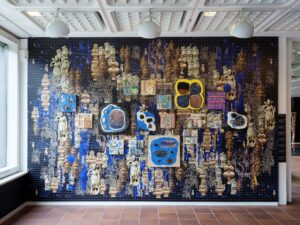
Photo: Heinrich Holtgreve
Exhibition: CHAOSMOS at the Kunstmuseum Bochum 2024
Another central theme in Weber’s work is the engagement with female mythological figures. In the works “Goddess Banner” and “Goddess Wall”, Weber explores four goddesses who represent complex and hybrid identities. Nemesis, the Greek goddess of righteous anger, is at the same time the goddess of retributive justice. Olokun, a goddess from the Yoruba religion, stands for the depths of the ocean as well as for prosperity and fertility. Ištar, the Mesopotamian goddess, unites the seeming opposites of war and femininity. Kali, the Hindu deity, symbolises death and destruction, yet equally embodies renewal and transformation. In Weber’s work, these goddesses enter into dialogue with one another and depict femininity in all its complexity and many-layeredness.12Information material on the exhibition Chaosmos at the Kunstmuseum Bochum, 8 June – 13 October 2024 (accessed on 26 February 2025).
Nominations and awards
- 2021: Graduate scholarship from the Freunde und Förderer der Kunstakademie e. V. (Friends and Patrons of the Kunstakademie Düsseldorf)13Weber, Theresa (n.d.): CV. In: Website of Theresa Weber. Available online at: https://www.theresaweber.de/wp-content/uploads/2024/06/CV-English-2024.pdf (accessed on 26 February 2025).
- 2021: Nomination for the Bundespreis für Kunststudierende (Federal Prize for Art Students)14n.a. (2021): Archiv. In: Website of the Bundespreis für Kunststudierende. Available online at: https://www.kunst-wettbewerb.de/archiv/2021/ (accessed on 26 February 2025).
- 2022: Förderpreis (sponsorship award) of the Kunst- und Kulturstiftung der Stadtsparkasse Düsseldorf15n.a. (2022): Düsseldorf: Sparkassen-Förderpreis für Theresa Weber. In: Kunstforum International, article of 27 May. Available online at: https://www.kunstforum.de/nachrichten/duesseldorf-sparkassen-foerderpreis-fuer-theresa-weber/ (accessed on 26 February 2025).
- 2023: Nomination for the Museum van Bommel van Dam Preis16n.a. (2023): VBVD-Prijs 2023. Nominierte Kunsttalente und etablierte ehemalige VBVD-Preisträger. In: Website of the Museum van Bommel van Dam. Available online at: https://www.vanbommelvandam.nl/de/ausstellungen/vbvd-prijs/ (accessed on 26 February 2025).
- 2024: Dekoloniale Berlin Residency17n.a. (n.d.): Dekoloniale Berlin Residents Künstler*innen bei „Dekoloniale – was bleibt?!“. In: Stadtmuseum Berlin. Available online at: https://www.stadtmuseum.de/dekoloniale-berlin-residents (accessed on 26 February 2025). 18n.a. (2024): Dekoloniale and C& Announce Berlin Residents 2024. In: Contemporary And (C&), news item of 2 April. Available online at: https://contemporaryand.com/magazines/dekoloniale-and-c-announce-berlin-residents-2024/ (accessed on 26 February 2025).
- 2024: Winner of the audience award of the Museum van Bommel van Dam Preis19n.a. (2023): VBVD-Prijs 2023. Nominierte Kunsttalente und etablierte ehemalige VBVD-Preisträger. In: Website of the Museum van Bommel van Dam. Available online at: https://www.vanbommelvandam.nl/de/ausstellungen/vbvd-prijs/ (accessed on 26 February 2025).
- 2025: Baltic Gallery of Contemporary Art Residency, Ustka, Poland20Bałtycka Galeria Sztuki Współczesnej/Baltic Gallery of Contemporary Art (2026): Residency Participants. In: Website of the BGSW. Available online at: https://bgsw.pl/en/residency/ (accessed on 23 February 2026).
- 2026: Publication funding from the Senatsverwaltung für Kultur und Gesellschaftlichen Zusammenhalt Berlin (Berlin Senate Department for Culture and Social Cohesion)21Senatsverwaltung für Kultur und Gesellschaftlichen Zusammenhalt (2026): Fördermittel für die Präsentation zeitgenössischer Kunst in Berlin für das Jahr 2026 vergeben. In: Website of the Senatsverwaltung, press release of 16 January. Available online at: https://www.berlin.de/sen/kultgz/aktuelles/pressemitteilungen/2026/pressemitteilung.1634304.php (accessed on 23 February 2026).
Exhibitions and performances (selection)
- 2021: Cosmic Momento, Moltkerei Werkstatt e. V., Cologne, Germany
- 2021: Fluidity, Dortmunder Kunstverein, Dortmund, Germany
- 2021: Woven Memories, Dortmunder Kunstverein, Dortmund, Germany
- 2021: Sweet Lies: The Fictions of Belonging, Ludwig Forum, Aachen, Germany
- 2021–2022: Attempts To Be Many, Philara Collection, Düsseldorf, Germany
- 2022: off the beaten rack KIT, Kunst im Tunnel, Düsseldorf, Germany
- 2022: Mother(land), Z33, Hasselt, Belgium
- 2023: Cycles of Unmasking Entanglements, Somerset House, England
- 2023: Moonlight Sonata, New Contemporaries, South London Gallery, England
- 2024: CHAOSMOS, Kunstmuseum Bochum, Germany
- 2024: Alle Menschen werden Brüder (All Men Shall Be Brothers), Neun Kelche, Berlin, Germany
- 2024: Universe of the Hybrids, ChertLüdde, Berlin, Germany
- 2025: Atopolis, Project Loop, London, England
- 2025: With the Floats, Hatch Gallery, Paris, France, ARCO, Madrid, Spain
External links
- Website of Theresa Weber
Machine translation: This article was translated automatically from the German original.
- 1n.a. (2023): WDR-Kultursommer 2023: Theresa Weber. In: WDR, article of 12 July. Available online at: https://www1.wdr.de/fernsehen/hier-und-heute/kultursommer/kultursommer-theresa-weber-100.html (accessed on 26 February 2025). ↩︎
- 2Weber, Theresa (n.d.): About. In: Website of Theresa Weber. Available online at: https://www.theresaweber.de/about/ (accessed on 26 February 2025). ↩︎
- 3n.a. (2024): Theresa Weber. CHAOSMOS. In: Kunstmuseum Bochum. Available online at: https://www.kunstmuseumbochum.de/ausstellung-veranstaltung/details/theresa-weberchaosmos/ (accessed on 26 February 2025). ↩︎
- 4n.a. (2024): Theresa Weber. CHAOSMOS. In: Kunstmuseum Bochum. Available online at: https://www.kunstmuseumbochum.de/ausstellung-veranstaltung/details/theresa-weberchaosmos/ (accessed on 26 February 2025). ↩︎
- 5Redaktion (2018): Residency in Bogotá – Carolin Israel und Theresa Weber. In: Kunstbar Contemporary Art, article of 3 May. Available online at: https://www.kunstbar.de/home/2018/5/3/residency-in-bogota-carolin-israel-und-theresa-weber (accessed on 26 February 2025). ↩︎
- 6Weber, Theresa (n.d.): CV. In: Website of Theresa Weber. Available online at: https://www.theresaweber.de/wp-content/uploads/2024/06/CV-English-2024.pdf (accessed on 26 February 2025). ↩︎
- 7On these traditionally female cultural techniques, see also Gipson, Ferren (2022): Kunst von Frauen: Vom weiblichen Kunsthandwerk zur feministischen Avantgarde. München/London/New York: Prestel, ISBN 978-3-7913-7700-1. ↩︎
- 8n.a. (2024): Theresa Weber. CHAOSMOS. In: Kunstmuseum Bochum. Available online at: https://www.kunstmuseumbochum.de/ausstellung-veranstaltung/details/theresa-weberchaosmos/ (accessed on 26 February 2025). ↩︎
- 9In some cases, however, wearing artificial nails is also seen as a form of cultural appropriation: “Just like cornrows, wigs, lip fillers and big booties, long, colourful acrylic nails are the next step in the series of once negatively judged attributes of a marginalised group becoming mainstream. Another example of the middle class appropriating Black culture without bearing the same negative consequences,” says Akesha Reid, beauty broadcaster at refinery29, quoted in Cosmo (2024): „Gel-Nägel tragen Schwarze Kultur“, in: Instagram, 13 August. Available online at: https://www.instagram.com/cosmo/p/C-m99pssj4S/?img_index=1 (accessed on 23 February 2025). ↩︎
- 10n.a. (2023): WDR-Kultursommer 2023: Theresa Weber. In: WDR, article of 12 July. Available online at: https://www1.wdr.de/fernsehen/hier-und-heute/kultursommer/kultursommer-theresa-weber-100.html (accessed on 26 February 2025). ↩︎
- 11n.a. (n.d.): Theresa Weber. In: kunst + tonic. Available online at: https://kunstundtonic.de/theresa-weber/ (accessed on 26 February 2025). ↩︎
- 12Information material on the exhibition Chaosmos at the Kunstmuseum Bochum, 8 June – 13 October 2024 (accessed on 26 February 2025). ↩︎
- 13Weber, Theresa (n.d.): CV. In: Website of Theresa Weber. Available online at: https://www.theresaweber.de/wp-content/uploads/2024/06/CV-English-2024.pdf (accessed on 26 February 2025). ↩︎
- 14n.a. (2021): Archiv. In: Website of the Bundespreis für Kunststudierende. Available online at: https://www.kunst-wettbewerb.de/archiv/2021/ (accessed on 26 February 2025). ↩︎
- 15n.a. (2022): Düsseldorf: Sparkassen-Förderpreis für Theresa Weber. In: Kunstforum International, article of 27 May. Available online at: https://www.kunstforum.de/nachrichten/duesseldorf-sparkassen-foerderpreis-fuer-theresa-weber/ (accessed on 26 February 2025). ↩︎
- 16n.a. (2023): VBVD-Prijs 2023. Nominierte Kunsttalente und etablierte ehemalige VBVD-Preisträger. In: Website of the Museum van Bommel van Dam. Available online at: https://www.vanbommelvandam.nl/de/ausstellungen/vbvd-prijs/ (accessed on 26 February 2025). ↩︎
- 17n.a. (n.d.): Dekoloniale Berlin Residents Künstler*innen bei „Dekoloniale – was bleibt?!“. In: Stadtmuseum Berlin. Available online at: https://www.stadtmuseum.de/dekoloniale-berlin-residents (accessed on 26 February 2025). ↩︎
- 18n.a. (2024): Dekoloniale and C& Announce Berlin Residents 2024. In: Contemporary And (C&), news item of 2 April. Available online at: https://contemporaryand.com/magazines/dekoloniale-and-c-announce-berlin-residents-2024/ (accessed on 26 February 2025). ↩︎
- 19n.a. (2023): VBVD-Prijs 2023. Nominierte Kunsttalente und etablierte ehemalige VBVD-Preisträger. In: Website of the Museum van Bommel van Dam. Available online at: https://www.vanbommelvandam.nl/de/ausstellungen/vbvd-prijs/ (accessed on 26 February 2025). ↩︎
- 20Bałtycka Galeria Sztuki Współczesnej/Baltic Gallery of Contemporary Art (2026): Residency Participants. In: Website of the BGSW. Available online at: https://bgsw.pl/en/residency/ (accessed on 23 February 2026). ↩︎
- 21Senatsverwaltung für Kultur und Gesellschaftlichen Zusammenhalt (2026): Fördermittel für die Präsentation zeitgenössischer Kunst in Berlin für das Jahr 2026 vergeben. In: Website of the Senatsverwaltung, press release of 16 January. Available online at: https://www.berlin.de/sen/kultgz/aktuelles/pressemitteilungen/2026/pressemitteilung.1634304.php (accessed on 23 February 2026). ↩︎
