
Erna Pinner (*27 January 1890 in Frankfurt am Main; † 5 May 1987 in London) was a painter, illustrator, world traveller, journalist and author of popular science books about animals.
Career
Erna Pinner studied painting at the Städelsches Kunstinstitut in Frankfurt, with the Frankfurt artist Ottilie W. Roederstein, with Lovis Corinth in Berlin and at the Académie Ranson in Paris with Maurice Denis, Felix Vallotton and Paul Sérusier. When the First World War broke out, she returned to Frankfurt am Main and during the war years created almost life-sized grotesque dolls. At the same time, she began making animal sketches at Frankfurt Zoo and designing costumes and stage sets. In the 1920s she travelled with her partner Kasimir Edschmid through France, Italy, Greece, Corsica, Palestine, East and South-West Africa and Latin America. Her illustrations appeared in Kasimir Edschmid’s travel books as well as in illustrated magazines and daily newspapers. She also published her own texts in magazines and newspapers. In 1931 Pinner published a travel book of her own with the Erich Reiss Verlag in Berlin.1Pinner, Erna (1931): Ich reise durch die Welt. With 104 illustrations by the author. Berlin. In 1935, as a Jew, she was forced to leave Germany. She emigrated to London, where she had relatives on her mother’s side. There, under difficult conditions, she built a new livelihood as an illustrator of popular science books, above all about animals. In 1951 she published Curious Creatures, which she both wrote and illustrated, a book about oddities in the animal kingdom that was translated into several languages.2Weidle, Barbara (ed.) (1997): »Ich reise durch die Welt«. Die Zeichnerin und Publizistin Erna Pinner. Schriftenreihe Verein August Macke Haus Bonn, No. 23, Bonn, ISBN 3-929607-22-0, p. 203 ff. Hereafter cited as: Pinner (1997). Her first solo exhibition in Germany after the Second World War took place in 1997 at the August Macke Haus in Bonn. In an expanded form, this exhibition was shown in 2004 at the Deutsche Nationalbibliothek (German National Library) in Frankfurt and in 2005 at the Deutsche Nationalbibliothek in Leipzig. The curator of these exhibitions was Barbara Weidle. In 2023 the artist returned to public awareness in the exhibition »Zurück ins Licht. Vier Künstlerinnen – Ihre Werke. Ihre Wege« (Back into the Light. Four Women Artists – Their Works. Their Paths) at the Jüdisches Museum Frankfurt (Jewish Museum Frankfurt) (curator: Dr Eva Sabrina Atlan).
Illustrator in the 1920s
A polio infection, which she had contracted while drawing on a pig farm, forced Erna Pinner to give up painting in 1919 and to devote herself exclusively to drawing and illustration. Das Schweinebuch (The Pig Book), with texts and illustrations by Erna Pinner, was published in 1922 by the Erich Reiss Verlag in Berlin. During this decade Pinner, who was a friend of Renée Sintenis, made a name for herself as an animal draughtswoman. Her little book Tierskizzen aus dem Frankfurter Zoo (Animal Sketches from Frankfurt Zoo), 1927, was sold at the zoo’s ticket office. She exhibited with the Darmstädter Sezession, of which she was a member, and in Alfred Flechtheim’s galleries in Berlin and Frankfurt, and she also exhibited with GEDOK Frankfurt. With her travelling companion Kasimir Edschmid she formed a glamorous artistic duo. Almost all of Kasimir Edschmid’s travel books contained her highly distinctive vedute of cities and landscapes, which she breathed onto the paper with just a few strokes.3Edschmid, Kasimir (1927): Basken, Stiere, Araber. Ein Buch über Spanien und Marokko. With 46 drawings by Erna Pinner. Berlin: Frankfurter Verlagsanstalt. 4Edschmid, Kasimir (1927): Das große Reisebuch. Von Stockholm bis Korsika, von Monte Carlo bis Assisi. With 15 drawings by Erna Pinner. Berlin: Deutsche Buchgemeinschaft. 5Edschmid, Kasimir (1927): Die neue Frau. Short stories. With 7 drawings by Erna Pinner. Berlin: Deutsche Buchgemeinschaft. Some of Edschmid’s books were published with photographs by Erna Pinner. She always took her Rolleiflex with her on her travels.6Edschmid, Kasimir (1932): Zauber und Größe des Mittelmeers. With photographs by Erna Pinner. Frankfurt. 7Edschmid, Kasimir (1932): Südamerika wird photographiert. With 64 photographs by Erna Pinner. Bielefeld/Leipzig: Velhagen & Klasing. Through her publisher Erich Reiss she met Gottfried Benn in 1931, with whom she shared a deep friendship, interrupted, however, by his temporary sympathy for National Socialism.8The correspondence between Pinner and Benn after the Second World War has been published, as far as it has survived. Pinner (1997): »Immer Dein Bellealliancestraßengefährte«, pp. 139–157. Her book Ich reise durch die Welt (I Travel Through the World), published in the same year, in a sense sums up her life on the move around the world, which came to an abrupt end with the rise of National Socialism. In 1932 Pinner wrote an article for the Kölnische Zeitung, »Die Männer als starkes und schwaches Geschlecht« (Men as the Strong and the Weak Sex), which clearly reveals her fundamental commitment to women’s emancipation.9Reprinted in: Pinner (1997), pp. 194–198.
Emigration and new beginning in London in 1935
In October 1935 Erna Pinner left Frankfurt am Main, her studio and her old life in order to find safety in London from persecution by the National Socialists. She could take with her only works on paper, small-format pieces, photographs and books. She had to leave her early work behind. It was later destroyed in a bombing raid on her parents’ house in Bockenheimer Landstraße. Her relationship with Kasimir Edschmid, who as a German-language author did not want to emigrate to England, broke down. Nevertheless, the two remained friends for the rest of their lives.
In the London district of Hampstead, where many emigrants from Germany and Austria settled, the artist found a small two-room flat in which she was to live and work in modest circumstances until the end of her life (1987).
At the age of 45, the artist had to reinvent herself once again in England. Nobody had been waiting for her; many other emigrants were likewise looking for a place in English society and, above all, for a job. That she succeeded was due to her energy, tenacity, discipline and social talent. She was also lucky. An early encounter with Julian Huxley, the director of London Zoo, paved her way into the »London Zoological Society«. She also devoted herself intensively to scientific studies. She soon received her first commissions to illustrate animal books and popular science studies, for example for Animal Favourites by D. Seth Smith10Smith, D. Seth (1936): Animal Favorites. Illustrated by Erna Pinner. London: Country Life. or the request to design a double page for the new zoo guide of 1937.11»Zoo« Official Guide. Ma pof geographical distribution. Zoological Society, London 1937. In 1939/40 she created the dust jacket and illustrations for Felix Salten’s Bambi’s Children. But these commissions were not enough to live on. During the Second World War the artist kept her head above water by producing greetings postcards and animals made of oilcloth.12On Erna Pinner’s life and work in England, see: Weidle, Barbara (2021): »Im Stromgebiet der Zoologie«: Erna Pinners Neuanfang im englischen Exil. In: Seeber, Ursula/Zwerger, Veronika/Bischoff, Doerte/Swiderski Carla (eds.): Mensch und Tier in Reflexionen des Exils. Exilforschung vol. 39, ISBN 978-3-11-073080-7, pp. 301–324; Weidle, Barbara (2022): Zoologie als Kunst. In: Atlan, Eva Sabrina/Wenzel, Mirjam (eds.): Rosy Lilienfeld, Amalie Seckbach, Erna Pinner, Ruth Cahn. Zurück ins Licht. Vier Künstlerinnen – Ihre Werke. Ihre Wege. Bielefeld: Kerber Verlag, ISBN 978-3-7356-0856-7, pp. 120–125. And during the »Blitz« she kept fire watch with her friend, the sculptor Anna Mahler.
Her delicate, airy drawing style soon changed to a more naturalistic, yet still highly artistic mode of representation. Characteristic of her approach to illustration commissions was systematic research in libraries and zoological gardens and an intensive immersion in the subject matter. For The Corridor of Life by W. E. Swinton,13Swinton, W. E. (1948): The Corridor of Life. With 80 Illustrations by Erna Pinner. London: Jonathan Cape. for example, Erna Pinner immersed herself in palaeontological studies. The result was vivid, almost lifelike images of a wide variety of dinosaur species, often complemented by delicate fragments of landscape reminiscent of her early work.
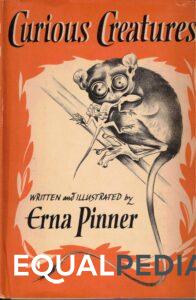
Precision and the wish to entertain her readers characterise Erna Pinner’s first book of her own in England. Curious Creatures was published in 1951 by Jonathan Cape in London. This entertaining book describes strange creatures of the animal world, such as quadrupeds that fly, camouflage, and insects with peculiar body shapes and habits. It is her most successful publication and, once again, a kind of summation of her skill. It was translated into French, Danish, Swedish and Dutch and was also published in the USA. The author made the German translation herself.
Alongside her work as an illustrator, from 1948 onwards the artist wrote science journalism for the Zurich periodicals Die Tat and Die Weltwoche. Erna Pinner continued to publish articles and illustrations until her 90th birthday in 1980. She died in London on 5 May 1987, largely forgotten, ten years before her rediscovery.
Estate
The Deutsche Nationalbibliothek, Deutsches Exilarchiv 1933–1945 (German Exile Archive) in Frankfurt holds material on Erna Pinner, mainly from the period of her exile in London.
Numerous drawings and documents by Erna Pinner are also held by the Institut für Stadtgeschichte (Institute for Urban History), Frankfurt am Main.
The Jüdisches Museum Frankfurt also holds an extensive collection from the estate dating from the 1920s, including drawings and photo albums.
Parts of the estate are still owned by her heirs in London.
Awards
- 1959 Bundesverdienstkreuz Erster Klasse (Officer’s Cross of the Order of Merit of the Federal Republic of Germany)
Publications (selection)
- Klabund (1919/1921): Das Blumenschiff. With 55 woodcuts by Erna Pinner. Berlin: Reiss.
- (1921): Das Puppenbuch. With images of the dolls by Lotte Pritzel and Erna Pinner, with texts by René Schickele, Kasimir Edschmid, Theodor Däubler and Carlo Mierendorff. Berlin: Reiss.
- Pinner, Erna (1922): Das Schweinebuch. With illustrations by the author. Berlin.
- Edschmid, Kasimir (1923): Zur Naturgeschichte der Antilopen. With original lithographs by Erna Pinner. Darmstadt: Die Dachstube.
- Edschmid, Kasimir (1925): Bullis und Pekingesen. With hand-coloured original lithographs by Erna Pinner. Darmstadt: Die Dachstube.
- Fleuron, Svend (1925): Der Graf auf Egerup. With illustrations by Erna Pinner. Jena: Eugen Diederichs.
- Edschmid, Kasimir (1926): Der Russen-Zoo. Animal sketches. With 8 original etchings by Erna Pinner. Darmstadt: Die Dachstube.
- Pinner, Erna (1927): Tierskizzen aus dem Frankfurter Zoo. Frankfurt am Main.
- Pinner, Erna (1927): Eine Dame in Griechenland. With 30 drawings by the author. Darmstadt: Darmstädter Verlag.
- Levy, S. B. (1929): Hebräische Lese-Fibel. With illustrations by Erna Pinner. Frankfurt am Main: Lehrberger & Co.
- Pinner, Erna (1931): Ich reise durch die Welt. With 104 illustrations by the author. Berlin.
- Smith, D. Seth (1936): Animal Favorites. Illustrated by Erna Pinner. London: Country Life.
- Grant Watson, E. L. (1938): Country Holiday. With illustrations by Erna Pinner. London.
- Longdon, H. W. (1940): Ingwe the Leopard and other Tales. With Illustrations by Erna Pinner. London.
- Salten, Felix (1940): Bambi’s Children. With illustrations by Erna Pinner. London: Bobbs-Merrill.
- Loeser, J. L. (1940): Animal Behaviour. With illustrations by Erna Pinner. London: Macmillan & Co.
- (1943): A Book of Animal Verse. Chosen by E. C. R. Hadfield. Illustrated by Erna Pinner. London: Oxford University Press.
- Vevers, G. M. (1943): Animals from A–Z. With colored illustrations by Erna Pinner. London: Hammond.
- Shorten, M. (1945): Wonders of Animal Life. With colored illustrations by Erna Pinner. London: Penguin.
- Swinton, W. E. (1948): The Corridor of Life. With 80 Illustrations by Erna Pinner. London: Jonathan Cape.
- Pinner, Erna (1951): Curious Creatures. With 170 illustrations by the author. London: Jonathan Cape.
- Pinner, Erna (1955): Wunder der Wirklichkeit. Seltsame Geschöpfe der Tierwelt. With 61 illustrations by the author. Hamburg/Wien: Paul Zsolnay.
- Pinner, Erna (1959): Born Alive. Written and illustrated by Erna Pinner. London: Jonathan Cape.
- Pinner, Erna (2022): Curious Creatures. Seltsame Geschöpfe der Tierwelt. Text and illustrations by Erna Pinner. With an afterword by Barbara Weidle. Bonn: Weidle Verlag, ISBN 978-3-8353-7565-9.
Further reading
- Becker, Lutz (1987): The Art of Erna Pinner. Book Illustrations, Puppets and the Study of Animals. In: AJR Information, 42(5), p. 8.
- Weidle, Barbara (ed.) (1997): »Ich reise durch die Welt«. Die Zeichnerin und Publizistin Erna Pinner. Schriftenreihe Verein August Macke Haus Bonn, No. 23, Bonn, ISBN 3-929607-22-0.
- Edschmid, Ulrike (1999): »Wir wollen nicht mehr darüber reden…«. Kasimir Edschmid und Erna Pinner. Eine Geschichte in Briefen. München: Luchterhand Literaturverlag, ISBN 3-630-87027-9.
- Becker, Eva (2004): Erna Pinners halbes Leben im Exil. In: Exil, 24(2), pp. 61–74.
- Netuschil, Claus K. (2013): Erna Pinner. In: Der weibliche Blick. Vergessene und Verschollene Künstlerinnen in Darmstadt 1880–1930. Ed. by Claus Netuschil. With further contributions by Agnes Schmidt, Renate Charlotte Hoffmann, Stephanie Hauschild, Doris Hermanns and Bettina Bergstedt. Darmstadt: Luise Büchner-Gesellschaft/Kunst Archiv Darmstadt, ISBN 978-3-9808630-5-6, p. 152.
- Bußmann, Annette (2019): »Das Leben ist eine Metamorphose«: Erna Pinner als Mittlerin zwischen den Kulturen im britischen Exil. In: Zeitschrift für Museum und Bildung, 86–87, pp. 76–90.
- Dogramaci, Burcu (2021.): Curious Creatures. In: METROMOD Archive. Online at: https://archive.metromod.net/viewer.p/69/1470/object/5140-11258638 (accessed on 9 May 2024).
- Weidle, Barbara (2021): »Im Stromgebiet der Zoologie«: Erna Pinners Neuanfang im englischen Exil. In: Seeber, Ursula/Zwerger, Veronika/Bischoff, Doerte/Swiderski Carla (eds.): Mensch und Tier in Reflexionen des Exils. Exilforschung vol. 39, ISBN 978-3-11-073080-7, pp. 301–324.
- Pinner, Erna (2022): Curious Creatures. Seltsame Geschöpfe der Tierwelt. Text and illustrations by Erna Pinner. With an afterword by Barbara Weide. Bonn: Weidle Verlag, ISBN 978-3-8353-7565-9.
- Schmetterling, Astrid (2022): In Frankfurt und in der Welt. In: Atlan, Eva Sabrina/Wenzel, Mirjam (eds.): Rosy Lilienfeld, Amalie Seckbach, Erna Pinner, Ruth Cahn. Zurück ins Licht. Vier Künstlerinnen – Ihre Werke. Ihre Wege. Bielefeld: Kerber Verlag, ISBN 978-3-7356-0856-7, pp. 115–119.
- Weidle, Barbara (2022): Zoologie als Kunst. In: Atlan, Eva Sabrina/Wenzel, Mirjam (eds.): Rosy Lilienfeld, Amalie Seckbach, Erna Pinner, Ruth Cahn. Zurück ins Licht. Vier Künstlerinnen – Ihre Werke. Ihre Wege. Bielefeld: Kerber Verlag, ISBN 978-3-7356-0856-7, pp. 120–125.
- Hermanns, Doris (2022): »Und alles ist hier fremd«. Deutschsprachige Schriftstellerinnen im britischen Exil. Berlin: AvivA Verlag, ISBN 978-3-949302-05-3.
Exhibitions (selection)
- 1923: Berlin, Galerie Flechtheim
- 1926: Frankfurt am Main, Flechtheim und Kahnweiler
- 1929: Cologne, Kunstsalon Hermann Abels
- 1933: Frankfurt am Main, Gedok
- Until 1933 also participation in numerous group exhibitions
- 1997: Ich reise durch die Welt. Die Zeichnerin und Publizistin Erna Pinner. Bonn, August Macke Haus
- 2004: Erna Pinner. Deutsche Nationalbibliothek Frankfurt
- 2005: Erna Pinner. Deutsche Bücherei Leipzig
- 2023: Zurück ins Licht. Vier Künstlerinnen – Ihre Werke. Ihre Wege. Rosy Lilienfeld, Amalie Seckbach, Erna Pinner, Ruth Cahn. Jüdisches Museum Frankfurt
External links
- Literature by and about Erna Pinner in the catalogue of the Deutsche Nationalbibliothek
- Erna Pinner in the Digital Collection of the Städel Museum
- Erna Pinner in the database of the Institut für Stadtgeschichte Frankfurt am Main
- Information on the exhibition “Zurück ins Licht. Vier Künstlerinnen – Ihre Werke. Ihre Wege” at the Jüdisches Museum Frankfurt
- “Eine Frankfurter Künstlerin auf Reisen. Die Fotoalben von Erna Pinner” (A Frankfurt Artist on Her Travels. Erna Pinner’s Photo Albums) on the blog of the Jüdisches Museum Frankfurt
Machine translation: This article was translated automatically from the German original.
- 1Pinner, Erna (1931): Ich reise durch die Welt. With 104 illustrations by the author. Berlin. ↩︎
- 2Weidle, Barbara (ed.) (1997): »Ich reise durch die Welt«. Die Zeichnerin und Publizistin Erna Pinner. Schriftenreihe Verein August Macke Haus Bonn, No. 23, Bonn, ISBN 3-929607-22-0, p. 203 ff. Hereafter cited as: Pinner (1997). ↩︎
- 3Edschmid, Kasimir (1927): Basken, Stiere, Araber. Ein Buch über Spanien und Marokko. With 46 drawings by Erna Pinner. Berlin: Frankfurter Verlagsanstalt. ↩︎
- 4Edschmid, Kasimir (1927): Das große Reisebuch. Von Stockholm bis Korsika, von Monte Carlo bis Assisi. With 15 drawings by Erna Pinner. Berlin: Deutsche Buchgemeinschaft. ↩︎
- 5Edschmid, Kasimir (1927): Die neue Frau. Short stories. With 7 drawings by Erna Pinner. Berlin: Deutsche Buchgemeinschaft. ↩︎
- 6Edschmid, Kasimir (1932): Zauber und Größe des Mittelmeers. With photographs by Erna Pinner. Frankfurt. ↩︎
- 7Edschmid, Kasimir (1932): Südamerika wird photographiert. With 64 photographs by Erna Pinner. Bielefeld/Leipzig: Velhagen & Klasing. ↩︎
- 8The correspondence between Pinner and Benn after the Second World War has been published, as far as it has survived. Pinner (1997): »Immer Dein Bellealliancestraßengefährte«, pp. 139–157. ↩︎
- 9Reprinted in: Pinner (1997), pp. 194–198. ↩︎
- 10Smith, D. Seth (1936): Animal Favorites. Illustrated by Erna Pinner. London: Country Life. ↩︎
- 11»Zoo« Official Guide. Ma pof geographical distribution. Zoological Society, London 1937. ↩︎
- 12On Erna Pinner’s life and work in England, see: Weidle, Barbara (2021): »Im Stromgebiet der Zoologie«: Erna Pinners Neuanfang im englischen Exil. In: Seeber, Ursula/Zwerger, Veronika/Bischoff, Doerte/Swiderski Carla (eds.): Mensch und Tier in Reflexionen des Exils. Exilforschung vol. 39, ISBN 978-3-11-073080-7, pp. 301–324; Weidle, Barbara (2022): Zoologie als Kunst. In: Atlan, Eva Sabrina/Wenzel, Mirjam (eds.): Rosy Lilienfeld, Amalie Seckbach, Erna Pinner, Ruth Cahn. Zurück ins Licht. Vier Künstlerinnen – Ihre Werke. Ihre Wege. Bielefeld: Kerber Verlag, ISBN 978-3-7356-0856-7, pp. 120–125. ↩︎
- 13Swinton, W. E. (1948): The Corridor of Life. With 80 Illustrations by Erna Pinner. London: Jonathan Cape. ↩︎
