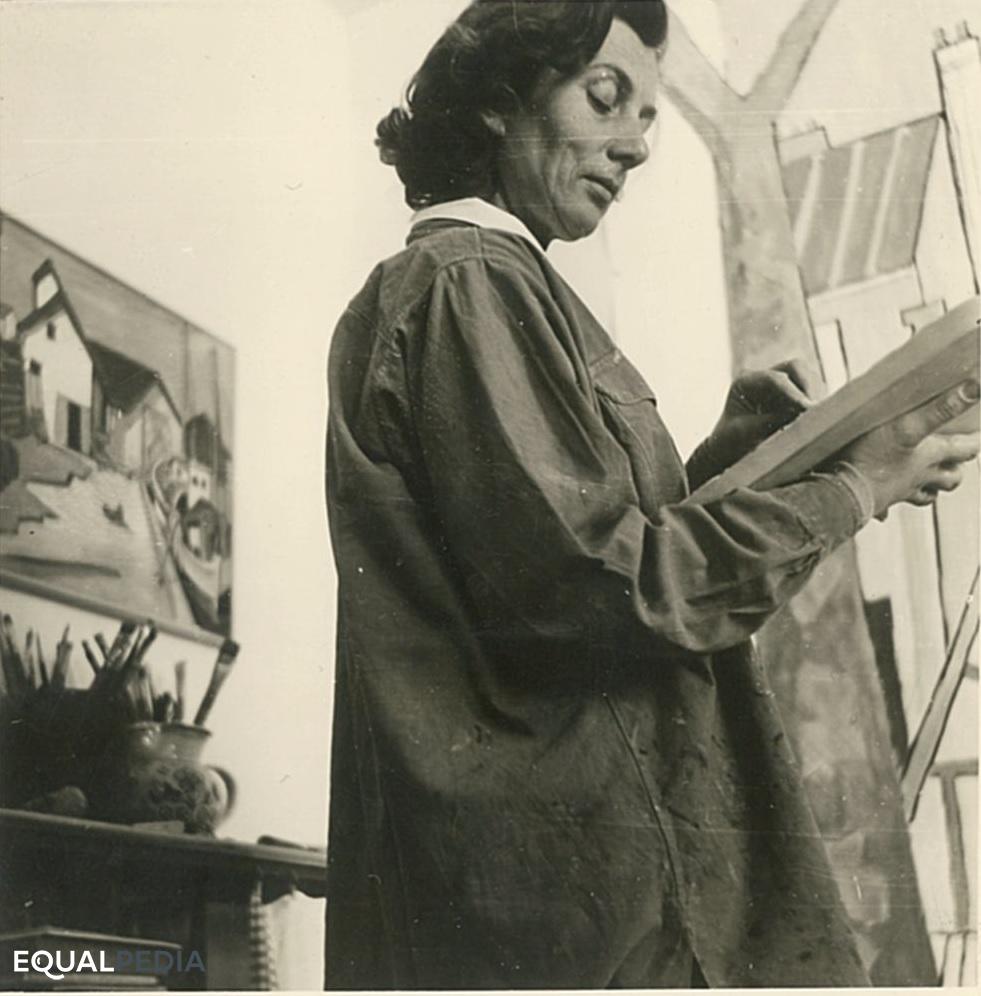
Inge Hergenhahn-Dinand (* 14 August 1907 in Darmstadt; † 11 May 2003 in Frankfurt am Main), née Dinand, was a German artist, a master student of Max Beckmann and co-initiator of the “Frankfurter Kreis” (Frankfurt Circle).
Career

© Heirs of Hergenhahn-Dinand
Inge Dinand was born on 14 August 1907 in Darmstadt. Her father, Paul Dinand, was a naturopath (Heilpraktiker). At her mother’s urging, she attended the school of home economics in Thale in the Harz mountains before beginning her art studies in 1925, at the age of just 18, under Peter Rasmussen at the new Kunstgewerbeschule (School of Applied Arts; from 1942 Staatliche Hochschule für bildende Künste – Städelschule) in Frankfurt am Main. In 1928 she became a master student in the class of Max Beckmann, to which she belonged until 1932.1n. a. (n. d.): Inge Hergenhahn-Dinand (geb. Dinand). In: Webseite des Museums Giersch der Goethe-Universität. Available online at: https://georg-heck.museum-giersch.de/inge_hergenhahn-dinand/ (accessed on 24 October 2022).2Netuschil, Claus K. (2013): Der Weibliche Blick. Vergessene und verschollene Künstlerinnen in Darmstadt 1880–1930. Exhibition catalogue. Darmstadt: Luise Büchner-Gesellschaft/Kunst Archiv Darmstadt, ISBN 978-3-9808630-5-6, pp. 118–121.3Netuschil, Claus K. (n. d.): Hergenhahn-Dinand, Inge. In: Stadtlexikon Darmstadt. Available online at: https://www.darmstadt-stadtlexikon.de/h/hergenhahn-dinand-inge.html (accessed on 24 October 2022).
Early work
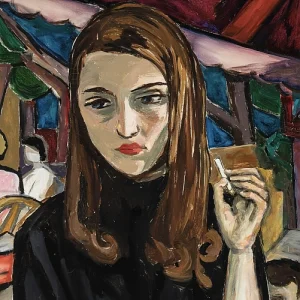
Dinand already took part in exhibitions while still a student. Her participation in an exhibition of young artists at the Reckendorfhaus in Berlin in 1929 is documented. Paul Westheim, the art critic and art collector, wrote of the selection that only one work from Beckmann’s class, namely that of Inge Dinand, had been accepted by the jury; the others, he said, were merely “fake Beckmanns”.4Westheim, Paul (1930/1978), p. 5. See also: Fittkau, Hans Jürgen (2000): Aus der Meisterklasse Max Beckmanns. Karl Tratt, Friedrich Wilhelm Meyer und ihre Kommilitonen. Exhibition catalogue. Frankfurt/M.: Frankfurter Sparkasse, pp. 43–45; Fittkau, Hans Jürgen (2011): Aus der Meisterklasse Max Beckmanns. Der Frankfurter Maler Karl Tratt (1900–1937). Weimar: VDG, ISBN 978-3-89739-706-4. In 1930, works by Inge Dinand were also on view together with works by a number of students of the Kunstgewerbeschule. R. Diehl wrote in the Frankfurter Nachrichten: “Comparatively the most independent […] is the gifted Inge Dinand, in whose pictures […] life is not crushed by style, but a spiritual unity is achieved.” Two years later, in 1932, another exhibition took place at the Galerie Prestel, this time of a small group consisting of Dinand, Walter Hergenhahn, Theo Garve and Karl Tratt. Once again she stood out: “Even more decisively than on earlier occasions, Inge Dinand emerges as the strongest artistic force of the small group. Her penetratingly characterised portraits of children […] are documents of a talent developing with great strength of character […].”5Undated newspaper clippings in the estate of Karl Tratt, bearing only the handwritten notes “Frankfurter Nachrichten 1930” and “Frankfurter Nachrichten 1932”. Inge Dinand and Karl Tratt in particular were already credited with independence by the press in the early 1930s. “Thus Inge Dinand was indeed the only one of Beckmann’s students who, according to Paul Westheim, did not deliver ‘series production’. The jury let only one of these compositions (by Inge Dinand, Darmstadt) pass. In the reviews of the non-fascist press, too, it was above all she and her fellow student Karl Tratt who were singled out: If, however, one disregards this orientation towards the role model, which expresses itself predominantly in the choice of motifs and in the composition, what remains in Karl Tratt’s work, alongside cultivated painterly craftsmanship, is the ability to bring his subjects vividly to life in spirit, which naturally has its most immediate effect in the portraits. Inge Dinand, too, owes to her teacher her expressive sense of form and the balance of her planar composition despite the differentiated painterly treatment. Beginnings of an independent development can be perceived in the portrait and in the figurative compositions.” 6Victor, Marion (2026): Ehrfurcht vor dem Gegenstand und das Gesetz der Fläche. In: TEXTOR online, article of 19 January 2026. Available online at: https://textor.online/de/texte-detailseite/ehrfurcht-vor-dem-gegenstand-und-das-gesetz-der-flaeche-die-meisterklasse-max-beckmanns/ (accessed on 20 January 2026). The digital collection of the Städel in Frankfurt am Main includes a Kinderbildnis 1932–1933 (Portrait of a Child) by Inge Dinand, which was acquired in 1933 as a transfer from the Frankfurter Künstlerförderung (Frankfurt artists’ support programme).
1933 to 1945

On 7 February 1933, the exhibition Das Junge Frankfurt (Young Frankfurt) opened at the Frankfurter Kunstverein; Dinand was also represented in it. What had been planned as the next step towards an existence as a freelance artist ended with the proscription of her art; together with the works of her teacher and those of her fellow students, her works were branded as “degenerate”. The Frankfurter Volksblatt now wrote of “art of decay” and “products of mentally ill or feeble-minded children”.7Quoted from the file of Dr Inge Eichler in the Frankfurter Stadtarchiv 52/852. The exhibition was closed prematurely after only two weeks.
The Nazis’ seizure of power amounted to a ban on practising her profession. Inge Dinand thereupon withdrew into private life for the time being. She married her former fellow student and colleague Walter Hergenhahn. Her father-in-law set up a studio for her in the attic of the house at Gärtnerweg 16 in Frankfurt am Main, where she could work undisturbed.

© Heirs of Hergenhahn-Dinand
Her sons Michael and Kay were born in 1935 and 1937. Regular trips took Inge Hergenhahn-Dinand to Sylt. There she created a series of watercolours that survived the war.8n. a. (n. d.): Inge Hergenhahn-Dinand (geb. Dinand). In: Webseite des Museums Giersch der Goethe-Universität. Available online at: https://georg-heck.museum-giersch.de/inge_hergenhahn-dinand/ (accessed on 24 October 2022).
From 1936 onwards, Inge Hergenhahn-Dinand appears to have come to terms with the regime: in 1936, 1940, 1941 and 1942 she took part in official exhibitions. After the first bombing of the Gärtnerweg in 1942, she and her two young sons found refuge with friends in the Wartheland (now Poland). In March 1944 the house on Gärtnerweg was completely destroyed, and with it by far the greater part of her work. Only a suitcase containing the Sylt watercolours survived the bombing. Towards the end of the war, Inge Hergenhahn-Dinand fled back to the West with her children via Mietzelfelde and Stralsund to Hamburg. For the time being, the flight ended in 1945 in Wedel/Holstein.
After the Second World War

© Heirs of Hergenhahn-Dinand
In 1946, together with her two sons and Walter Hergenhahn, she found a home for the next ten years in Nierstein on the Rhine, where her brother Frithjof Dinand had a medical practice. But soon there were connections to Frankfurt and to Darmstadt, her birthplace. Contacts were established with the Neuen Darmstädter Sezession (New Darmstadt Secession), in whose exhibitions she took part time and again from 1946 onwards, for example in the 1950 exhibition Das Menschenbild in unserer Zeit (The Image of Man in Our Time). Works by her were again represented in the 1947 exhibition of the Frankfurter Kunstverein, Frankfurter Künstler der Gegenwart (Frankfurt Artists of the Present). She was also a member of the artists’ association Neue Gruppe Rheinland-Pfalz (New Group Rhineland-Palatinate), which Walter Hergenhahn founded in 1954. From the early 1950s she travelled regularly to Spain and, above all, to France. It was not until 1956 that she returned to Frankfurt am Main with her husband.
From 1951 to 1959, Inge Hergenhahn-Dinand took part in the five editions of the touring exhibition Farbige Graphik (Colour Prints) of the Kestner-Gesellschaft Hannover, which was initiated by Alfred Hentzen and shown in numerous cities.9On the occasion of the 5th exhibition, Werner Schmalenbach states in Schweizer Kunst, 1960, issue 1, that it was shown in 27 cities in 1951, in 39 in 1953, in 48 in 1955 and in 43 in 1957 (available online at: https://www.e-periodica.ch/digbib/view?pid=swk-001%3A1960%3A0%3A%3A112#140 (accessed on 10 September 2022).).

The regularity of her participation shows that her woodcuts and lithographs could well hold their own alongside works by her male colleagues such as HAP Grieshaber, Karl Hartung and Wilhelm Nay.10Grieshaber, Hartung and Nay were represented at documenta I . Alfred Hentzen, who headed the Kestner-Gesellschaft until 1955 and had initiated the touring exhibition Farbige Graphik , was also one of the advisers in the preparation of documenta I. – Georg Heck took part in the Farbige Graphik exhibitions in 1951, 1957 and 1959. Her very own visual language is striking for its working-out of structures, which strips the mostly landscape motifs of anything anecdotal and instead brings them closer to timeless, abstract forms without denying the object.
In 1958 Hergenhahn-Dinand separated from her husband Walter Hergenhahn. After her divorce, she lived with the architect Günter Bock until 1967.

Despite numerous exhibitions and recognition beyond the region, it remained difficult for Hergenhahn-Dinand to earn a living. She therefore also trained as a weaver at the Werkkunstschule in Offenbach. Commissions for carpets and paraments for churches followed. In addition, from 1957 she ran summer courses in painting and drawing in Klappholttal on Sylt. In 1965, together with Georg Heck, she received the study-trip prize of the Heusenstamm-Stiftung and travelled to Provence.11n. a. (n. d.): Inge Hergenhahn-Dinand (geb. Dinand). In: Webseite des Museums Giersch der Goethe-Universität. Available online at: https://georg-heck.museum-giersch.de/inge_hergenhahn-dinand/ (accessed on 24 October 2022). In 1968/69 she tried to establish herself as a gallery owner. In her gallery she showed works by Thomas Bayrle, Karl Kunz and Arnulf Rainer, among others.
Late work

© Heirs of Hergenhahn-Dinand
From the 1970s onwards, a farmhouse in the Vogelsberg became her second residence. During this period she created an extensive late oeuvre in which she remained true to her very own free painterly visual language, which sought a balance between the two principles laid down by her teacher Max Beckmann: “reverence for the object” and the “law of the surface”. It comprises landscapes, still lifes and portraits in oil, drawings and etchings. In 1976, together with Georg Heck, Hergenhahn-Dinand was one of the co-initiators of the Frankfurter Kreis, an artists’ group of eleven long-established artists, some of them friends, including several former students of Max Beckmann: the sculptors Hermann zur Strassen, Hans Bernt Gebhardt and Willi Schmidt, and the eight painters Karl Degener, Ursula Dittmann, Maria Houben, Gerta Kleist, Ruth Putensen, Susanne Schönberger, Thomas Zach and Georg Heck. Hergenhahn-Dinand made her gallery’s client index available.12n. a. (n. d.): Gemeinsame Interessen: der Frankfurter Kreis. In: Webseite des Museums Giersch der Goethe-Universität. Available online at: https://georg-heck.museum-giersch.de/frankfurter_kreis/ (accessed on 24 October 2022).
In the last years of her life, Inge Hergenhahn-Dinand lived in Frankfurt’s Westend district, cared for mainly by her elder son and the family. She died on 11 May 2003 and was buried beside Walter Hergenhahn in Frankfurt’s Hauptfriedhof (Main Cemetery).
List of post-war exhibitions (probably incomplete)
-

Inge Hergenhahn-Dinand, Dünenlandschaft (Dune Landscape), 1976, oil on canvas, 75 x 60 cm, private collection. © Heirs of Hergenhahn-Dinand 1947: Frankfurt am Main, Kunstverein/Städel, “Frankfurter Kunst der Gegenwart”
- 1947: Mainz, Haus am Dom, “Neue deutsche Kunst”
- 1949: Mainz, Haus am Dom, Inge Hergenhahn (solo exhibition)
- 1951: Darmstadt, Mathildenhöhe, Darmstädter Sezession
- 1951: Touring exhibition of the Kestner Gesellschaft Hannover, Farbige Graphik
- 1952: Mainz, Haus am Dom, “Kunst in Rheinland-Pfalz”
- 1953: Bielefeld, Städt. Kunsthaus, Inge Hergenhahn-Dinand and Jo Pieper
- 1953: Frankfurt am Main, Kunstverein, “Kanada half – Wir malten”
- 1953: Touring exhibition of the Kestner Gesellschaft Hannover, Farbige Graphik
- 1954: Darmstadt, Mathildenhöhe, “Das Bild der Landschaft”
- 1954: Frankfurt am Main, Kunstverein, “Frankfurter Maler und Bildhauer der Gegenwart”
- 1954: Mainz, Haus am Dom, Neue Gruppe Rheinland-Pfalz. (also 1955 and 1956)
- 1954: Touring exhibition of the Kestner Gesellschaft Hannover, Farbige Graphik
- 1955: Heidelberg, Graphisches Kabinett Hanna Grisebach
- 1955: Worms, Heylshof
- 1955: Mainz, Haus am Dom, Neue Gruppe Rheinland-Pfalz
- 1955: Touring exhibition of the Kestner Gesellschaft Hannover, Farbige Graphik
- 1956: Frankfurt am Main, Hanna Bekker vom Rath, “Deutsche Gegenwartskunst” (for South America, South Africa and India)
- 1956: Reutlingen, Spendhaus, Neue Gruppe Rheinland-Pfalz
- 1956: Mainz, Haus am Dom, Neue Gruppe Rheinland-Pfalz
- 1957: New York, Gedok/Unesco
- 1957: Touring exhibition of the Kestner Gesellschaft Hannover, Farbige Graphik
- 1959: Touring exhibition of the Kestner Gesellschaft Hannover, Farbige Graphik
- 1964: Salzburg, Casino Mirabell, “Frankfurter Graphik”
- 1965: Frankfurt am Main, Kunstverein, Frankfurter Sezession
- 1965: Bad Homburg, Studio Kaluza, solo exhibition
- 1966: Frankfurt am Main, Heussenstammstiftung, solo exhibition
- 1966: Frankfurt am Main, Haus Dornbusch, Gedok
- 1966: Athens, BBK, “Hessische Grafik in Athen”
- 1967: Munich, Neue Münchner Galerie, solo exhibition
- 1977: Frankfurt am Main, Steineres Haus, “Frankfurter Künstler im Steinernen Haus”
- 1978: Friedberg, Kunstverein/Galerie Altes Rathaus, solo exhibition
- 1978: Höchst, Gal. Meyer- Ellinger in the Jahrhunderthalle
- 1979: Keitum, Raiffeisenbank, solo exhibition
- 1980: Frankfurt am Main, Karmeliterkloster, “Max Beckmanns Frankfurter Schüler”
- 1980: Frankfurt am Main, Steinernes Haus, annual exhibition
- 1980: Oberursel, Galerie auf der Treppe, solo exhibition
- 1981: Recklinghausen/Ruhrfestspiele, SPK, solo exhibition
- 1982: Frankfurt am Main, Galerie Meyer-Ellinger, Frankfurter Versicherungs-AG, solo exhibition
- 1982: Heidelberg, Galerie Olaf Greiser, solo exhibition
- 1982: Mainz, City Hall, “Mainzer Kunstszene nach der Stunde Null 45–54”
- 1988: Darmstadt, Saalbau-Galerie Darmstadt/Claus K. Netuschil, solo exhibition
Further reading
- Dezernat Kultur und Freizeit der Stadt Frankfurt am Main/Amt für Wissenschaft und Kunst (ed.) (1980): Max Beckmanns Frankfurter Schüler 1925–1933: Carla Brill Inge Dinand Theo Garve Georg Heck Walter Hergenhahn Anna Krüger Leo Maillet Hella Mandt Friedrich Wilhelm Meyer Mari Louise von Motesiczky Alfred Nungesser Karl Tratt. Editing and exhibition: Dieter Hoffmann and Günther Vogt. Frankfurt/M.: Kommunale Galerie, n. p.
- Fittkau, Hans Jürgen (2011): Aus der Meisterklasse Max Beckmanns. Der Frankfurter Maler Karl Tratt (1900–1937). Weimar: VDG, ISBN 978-3-89739-706-4.
- Netuschil, Claus K. (2013): Der Weibliche Blick. Vergessene und verschollene Künstlerinnen in Darmstadt 1880–1930. Exhibition catalogue. Darmstadt: Luise Büchner-Gesellschaft/Kunst Archiv Darmstadt, ISBN 978-3-9808630-5-6, pp. 118–121.
- Fittkau, Hans Jürgen (2000): Aus der Meisterklasse Max Beckmanns. Karl Tratt, Friedrich Wilhelm Meyer und ihre Kommilitonen. Frankfurt/M.: Frankfurter Sparkasse, pp. 43–45.
- Schulze, Sabine (ed.)/Mann, Stephan (comp.) (1998): Das 20. Jahrhundert im Städel. Stuttgart: Hatje Cantz, ISBN 978-3-7757-0707-7,41.
- von der Dollen, Ingrid (2000): Malerinnen im 20. Jahrhundert. München: Hirmer, ISBN 978-3-7774-8700-7, 238–243.
External links
- Literature by and about Inge Hergenhahn-Dinand in the catalogue of the Deutsche Nationalbibliothek (German National Library)
- Inge Hergenhahn-Dinand in the Hessische Biografie (Hessian Biography)
Machine translation: This article was translated automatically from the German original.
- 1n. a. (n. d.): Inge Hergenhahn-Dinand (geb. Dinand). In: Webseite des Museums Giersch der Goethe-Universität. Available online at: https://georg-heck.museum-giersch.de/inge_hergenhahn-dinand/ (accessed on 24 October 2022). ↩︎
- 2Netuschil, Claus K. (2013): Der Weibliche Blick. Vergessene und verschollene Künstlerinnen in Darmstadt 1880–1930. Exhibition catalogue. Darmstadt: Luise Büchner-Gesellschaft/Kunst Archiv Darmstadt, ISBN 978-3-9808630-5-6, pp. 118–121. ↩︎
- 3Netuschil, Claus K. (n. d.): Hergenhahn-Dinand, Inge. In: Stadtlexikon Darmstadt. Available online at: https://www.darmstadt-stadtlexikon.de/h/hergenhahn-dinand-inge.html (accessed on 24 October 2022). ↩︎
- 4Westheim, Paul (1930/1978), p. 5. See also: Fittkau, Hans Jürgen (2000): Aus der Meisterklasse Max Beckmanns. Karl Tratt, Friedrich Wilhelm Meyer und ihre Kommilitonen. Exhibition catalogue. Frankfurt/M.: Frankfurter Sparkasse, pp. 43–45; Fittkau, Hans Jürgen (2011): Aus der Meisterklasse Max Beckmanns. Der Frankfurter Maler Karl Tratt (1900–1937). Weimar: VDG, ISBN 978-3-89739-706-4. ↩︎
- 5Undated newspaper clippings in the estate of Karl Tratt, bearing only the handwritten notes “Frankfurter Nachrichten 1930” and “Frankfurter Nachrichten 1932”. ↩︎
- 6Victor, Marion (2026): Ehrfurcht vor dem Gegenstand und das Gesetz der Fläche. In: TEXTOR online, article of 19 January 2026. Available online at: https://textor.online/de/texte-detailseite/ehrfurcht-vor-dem-gegenstand-und-das-gesetz-der-flaeche-die-meisterklasse-max-beckmanns/ (accessed on 20 January 2026). ↩︎
- 7Quoted from the file of Dr Inge Eichler in the Frankfurter Stadtarchiv 52/852. ↩︎
- 8n. a. (n. d.): Inge Hergenhahn-Dinand (geb. Dinand). In: Webseite des Museums Giersch der Goethe-Universität. Available online at: https://georg-heck.museum-giersch.de/inge_hergenhahn-dinand/ (accessed on 24 October 2022). ↩︎
- 9On the occasion of the 5th exhibition, Werner Schmalenbach states in Schweizer Kunst, 1960, issue 1, that it was shown in 27 cities in 1951, in 39 in 1953, in 48 in 1955 and in 43 in 1957 (available online at: https://www.e-periodica.ch/digbib/view?pid=swk-001%3A1960%3A0%3A%3A112#140 (accessed on 10 September 2022).). ↩︎
- 10Grieshaber, Hartung and Nay were represented at documenta I . Alfred Hentzen, who headed the Kestner-Gesellschaft until 1955 and had initiated the touring exhibition Farbige Graphik , was also one of the advisers in the preparation of documenta I. – Georg Heck took part in the Farbige Graphik exhibitions in 1951, 1957 and 1959. ↩︎
- 11n. a. (n. d.): Inge Hergenhahn-Dinand (geb. Dinand). In: Webseite des Museums Giersch der Goethe-Universität. Available online at: https://georg-heck.museum-giersch.de/inge_hergenhahn-dinand/ (accessed on 24 October 2022). ↩︎
- 12n. a. (n. d.): Gemeinsame Interessen: der Frankfurter Kreis. In: Webseite des Museums Giersch der Goethe-Universität. Available online at: https://georg-heck.museum-giersch.de/frankfurter_kreis/ (accessed on 24 October 2022). ↩︎