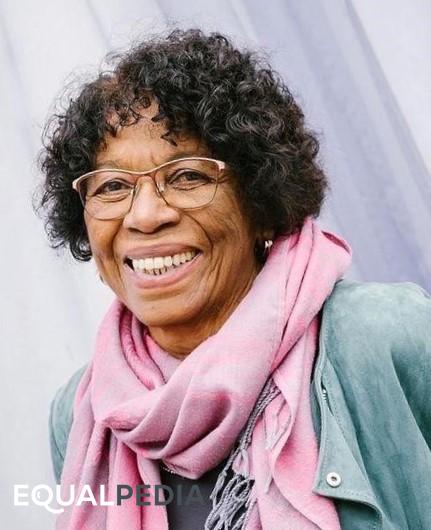
Marion Kraft (born 1946 in Gelsenkirchen)1Deutsche Nationalbibliothek (n. d.): Marion Kraft. Datensatz der Deutschen Nationalbibliothek. In: Webseite der Deutschen Nationalbibliothek. Online at: http://d-nb.info/gnd/1047595737 (accessed 18/10/2021). is an Afro-German literary scholar, lecturer, author and translator. She has written numerous books and essays on racism, literature – especially by Black women writers – feminism and the Black movement in Germany.2n. a. (n. d.): Marion Kraft – Empowerment und Widerstand. In: Webseite des Verlags worten & meer. Online at: https://wortenundmeer.net/product/marion-kraft-empowerment-und-widerstand/ (accessed 18/10/2021).
Career
Marion Kraft was born in Gelsenkirchen in 1946 to a German mother and an African American US soldier, and grew up in Mannheim.3Lehmann, Bebero (2019): „Wir wuchsen isoliert auf“. In: der Freitag, interview from issue 09/2019. Online at: https://www.freitag.de/autoren/der-freitag/wir-wuchsen-isoliert-auf (accessed 18/10/2021). Her father returned to the USA shortly after her birth; Kraft never got to know him. Even in her childhood as a Black “occupation child” (Besatzungskind) with a single, unmarried mother, she experienced stigmatisation and “othering”.
After her mother died when Marion Kraft was 12 years old, she lived with her grandmother.4Timm, Ulrike (2021): „Meine Generation ist mit dem N-Wort aufgewachsen“. In: Deutschlandfunk Kultur, interview of 02/08. Online at: https://www.deutschlandfunkkultur.de/autorin-marion-kraft-meine-generation-ist-mit-dem-n-wort.970.de.html?dram:article_id=478807 (accessed 18/10/2021). After completing her secondary school certificate (Realschulabschluss), Kraft did an apprenticeship and worked until 1969 as a secretary, translator and foreign-language correspondent. Later she obtained her Abitur (university entrance qualification) at the evening grammar school (Abendgymnasium) in Mannheim and worked at the Council of the European Communities in Brussels. From 1970 to 1976 she studied English and American Studies, German Studies, Education and Philosophy in Cologne and Frankfurt am Main.5Webseite von Marion Kraft. Online at: http://www.marion-kraft.de/ (accessed 18/10/2021).6Timm, Ulrike (2021): „Meine Generation ist mit dem N-Wort aufgewachsen“. In: Deutschlandfunk Kultur, interview of 02/08. Online at: https://www.deutschlandfunkkultur.de/autorin-marion-kraft-meine-generation-ist-mit-dem-n-wort.970.de.html?dram:article_id=478807 (accessed 18/10/2021).7n. a. (2015): Autorinnen und Autoren. In: Kraft, Marion (ed.): Kinder der Befreiung. Transatlantische Erfahrungen und Perspektiven Schwarzer Deutscher der Nachkriegsgeneration. Münster: Unrast, p. 366. During her studies, in 1974 she went to Ohio State University as an assistant teacher. After her second state examination (2. Staatsexamen), Marion Kraft worked as a teacher at a grammar school (Gymnasium) in Frankfurt, and from 1979 to 1982 she taught German as a foreign language at the Goethe-Institut in Göttingen. She then taught literature, English and women’s studies at the Oberstufen-Kolleg (upper secondary college) of Bielefeld University.8n. a. (n. d.): Ehemalige Mitarbeiter*innen Laborschule und Oberstufen-Kolleg. Online at: https://ekvv.uni-bielefeld.de/pers_publ/publ/PersonDetail.jsp?personId=91861 (accessed 18/10/2021). In 1994/1995 Kraft earned her doctorate at Osnabrück University; her dissertation, entitled The African Continuum and African American Women Writers, was published in 1995.9Webseite von Marion Kraft. Online at: http://www.marion-kraft.de/ (accessed 18/10/2021).10n. a. (2015): Autorinnen und Autoren. In: Kraft, Marion (ed.): Kinder der Befreiung. Transatlantische Erfahrungen und Perspektiven Schwarzer Deutscher der Nachkriegsgeneration. Münster: Unrast, p. 366.
Women’s movement and Black movement in Germany
Already during her studies Kraft became politically active: she supported the liberation movements in African countries such as Zimbabwe and maintained contacts with the Black Panther movement. During her time at the University of Frankfurt she was, with few exceptions, the only Black woman; she experienced that racism was not an issue either at the university or in the women’s movement, in which she was also active. “Even among women, the literature is white,” as Kraft recalls.11Timm, Ulrike (2021): „Meine Generation ist mit dem N-Wort aufgewachsen“. In: Deutschlandfunk Kultur, interview of 02/08. Online at: https://www.deutschlandfunkkultur.de/autorin-marion-kraft-meine-generation-ist-mit-dem-n-wort.970.de.html?dram:article_id=478807 (accessed 18/10/2021). In academia, too, there is neither a racism-sensitive environment nor racism-sensitive use of language.12Lehmann, Bebero (2019): „Wir wuchsen isoliert auf“. In: der Freitag, interview from issue 09/2019. Online at: https://www.freitag.de/autoren/der-freitag/wir-wuchsen-isoliert-auf (accessed 18/10/2021).
In 1985, at a feminist literature conference in Hamburg, Kraft met the poet and activist May Ayim. Dagmar Schultz, co-editor of the book Farbe bekennen, approached her there and asked whether she knew Audre Lorde. In 1986 Kraft travelled to Berlin to interview Audre Lorde. The two shared a friendship that lasted many years; Lorde in turn inspired Ayim, Schultz and Katharina Oguntoye to create their work Farbe bekennen. Afro-deutsche Frauen auf den Spuren ihrer Geschichte (published in English as Showing Our Colors: Afro-German Women Speak Out), which is today a classic of the Afro-German movement.13n. a. (n. d.): May Ayim, Katharina Oguntoye, Dagmar Schultz (Hg.) Farbe bekennen. Afro-deutsche Frauen auf den Spuren ihrer Geschichte. In: Webseite des Orlanda Verlags. Online at: https://orlanda.de/book/may-ayim-katharina-oguntoye-dagmar-schultz-hg-farbe-bekennen-afro-deutsche-frauen-auf-den-spuren-ihrer-geschichte (accessed 18/10/2021). 14Lehmann, Bebero (2019): „Wir wuchsen isoliert auf“. In: der Freitag, interview from issue 09/2019. Online at: https://www.freitag.de/autoren/der-freitag/wir-wuchsen-isoliert-auf (accessed 18/10/2021).15Gerk, Andrea (2021): „Ihr müsst euch sichtbar machen“. Marion Kraft im Gespräch mit Andrea Gerk. In: Deutschlandfunk Kultur, contribution of 06/05. Online at: https://www.deutschlandfunkkultur.de/sister-outsider-von-audre-lorde-ihr-muesst-euch-sichtbar.1270.de.html?dram:article_id=496782 (accessed 28/10/2021).
In her research Kraft engaged with the works of both May Ayim and Audre Lorde and published several texts on these two important Black women writers. As early as 1994, Kraft’s tandem translation of Audre Lorde’s poems, produced together with Sigrid Markmann, was published; in 2021 Audre Lorde’s essays Sister Outsider appeared in a new translation by Marion Kraft and Eva Bonné, to which Kraft contributed an afterword. In an interview on the publication of the translation, Kraft criticised general translation errors that could be avoided if “publishers” had no “reservations” (Berührungsängste) “towards experts who do not belong to the mainstream”.16Kraft, Marion/Bonné, Eva (2021): Wer spricht wie für wen mit welchen Worten? In: Toledo. Online at: https://www.toledo-programm.de/talks/2465/marion-kraft-und-eva-bonne-wer-spricht-wie-fur-wen-mit-welchen-worten (accessed 18/10/2021). Kraft repeatedly points out that an insensitive use of language can be hurtful to readers. For the translation of Lorde’s essays, she and Bonné found a language usage critical of racism:
“For example, we did not translate the English word ‘race’ with the German word ‘Rasse‘. We also capitalised ‘Black’ (Schwarz) in its adjectival use, whereas we wrote ‘white‘ (weiß) in lower case and italics. I emphasised that it must be made clear that the use of ‘white‘ is not about skin colour, but that the term is a frame of reference against which everything else is defined as ‘other’.”17Rosche, Julia (2021): „Audre Lordes Lyrik sollte hierzulande einen anderen Stellenwert erhalten“. In: TraLaLit, interview of 30/07. Online at: https://www.tralalit.de/2021/07/30/audre-lordes-lyrik-sollte-hierzulande-einen-anderen-stellenwert-erhalten/ (accessed 18/10/2021).
When it became known in 2021 that the poems of Amanda Gorman were to be translated in the Netherlands by Marieke Lucas Rijneveld, Kraft also criticised the choice, since Rijneveld lacked expertise in African American history and tradition:
“The closer I am to the worlds of experience of an author, the more consciously I can make decisions about language – recognising where a term may be neutral in one cultural context but perhaps hurtful or even racist in another.”18Grüter, Irene (2021): Es geht nicht um Hautfarben, sondern um Machtstrukturen. In: SRF, interview of 06/03. Online at: https://www.srf.ch/kultur/literatur/uebersetzung-amanda-gorman-es-geht-nicht-um-hautfarben-sondern-um-machtstrukturen (accessed 18/10/2021).
In 2015 Kraft’s work Kinder der Befreiung. Transatlantische Erfahrungen und Perspektiven Schwarzer Deutscher der Nachkriegsgeneration was published, in which she brings together the voices of Black Germans and gives a historical overview of the history of Black people in Germany.
Memberships and voluntary work
Since 1986 Marion Kraft has been a member of the Initiative Schwarze Menschen in Deutschland (Initiative of Black People in Germany)19Timm, Ulrike (2021): „Meine Generation ist mit dem N-Wort aufgewachsen“. In: Deutschlandfunk Kultur, interview of 02/08. Online at: https://www.deutschlandfunkkultur.de/autorin-marion-kraft-meine-generation-ist-mit-dem-n-wort.970.de.html?dram:article_id=478807 (accessed 18/10/2021). and is one of its co-founders.20n. a. (2018): Schwarze Autorinnen. In: Webseite des Frauenzentrums Laatzen. Online at: https://frauenzentrum-laatzen.de/schwarze-autorinnen/ (accessed 18/10/2021). For several years she was a reviewer for scholarship holders of the Heinrich-Böll-Stiftung (Heinrich Böll Foundation), and in 2004 she was a jury member of the May Ayim Award, the first Black German literary prize, which has so far been awarded only once.21n. a. (n. d.): Lehrtätigkeiten. In: Webseite von Marion Kraft. Online at: http://www.marion-kraft.de/lehrtaetigkeiten.html (accessed 18/10/2021).22Kelly, Natasha A. (2018): May Ayim. In: Digitales Deutsches Frauenarchiv. Online at: https://www.digitales-deutsches-frauenarchiv.de/akteurinnen/may-ayim (accessed 18/10/2021).
Publications (selection)
Own publications and edited volumes
- Kraft, Marion (1976): Kurt Tucholsky und seine publizistischen Arbeiten aus der Zeit der Weimarer Republik. Universität Frankfurt/M.
- Kraft, Marion (1985): Fremdsprachenkurse Englisch. Entwurf eines Rahmencurriculums für den Fremdsprachenunterricht am Oberstufen-Kolleg. Bielefeld: Oberstufen-Kolleg des Landes Nordrhein-Westfalen an der Universität Bielefeld. AMBOS-Diskussionspapiere, No. 13.
- Kraft, Marion/Ashraf-Khan, Rukhsana Shamim (eds.) (1994): Schwarze Frauen der Welt. Europa und Migration. Berlin: Orlanda Verlag, ISBN 978-3-929823-07-3.
- Kraft, Marion (1995): The African Continuum and Contemporary African American Women Writers. Their Literary Presence and Ancestral Past. Frankfurt/M./Berlin/Bern/New York/Paris/Wien: Peter Lang, ISBN 978-3-631-49082-2 (also dissertation at Osnabrück University).
- Kraft, Marion (ed.) (2015): Kinder der Befreiung. Transatlantische Erfahrungen und Perspektiven Schwarzer Deutscher der Nachkriegsgeneration. Münster: Unrast Verlag, ISBN 978-3-89771-592-9.
- Kraft, Marion (2018): Empowering Encounters with Audre Lorde. Münster: Unrast Verlag, ISBN 978-3-89771-253-9.
- Kraft, Marion (ed.) (2020): Children of the Liberation. Transatlantic Experiences and Perspectives of Black Germans of the Post-War Generation. Edited and translated by Marion Kraft. Oxford/Bern/Berlin/Wien: Peter Lang, ISBN 978-1-78874-688-5.
- Kraft, Marion (2021): Empowerment und Widerstand: Inspirierende Begegnungen mit Audre Lorde. Hiddensee: w_orten & meer, ISBN 978-3-945644-24-9.
- Kraft, Marion (2026): Weltenwechsel. Novel. Leipzig: Orlanda, ISBN 978-3-949545-89-4.
Essays and contributions
- Kraft, Marion (1984): Die Friedensbewegung in England. Ein Unterrichtsvorschlag für den Englischunterricht auf der Sekundarstufe II oder der Kollegstufe. In: Herms, Dieter/Kramer, Jürgen (eds.): Englisch Alternativ. Gulliver, Vol. 15. Berlin: Argument Verlag.
- Kraft, Marion (1987): Kulturelle und fremdsprachliche Kompetenz im Literaturunterricht. Black Women Writers. Ein Unterrichtsbeispiel für die Sekundarstufe II. In: Englisch-Amerikanische Studien (EAST), No. 1.
- Kraft, Marion (1987): Vom kreativen Nutzen der Verschiedenheit – ein Interview mit Audre Lorde. In: Tarantel – Frauenzeitung, 4(22/23).
- Kraft, Marion (1988): Womanism – oder die unfreiwillige Schwesternschaft. Geschichte, Politik und Sexualität in den Erzählungen Alice Walkers. In: Frauen Literatur Politik. Literatur im historischen Prozess. Berlin: Argument Verlag, Vol. 21/22.
- Kraft, Marion (1988): Zwischen Aversion, Alibi und Anerkennung. Aspekte der Auseinandersetzung mit der Literatur Schwarzer Frauen. In: beiträge zur feministischen theorie und praxis, 11(23), pp. 139–146. Online at: https://www.genderopen.de/handle/25595/814 (accessed 18/10/2021).
- Kraft, Marion (1989): Blick auf eine andere Kultur. Afro-amerikanische Autorinnen. Ein Frauenliteraturkurs am Oberstufen-Kolleg. In: Bathe, Silvia et al (eds.). Frauen in der Hochschule – Lernen und Lehren im Wissenschaftsbetrieb. Weinheim: Deutscher Studienverlag (Blickpunkt Hochschuldidaktik 85).
- Kraft, Marion (1990): Annäherung an weite Horizonte. In: Käppeli, Anne-Marie/Kraft, Marion/Oduyoye, Mercy Amba/Zürcher, Maja: Ombres en Noir et Blanc – Schwarz-Weiß-Schatten – Shadows in Black and White. Pregny-Chambésy: Editions Aquarius SA.
- Kraft, Marion (1993): Audre Lorde – ihr Leben und Werk. In: IKA, No. 47.
- Kraft, Marion (1993): Literatur Schwarzer Frauen in den USA – Feministische Perspektiven auf eine kulturelle Tradition. In: Markmann, Sigrid (ed.): Kulturen in Kontakt. Hamburg: Verlag Dr. Kovac.
- Kraft, Marion (1993): Zur Repräsentation der Differenz in der afro-amerikanischen Literatur- Tradition und – Theorie. In: Brügmann, Margret/Kublitz-Kramer, Maria/Weiss, Cornelia (eds.): Textdifferenzen und Engagement. Pfaffenweiler: Centaurus Verlagsgesellschaft.
- Kraft, Marion (1997): Afterword (Nachwort). In: Ayim, May. Nachtgesang. Poems. Berlin: Orlanda Verlag.
- Feurle, Gisela/Kraft, Marion/Thormann, Ellen (2012): Kompetenzerwerb im fächerübergreifenden Unterricht am Oberstufen-Kolleg Bielefeld. In: Artmann, Michaela/Herzmann, Petra/Rabenstein, Kerstin (eds.): Das Zusammenspiel der Fächer beim Lernen. Immenhausen/Ks.: Prolog-Verlag.
- Kraft, Marion (2012): Vom kreativen Nutzen der Verschiedenheit. Marion Kraft im Gespräch mit Audre Lorde. In: Piesche, Peggy (ed.): Audre Lorde und die Schwarze Frauenbewegung in Deutschland. Berlin: Orlanda Verlag.
- Kraft, Marion (2014): Wege aus der Kälte. Erfahrungen Schwarzer Deutscher, damals und heute. Rosa-Luxemburg-Stiftung New York Office. Online at: https://www.rosalux.de/fileadmin/rls_uploads/pdfs/sonst_publikationen/kraftwegeausderkaelte.pdf (accessed 18/10/2021).
- Kraft, Marion (2014): Coming in from the cold. The Black German Experience, Past and Present. Rosa-Luxemburg-Stiftung New York Office. Online at: https://www.rosalux.de/en/publication/id/7973/coming-in-from-the-cold?cHash=42c35165378f852eb34f6d10d0a46ef3 (accessed 18/10/2021).
- Kraft, Marion (2015): May Ayim, Audre Lorde und die subversive Macht der Ver-Dichtung. In: Bergold-Caldwell, Denise/Digoh, Laura/Haruna-Oelker, Hadija/Nkwendja-Ngnoubamdjum, Cellehrist/Ridha, Camilla (eds.): Spiegelblicke. Perspektiven Schwarzer Bewegung in Deutschland. Berlin: Orlanda Frauenverlag, ISBN 978-3-944666-23-5, pp. 56–58.
- Morgenrath, Christa/Wernecke, Eva (eds.) (2023): Neue Töchter Afrikas. 30 Stimmen. A selection from New Daughters of Africa. Edited by Margaret Busby. Translated from the English by Aminata Cissé Schleicher & Eleonore Wiedenroth-Coulibaly. With a foreword by Marion Kraft. Münster: Unrast Verlag, ISBN 978-3-89771-616-2.
- Seubert, Rebekka (2025): James Gregory Atkinson. 6 Friedberg–Chicago. Exhibition catalogue. With contributions by James Gregory Atkinson, Karina Griffith, Maria Höhn, Marion Kraft, Lothar Lambert, Mearg Negusse, Rebekka Seubert, Eric Otieno Sumba & Alexander Ghedi Weheliye. Leipzig: Spector Books, ISBN 978-3-95905-618-2.
Translations
- Lorde, Audre (2020): Die Quelle unserer Macht. Translated from the American English by Marion Kraft and Sigrid Markmann. Münster: Unrast Verlag, ISBN 978-3-89771-611-7 (first published Berlin: Orlanda Verlag 1994).
- Lorde, Audre (2021): Sister Outsider. Translated from the English by Eva Bonné and Marion Kraft. München: Carl Hanser Verlag, ISBN 978-3-446-26971-2.
- Lorde, Audre (2021): Ein strahlendes Licht. Schriften, Reden und Gespräche. Translated from the English by Eva Bonné, Marion Kraft, Mirjam Nuenning and Pasquale Virginie Rotter. Zürich: AKI Verlag, ISBN 978-3-311-35001-9.
- Workneh, Lilly (ed.) (2021): Good Night Stories for Rebel Girls. 100 Lebensgeschichten Schwarzer Frauen. Translated from the English by Marion Kraft. München: Carl Hanser Verlag, ISBN 978-3-446-27133-3.
- Dabiri, Emma (2022): Was weiße Menschen jetzt tun können. Von „Allyship“ zu echter Koalition. Translated from the English by Marion Kraft. Berlin: Ullstein, ISBN 978-3-548-06660-8.
- Gorman, Amanda (2022): Call Us What We Carry. Was wir mit uns tragen. Bilingual edition. Translated from the English by Marion Kraft and Daniela Seel. Hamburg: Hoffmann und Campe, ISBN 978-3-455-01172-2.
- King, Martin Luther (2022): I have a dream/Ich habe einen Traum. With a foreword by Amanda Gorman. Translated from the American English by Daniele Seel (foreword) and Cornelia Holfelder-von der Tann (speech) in collaboration with Marion Kraft. Hamburg: HarperCollins, ISBN 978-3-365-00128-8.
- Emecheta, Buchi (2023): Second-Class Citizen. Translated from the English by Marion Kraft. Berlin: Blumenbar. ISBN 978-3-351-05114-3.
- Gorman, Amanda (2023): Irgendetwas, Irgendwann. Illustrations by Christian Robinson. Translated from the American English by Marion Kraft and Daniela Seel. Hamburg: Hoffmann und Campe, ISBN 978-3-455-01697-0.
- Stringfellow, Tara M. (2023): Memphis. Translated from the English by Marion Kraft. Hamburg: Ecco, ISBN 978-3-7530-0080-0.
- hooks, bell (2024): Bone Black. Erinnerungen an eine Kindheit. Translated from the American English by Marion Kraft. München: Elisabeth Sandmann Verlag, ISBN 978-3-949582-06-6.
- Kendi, Ibram X./Blain, Keisha N. (2024): 400 Seelen. Die Geschichte des Afrikanischen Amerika 1619–2019. Translated from the American by Sylvia Bieker, Aminata Cissé Schleicher, Bernd Gockel, Dominique Haensell, Ruth Keen, Marion Kraft, Andrea Kunstmann, Melody Makeda Ledwon, Elke Link, Felix Mayer, Mirjam Nuenning, Anna von Rath, Jacob Thomas, Alexander Wagner, Eleonore Wiedenroth-Coulibaly, Henriette Zeltner-Shane. München: btb, ISBN 978-3-442-75986-6.
- Morrison, Toni (2024): Tar Baby. Translated from the English by Uli Aumüller and Uta Goridis, revised and linguistically updated by Marion Kraft. Hamburg: Rowohlt, ISBN 978-3-499-01362-1.
- Morrison, Toni (2025): Liebe. Translated from the English by Thomas Piltz, revised and linguistically updated by Marion Kraft. Hamburg: Rowohlt, ISBN 978-3-499-01559-5.
- Morrison, Toni (2025): Heimkehr. Translated from the English by Thomas Piltz, revised and linguistically updated by Marion Kraft. Hamburg: Rowohlt, ISBN 978-3-498-04525-8.
External links
- Website of Marion Kraft
- Literature by and about Marion Kraft in the German National Library (Deutsche Nationalbibliothek)
Machine translation: This article was translated automatically from the German original.
- 1Deutsche Nationalbibliothek (n. d.): Marion Kraft. Datensatz der Deutschen Nationalbibliothek. In: Webseite der Deutschen Nationalbibliothek. Online at: http://d-nb.info/gnd/1047595737 (accessed 18/10/2021). ↩︎
- 2n. a. (n. d.): Marion Kraft – Empowerment und Widerstand. In: Webseite des Verlags worten & meer. Online at: https://wortenundmeer.net/product/marion-kraft-empowerment-und-widerstand/ (accessed 18/10/2021). ↩︎
- 3Lehmann, Bebero (2019): „Wir wuchsen isoliert auf“. In: der Freitag, interview from issue 09/2019. Online at: https://www.freitag.de/autoren/der-freitag/wir-wuchsen-isoliert-auf (accessed 18/10/2021). ↩︎
- 4Timm, Ulrike (2021): „Meine Generation ist mit dem N-Wort aufgewachsen“. In: Deutschlandfunk Kultur, interview of 02/08. Online at: https://www.deutschlandfunkkultur.de/autorin-marion-kraft-meine-generation-ist-mit-dem-n-wort.970.de.html?dram:article_id=478807 (accessed 18/10/2021). ↩︎
- 5Webseite von Marion Kraft. Online at: http://www.marion-kraft.de/ (accessed 18/10/2021). ↩︎
- 6Timm, Ulrike (2021): „Meine Generation ist mit dem N-Wort aufgewachsen“. In: Deutschlandfunk Kultur, interview of 02/08. Online at: https://www.deutschlandfunkkultur.de/autorin-marion-kraft-meine-generation-ist-mit-dem-n-wort.970.de.html?dram:article_id=478807 (accessed 18/10/2021). ↩︎
- 7n. a. (2015): Autorinnen und Autoren. In: Kraft, Marion (ed.): Kinder der Befreiung. Transatlantische Erfahrungen und Perspektiven Schwarzer Deutscher der Nachkriegsgeneration. Münster: Unrast, p. 366. ↩︎
- 8n. a. (n. d.): Ehemalige Mitarbeiter*innen Laborschule und Oberstufen-Kolleg. Online at: https://ekvv.uni-bielefeld.de/pers_publ/publ/PersonDetail.jsp?personId=91861 (accessed 18/10/2021). ↩︎
- 9Webseite von Marion Kraft. Online at: http://www.marion-kraft.de/ (accessed 18/10/2021). ↩︎
- 10n. a. (2015): Autorinnen und Autoren. In: Kraft, Marion (ed.): Kinder der Befreiung. Transatlantische Erfahrungen und Perspektiven Schwarzer Deutscher der Nachkriegsgeneration. Münster: Unrast, p. 366. ↩︎
- 11Timm, Ulrike (2021): „Meine Generation ist mit dem N-Wort aufgewachsen“. In: Deutschlandfunk Kultur, interview of 02/08. Online at: https://www.deutschlandfunkkultur.de/autorin-marion-kraft-meine-generation-ist-mit-dem-n-wort.970.de.html?dram:article_id=478807 (accessed 18/10/2021). ↩︎
- 12Lehmann, Bebero (2019): „Wir wuchsen isoliert auf“. In: der Freitag, interview from issue 09/2019. Online at: https://www.freitag.de/autoren/der-freitag/wir-wuchsen-isoliert-auf (accessed 18/10/2021). ↩︎
- 13n. a. (n. d.): May Ayim, Katharina Oguntoye, Dagmar Schultz (Hg.) Farbe bekennen. Afro-deutsche Frauen auf den Spuren ihrer Geschichte. In: Webseite des Orlanda Verlags. Online at: https://orlanda.de/book/may-ayim-katharina-oguntoye-dagmar-schultz-hg-farbe-bekennen-afro-deutsche-frauen-auf-den-spuren-ihrer-geschichte (accessed 18/10/2021). ↩︎
- 14Lehmann, Bebero (2019): „Wir wuchsen isoliert auf“. In: der Freitag, interview from issue 09/2019. Online at: https://www.freitag.de/autoren/der-freitag/wir-wuchsen-isoliert-auf (accessed 18/10/2021). ↩︎
- 15Gerk, Andrea (2021): „Ihr müsst euch sichtbar machen“. Marion Kraft im Gespräch mit Andrea Gerk. In: Deutschlandfunk Kultur, contribution of 06/05. Online at: https://www.deutschlandfunkkultur.de/sister-outsider-von-audre-lorde-ihr-muesst-euch-sichtbar.1270.de.html?dram:article_id=496782 (accessed 28/10/2021). ↩︎
- 16Kraft, Marion/Bonné, Eva (2021): Wer spricht wie für wen mit welchen Worten? In: Toledo. Online at: https://www.toledo-programm.de/talks/2465/marion-kraft-und-eva-bonne-wer-spricht-wie-fur-wen-mit-welchen-worten (accessed 18/10/2021). ↩︎
- 17Rosche, Julia (2021): „Audre Lordes Lyrik sollte hierzulande einen anderen Stellenwert erhalten“. In: TraLaLit, interview of 30/07. Online at: https://www.tralalit.de/2021/07/30/audre-lordes-lyrik-sollte-hierzulande-einen-anderen-stellenwert-erhalten/ (accessed 18/10/2021). ↩︎
- 18Grüter, Irene (2021): Es geht nicht um Hautfarben, sondern um Machtstrukturen. In: SRF, interview of 06/03. Online at: https://www.srf.ch/kultur/literatur/uebersetzung-amanda-gorman-es-geht-nicht-um-hautfarben-sondern-um-machtstrukturen (accessed 18/10/2021). ↩︎
- 19Timm, Ulrike (2021): „Meine Generation ist mit dem N-Wort aufgewachsen“. In: Deutschlandfunk Kultur, interview of 02/08. Online at: https://www.deutschlandfunkkultur.de/autorin-marion-kraft-meine-generation-ist-mit-dem-n-wort.970.de.html?dram:article_id=478807 (accessed 18/10/2021). ↩︎
- 20n. a. (2018): Schwarze Autorinnen. In: Webseite des Frauenzentrums Laatzen. Online at: https://frauenzentrum-laatzen.de/schwarze-autorinnen/ (accessed 18/10/2021). ↩︎
- 21n. a. (n. d.): Lehrtätigkeiten. In: Webseite von Marion Kraft. Online at: http://www.marion-kraft.de/lehrtaetigkeiten.html (accessed 18/10/2021). ↩︎
- 22Kelly, Natasha A. (2018): May Ayim. In: Digitales Deutsches Frauenarchiv. Online at: https://www.digitales-deutsches-frauenarchiv.de/akteurinnen/may-ayim (accessed 18/10/2021). ↩︎