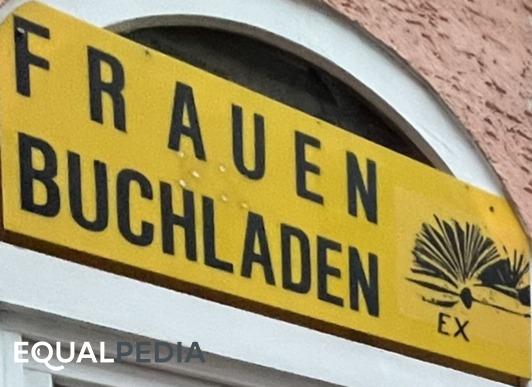
The Frauenbuchladen Frankfurt am Main (Frankfurt am Main women’s bookshop) was founded in 1976 in the circles of the undogmatic left, the Frankfurter Weiberrat and the women’s centre, and was one of the first women’s bookshops in the Federal Republic. Alongside the actual book trade, the Frauenbuchladen was also a meeting place for readings, lectures and discussions. Out of the Frankfurt Frauenbuchladen, its co-founder Ulrike Helmer established the Ulrike Helmer Verlag in 1987.
History and founding

from right to left: Beate Collin, Irmgard Schultz, (behind, with glasses) Anne Koenen, Gitti Vogel, Irmgard Stilper and Helga Kölln-Lay
Foto: Monika Müller
During the founding phase of autonomous women’s projects from the mid-1970s onwards, alongside women’s centres, health centres, feminist educational institutions and political women’s magazines, numerous women’s publishing houses, women’s book distributors and bookshops also came into being, making feminist theory-building, gender research and fiction from the new women’s movement accessible. At the same time, documents and political writings from the early women’s movement around 1900 were rediscovered and reissued.1FrauenMediaTurm (n. d.): Frauen als Gründerinnen: Frauenverlage, Zeitschriften. In: FrauenMediaTurm – Feministisches Archiv und Bibliothek. Online at: https://frauenmediaturm.de/neue-frauenbewegung/frauenzentren-emma-courage/ (accessed 20/08/2021). In the 1980s there were women’s bookshops in numerous West German cities, of which, as of 2021, only a few still exist.2Intro: “In the 1970s the autonomous women’s movement emerges in West Germany. In the course of this, numerous initiatives are founded here, for example women’s bookshops. They are intended not only to be places of encounter and education, but also to provide jobs for women. In the 1980s there is a women’s bookshop in many West German cities. By now they appear to have died out. Only a few are left, such as the Frauenbuchladen Xanthippe in Mannheim, whose co-founder Regine Elsässer speaks in the feature. The gap created by the closure of most women’s bookshops has been partly filled by FEMBooks, an online bookshop run by women* for women* and people interested in queer topics. But is that enough on its own? The founder of FEMBooks, Doreen Heide, as well as Dr Marianne Schmidbaur, academic managing director of the Cornelia Goethe Centrum für Frauenstudien und die Erforschung der Geschlechterverhältnisse in Frankfurt am Main, assess the current situation of women’s bookshops.” From: o. A. (2020): Eine eigene Buchhandlung. Ein Radiobeitrag über Frauenbuchläden. Frauenbuchläden die Dinosaurier des Feminismus? In: Audioportal Freier Radios, contribution of 12/01. Online at: https://www.freie-radios.net/99303 (accessed 20/08/2021). Nevertheless, new women’s bookshops are still being founded today, as the example of She said in Berlin shows. In September 2020 Emilia von Senger founded the bookshop in Neukölln, which stocks only works by women and queer authors.3Klein, Denise (2020): Frau hat was zu sagen. In: die tageszeitung, article of 02/03. Online at: https://taz.de/Frauenbuchhandlung-in-Berlin/!5666653/ (accessed 20/08/2021)
As one of the first feminist bookshops in Germany, the Frankfurt Frauenbuchladen opened in 1976 in the district of Bockenheim, Kiesstraße 27.4In 1975 the women’s bookshops Lillemors in Munich and Labrys in West Berlin had opened.5Sonnenberg, Uwe (2016): Von Marx zum Maulwurf: Linker Buchhandel in Westdeutschland in den 1970er Jahren. Göttingen: Wallstein Verlag, ISBN 978-3-8353-1816-8, p. 452. The founders came predominantly from student organisations such as the undogmatic left, which was particularly active in Frankfurt am Main (among others the women’s group of the undogmatic Revolutionärer Kampf (RK), the university Spontis and the Sozialistische Hochschulinitiative), the Frankfurter Weiberrat and the women’s centre.
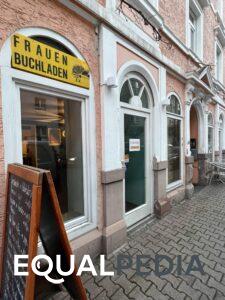
Foto: Frankfurter Archiv der Revolte
The Frankfurter Frauenbuchladen GmbH was run as a collective by ten to twelve women and developed beyond book selling into a meeting place and network for intellectual and political-feminist debates in the region. Readings, lectures and discussions with activists and authors from Europe and the USA took place in the bookshop, as did preparations for political actions. The team understood itself as part of the women’s movement and also passed on, among other things, addresses of gynaecologists and for legal advice.6Helmer, Ulrike (1988): Frauenbuchläden … in Frankfurt und anderswo. In: von Soden, Kristine (Hg.): Der große Unterschied. Die Neue Frauenbewegung und die Siebziger Jahre. Berlin: ElefantenPress, ISBN 978-3-88520-277-6, pp. 143–157.7Jung, Dörthe (2017): Wie die Frauenbewegung Frankfurt bewegte. Aufbruch und Rebellion: Die neue Frauenbewegung in Frankfurt 1968–1990. Lecture at the Deutsches Architekturmuseum Frankfurt am Main. In: Vortragsreihe “STADTplus. Die Stadt und der Feminismus” and the exhibition “Frau Architekt”, 04/10. Online at: http://www.doerthejung-consult.com/WEB/content/texte/Doerthe%20Jung%20im%20 Deutschen%20Architekturmuseum%202017.pdf (accessed 16/08/2021).8Börchers, Sabine (2016): Frauenbuchladen im Kollektiv. In: Dies. (Hg.): 101 Frauenorte in Frankfurt. Frankfurt/M.: Frankfurter Societäts-Medien GmbH, ISBN 978-3-95542-187-8, p. 59.
Differing feminist approaches, and the question – controversially discussed not only in the Frankfurt shop – of whether men should have access to the specialist bookshop or not, caused the founding collective to break apart in 1978. The opponents moved out; the supporters prevailed with the rule that male customers, and thus also supporters of the project, would be admitted to the space that was still primarily intended for women. The Karl-Marx-Buchhandlung, likewise situated in the vicinity of the Goethe University and in existence since 1970, for example refrained from carrying feminist titles in its own range in favour of the Frauenbuchladen. The comparatively close connection of the feminist bookshop project to groupings of the New Left scene in Frankfurt am Main was formative for other enterprises in the book and publishing trade in the 1970s as well.9Sonnenberg, Uwe (2010): Agitation und Aufklärung – Zur Geschichte linker Buchläden nach 1968. In: Bois, Marcel/Hüttner, Bernd (Hg.): Beiträge zur Geschichte einer pluralen Linken. Issue 2: Theorien und Bewegungen nach 1968. Berlin: Rosa-Luxemburg-Stiftung, p. 17. Online at: https://www.rosalux.de/fileadmin/rls_uploads/pdfs/rls_papers/Papers_Beitr_zur_Gesch_2.pdf (accessed 20/08/2021).10o. A. (1997): Die kleine und gutsortierte Buchmesse rund um die Universität. Die Buchläden in Bockenheim: Vom Kleinstbetrieb über Frauen- oder Ex-Linke-Buchhandlungen bis hin zum Antiquariat. In: Frankfurter Rundschau, article of 30/10., p. 22.
Organisation and budget
The founders’ collective initially understood the bookshop as an autonomous political project and only secondarily as a business. The shareholders made operations possible at first through private borrowing, loans from women and men friends, through the issuing of book vouchers and through unpaid labour.
With the expansion of the range and the growing workload and organisational effort, the bookshop women changed the operating concept at the beginning of the 1980s and set up two permanent full-time positions, which were passed on by rotation to one woman at a time for up to five years. All the others worked one day a week alongside their main occupations, above all on event organisation and networking. All decisions of the self-managed business were taken jointly in a weekly plenary.11o. A. (n. d.) Interview zum Frauenbuchladen Frankfurt mit Ulrike Helmer. In: AFAZ – Anarchistisch feministisch autonome Zeitung. Online at: http://www.anarchismus.de/afaz/afaz-nr2/frauenbula.htm (accessed 20/08/2021).
The founders were for the most part not experts from the book and publishing trade. They were students in the departments of politics, sociology, education, languages and law, and worked professionally as teachers and social scientists.
Besides the Frauenbuchladen Frankfurt am Main, in 1977 many further women’s bookshops (among others in West Berlin, Cologne, Hanover and Wiesbaden) declared to the Verlag des linken Buchhandels (VLB, publishing house of the left-wing book trade) that they were “autonomous” and would not allow themselves to be influenced in the founding and stock-building of new shops.12Zellmer, Elisabeth (2011): Töchter der Revolte? Frauenbewegung und Feminismus der 1970er Jahre in München. München: Oldenbourg, ISBN 978-3-486-70254-5. p. 199. The Frauenbuchladen supported itself throughout its entire existence and was not subsidised by public funds. In an interview Ulrike Helmer, co-founder of the Frauenbuchladen, explained: “One paradox of the Frauenbuchladen is, to this day, that financially it is carried by men, who place large orders there, e.g. for libraries, and not by its women customers. The reasons are, on the one hand, the disadvantaging of women on the labour market and their consequently lower purchasing power, and on the other hand the fact that well-earning women rarely buy at the Frauenbuchladen.”13o. A. (n. d.) Interview zum Frauenbuchladen Frankfurt mit Ulrike Helmer. In: AFAZ – Anarchistisch feministisch autonome Zeitung. Online at: http://www.anarchismus.de/afaz/afaz-nr2/frauenbula.htm (accessed 20/08/2021).
Fields of work and development of the range of books
In the bookshop’s early days only a few titles written by women were on the market in Germany; established publishers and bookshops showed hardly any interest in feminist publications at that time. The Frauenbuchladen initially offered international writings from the American, British, French, Italian and Spanish women’s movements. The first bestsellers, some of them in translation, were Elaine Morgan: Mythos vom schwachen Geschlecht, Juliet Mitchell: Frauenbewegung – Frauenbefreiung, Shulamith Firestone: Frauenbefreiung, Betty Fridan: Der Weiblichkeitswahn and Simone de Beauvoir: Das andere Geschlecht. In addition, political classics such as the writings of Rosa Luxemburg, Clara Zetkin and Friedrich Engels were sold.14Helmer, Ulrike (1988): Frauenbuchläden … in Frankfurt und anderswo. In: Von Soden, Kristine (Hg.): Der große Unterschied. Die Neue Frauenbewegung und die Siebziger Jahre. Berlin: ElefantenPress, ISBN 978-3-88520-277-6, pp. 143–157.
New publications from the women’s (self-)publishing houses were added, such as women’s yearbooks, the documentation of the Berlin women’s summer university held each year, and first findings from the emerging field of women’s studies, such as Ilse Kassner’s Trauer muß Aspasia tragen. Feminist handbooks and key literature from the women’s movement, such as Anja Meulenbelt’s Die Scham ist vorbei or Hexengeflüster, were among the programmes of Orlanda Verlag, Berlin, and of Verlag Frauenoffensive, based in Munich. For a time these titles could be obtained only through women’s bookshops.
By the 10th anniversary of the Frauenbuchladen in Frankfurt am Main, the range comprised numerous periodical titles, among them EMMA, COURAGE and the Frankfurter Frauenblatt, fiction and (auto)biographies by women, literature and fiction by and for lesbian women, non-fiction on the topics of women’s history, fascism and ethnology (on immigrant women, Natives, Romnja and Sintize, for example), texts of the new women’s movement on violence against women, sexuality, pornography and prostitution, feminist scholarship and research, feminist theories, for instance on housework, health and genetic and reproductive technologies. Further subject areas were education and parenthood, the ecology movement and also spiritual titles. Publications on women artists and on women in architecture and in film were part of the range, as were books from the men’s movement with gender-specific positions and, as before, foreign-language literature.15o. A. (1987): Selbstdarstellung. In: Brinkmann to Broxten, Eva/Fuchs, Claudia/Kiltz, Elke/Schäfer, Brigitte/Sellach, Brigitte in cooperation with WEIBH e. V. (Hg.) (1987): Ohne Netz und doppelten Boden: Frauenprojekte & Frauenpolitik in Hessen. Frankfurt/M.: Zypresse Druck, pp. 48–50.

Foto: Monika Müller
From the mid-1980s onwards, women’s literature was increasingly offered by other, non-specialised bookshops and publishers as well. Amid rising economic competition, the Frankfurt Frauenbuchladen positioned itself further as a forum for communication, discussion and events within the culture of the women’s movement.
In 1987 Ulrike Helmer, co-shareholder in the Frankfurt Frauenbuchladen from 1980 to 1992, founded the independent Ulrike Helmer Verlag in Frankfurt am Main (later Königstein/Ts., today Roßdorf near Darmstadt (as of 2021)), with the aim of making historical women authors and early feminist concepts visible above all.16The publishing programme began with the series edition klassikerinnen. One of the pioneering titles from women’s history research was Zukunft braucht Vergangenheit. Warum Geschichte uns angeht (Why History Matters. Life and Thought, German translation 2002) by the historian Gerda Lerner. From: de Andrés, Yvonne (2017): 30 Jahre Ulrike Helmer Verlag. Wie alles begann und … Interview von Yvonne de Andrés (AVIVA-Berlin) mit Ulrike Helmer. In: Website of the Ulrike Helmer Verlag. Online at: https://www.ulrike-helmer-verlag.de/2017/10/27/30-jahre-ulrike-helmer-verlag/ (accessed 20/08/2021).
After the 20th anniversary of the business under the motto Kontinuität und Risse, in 1998 the nine shareholders decided to close the Frauenbuchladen after 22 years. According to their own account, the reasons were declining turnover and a lack of women interested in taking over the business.17 o. A. (1998): Frauenbuchladen schließt. In: Frankfurter Allgemeine Zeitung, No. 77, article of 01/04., p. 50.
Founders, shareholders and staff
Ingrid Apel, Mahide Lein, Ulrike Helmer,18Helmer, Ulrike (2012): Bücher sind Klamotten fürs Hirn. Einblicke ins Buchhändlerische. Sulzbach/Ts.: Ulrike Helmer Verlag, ISBN 978-3-89741-322-1. Isabell Clasen19o. A. (1997): Die kleine und gutsortierte Buchmesse rund um die Universität. Die Buchläden in Bockenheim: Vom Kleinstbetrieb über Frauen- oder Ex-Linke-Buchhandlungen bis
hin zum Antiquariat. In: Frankfurter Rundschau, article of 30/10., p. 22.
Publications
- o. A. (1987): Selbstdarstellung. In: Brinkmann to Broxten, Eva/Fuchs, Claudia/Kiltz, Elke/Schäfer, Brigitte/Sellach, Brigitte in cooperation with WEIBH e. V. (Hg.) (1987): Ohne Netz und doppelten Boden: Frauenprojekte & Frauenpolitik in Hessen. Frankfurt/M.: Zypresse Druck, pp. 48–50.
- Helmer, Ulrike (1988): Frauenbuchläden … in Frankfurt und anderswo. In: Von Soden, Kristine (Hg.): Der große Unterschied. Die Neue Frauenbewegung und die Siebziger Jahre. Berlin: ElefantenPress, ISBN 978-3-88520-277-6, pp. 143–157.
- Strobl, Ingrid (1988): Zwischen Kürbisbrüsten und Entmannung. Bücher von Frauen für Frauen. In: Von Soden, Kristine (Hg.): Der große Unterschied. Die Neue Frauenbewegung und die Siebziger Jahre. Berlin: ElefantenPress, ISBN 978-3-88520-277-6, pp. 134–140.
- o. A. (n. d.) Interview zum Frauenbuchladen Frankfurt mit Ulrike Helmer. In: AFAZ – Anarchistisch feministisch autonome Zeitung. Online at: http://www.anarchismus.de/afaz/afaz-nr2/frauenbula.htm (accessed 20/08/2021).
Further reading
- Börchers, Sabine (2016): Frauenbuchladen im Kollektiv. In: Dies. (Hg.): 101 Frauenorte in Frankfurt. Frankfurt/M.: Frankfurter Societäts-Medien GmbH, ISBN 978-3-95542-187-8, pp. 58–59.
- FrauenMediaTurm (n. d.): Frauen als Gründerinnen: Frauenverlage, Zeitschriften. In: FrauenMediaTurm – Feministisches Archiv und Bibliothek. Online at: https://frauenmediaturm.de/neue-frauenbewegung/frauenzentren-emma-courage/ (accessed 20/08/2021).
- Hermanns, Doris (2021): Verlegerinnen unabhängiger Verlage: Ulrike Helmer. In: BücherFrauen Blog, interview of 26/01. Online at: https://blog.buecherfrauen.de/verlegerinnen-unabhaengiger-verlage-ulrike-helmer/ (accessed 16/11/2021).
- Zellmer, Elisabeth (2011): Töchter der Revolte? Frauenbewegung und Feminismus der 1970er Jahre in München. München: Oldenbourg, ISBN 978-3-486-70254-5.
Machine translation: This article was translated automatically from the German original.
- 1FrauenMediaTurm (n. d.): Frauen als Gründerinnen: Frauenverlage, Zeitschriften. In: FrauenMediaTurm – Feministisches Archiv und Bibliothek. Online at: https://frauenmediaturm.de/neue-frauenbewegung/frauenzentren-emma-courage/ (accessed 20/08/2021). ↩︎
- 2Intro: “In the 1970s the autonomous women’s movement emerges in West Germany. In the course of this, numerous initiatives are founded here, for example women’s bookshops. They are intended not only to be places of encounter and education, but also to provide jobs for women. In the 1980s there is a women’s bookshop in many West German cities. By now they appear to have died out. Only a few are left, such as the Frauenbuchladen Xanthippe in Mannheim, whose co-founder Regine Elsässer speaks in the feature. The gap created by the closure of most women’s bookshops has been partly filled by FEMBooks, an online bookshop run by women* for women* and people interested in queer topics. But is that enough on its own? The founder of FEMBooks, Doreen Heide, as well as Dr Marianne Schmidbaur, academic managing director of the Cornelia Goethe Centrum für Frauenstudien und die Erforschung der Geschlechterverhältnisse in Frankfurt am Main, assess the current situation of women’s bookshops.” From: o. A. (2020): Eine eigene Buchhandlung. Ein Radiobeitrag über Frauenbuchläden. Frauenbuchläden die Dinosaurier des Feminismus? In: Audioportal Freier Radios, contribution of 12/01. Online at: https://www.freie-radios.net/99303 (accessed 20/08/2021). ↩︎
- 3Klein, Denise (2020): Frau hat was zu sagen. In: die tageszeitung, article of 02/03. Online at: https://taz.de/Frauenbuchhandlung-in-Berlin/!5666653/ (accessed 20/08/2021) ↩︎
- 4In 1975 the women’s bookshops Lillemors in Munich and Labrys in West Berlin had opened. ↩︎
- 5Sonnenberg, Uwe (2016): Von Marx zum Maulwurf: Linker Buchhandel in Westdeutschland in den 1970er Jahren. Göttingen: Wallstein Verlag, ISBN 978-3-8353-1816-8, p. 452. ↩︎
- 6Helmer, Ulrike (1988): Frauenbuchläden … in Frankfurt und anderswo. In: von Soden, Kristine (Hg.): Der große Unterschied. Die Neue Frauenbewegung und die Siebziger Jahre. Berlin: ElefantenPress, ISBN 978-3-88520-277-6, pp. 143–157. ↩︎
- 7Jung, Dörthe (2017): Wie die Frauenbewegung Frankfurt bewegte. Aufbruch und Rebellion: Die neue Frauenbewegung in Frankfurt 1968–1990. Lecture at the Deutsches Architekturmuseum Frankfurt am Main. In: Vortragsreihe “STADTplus. Die Stadt und der Feminismus” and the exhibition “Frau Architekt”, 04/10. Online at: http://www.doerthejung-consult.com/WEB/content/texte/Doerthe%20Jung%20im%20 Deutschen%20Architekturmuseum%202017.pdf (accessed 16/08/2021). ↩︎
- 8Börchers, Sabine (2016): Frauenbuchladen im Kollektiv. In: Dies. (Hg.): 101 Frauenorte in Frankfurt. Frankfurt/M.: Frankfurter Societäts-Medien GmbH, ISBN 978-3-95542-187-8, p. 59. ↩︎
- 9Sonnenberg, Uwe (2010): Agitation und Aufklärung – Zur Geschichte linker Buchläden nach 1968. In: Bois, Marcel/Hüttner, Bernd (Hg.): Beiträge zur Geschichte einer pluralen Linken. Issue 2: Theorien und Bewegungen nach 1968. Berlin: Rosa-Luxemburg-Stiftung, p. 17. Online at: https://www.rosalux.de/fileadmin/rls_uploads/pdfs/rls_papers/Papers_Beitr_zur_Gesch_2.pdf (accessed 20/08/2021). ↩︎
- 10o. A. (1997): Die kleine und gutsortierte Buchmesse rund um die Universität. Die Buchläden in Bockenheim: Vom Kleinstbetrieb über Frauen- oder Ex-Linke-Buchhandlungen bis hin zum Antiquariat. In: Frankfurter Rundschau, article of 30/10., p. 22. ↩︎
- 11o. A. (n. d.) Interview zum Frauenbuchladen Frankfurt mit Ulrike Helmer. In: AFAZ – Anarchistisch feministisch autonome Zeitung. Online at: http://www.anarchismus.de/afaz/afaz-nr2/frauenbula.htm (accessed 20/08/2021). ↩︎
- 12Zellmer, Elisabeth (2011): Töchter der Revolte? Frauenbewegung und Feminismus der 1970er Jahre in München. München: Oldenbourg, ISBN 978-3-486-70254-5. p. 199. ↩︎
- 13o. A. (n. d.) Interview zum Frauenbuchladen Frankfurt mit Ulrike Helmer. In: AFAZ – Anarchistisch feministisch autonome Zeitung. Online at: http://www.anarchismus.de/afaz/afaz-nr2/frauenbula.htm (accessed 20/08/2021). ↩︎
- 14Helmer, Ulrike (1988): Frauenbuchläden … in Frankfurt und anderswo. In: Von Soden, Kristine (Hg.): Der große Unterschied. Die Neue Frauenbewegung und die Siebziger Jahre. Berlin: ElefantenPress, ISBN 978-3-88520-277-6, pp. 143–157. ↩︎
- 15o. A. (1987): Selbstdarstellung. In: Brinkmann to Broxten, Eva/Fuchs, Claudia/Kiltz, Elke/Schäfer, Brigitte/Sellach, Brigitte in cooperation with WEIBH e. V. (Hg.) (1987): Ohne Netz und doppelten Boden: Frauenprojekte & Frauenpolitik in Hessen. Frankfurt/M.: Zypresse Druck, pp. 48–50. ↩︎
- 16The publishing programme began with the series edition klassikerinnen. One of the pioneering titles from women’s history research was Zukunft braucht Vergangenheit. Warum Geschichte uns angeht (Why History Matters. Life and Thought, German translation 2002) by the historian Gerda Lerner. From: de Andrés, Yvonne (2017): 30 Jahre Ulrike Helmer Verlag. Wie alles begann und … Interview von Yvonne de Andrés (AVIVA-Berlin) mit Ulrike Helmer. In: Website of the Ulrike Helmer Verlag. Online at: https://www.ulrike-helmer-verlag.de/2017/10/27/30-jahre-ulrike-helmer-verlag/ (accessed 20/08/2021). ↩︎
- 17o. A. (1998): Frauenbuchladen schließt. In: Frankfurter Allgemeine Zeitung, No. 77, article of 01/04., p. 50. ↩︎
- 18Helmer, Ulrike (2012): Bücher sind Klamotten fürs Hirn. Einblicke ins Buchhändlerische. Sulzbach/Ts.: Ulrike Helmer Verlag, ISBN 978-3-89741-322-1. ↩︎
- 19o. A. (1997): Die kleine und gutsortierte Buchmesse rund um die Universität. Die Buchläden in Bockenheim: Vom Kleinstbetrieb über Frauen- oder Ex-Linke-Buchhandlungen bis
hin zum Antiquariat. In: Frankfurter Rundschau, article of 30/10., p. 22. ↩︎