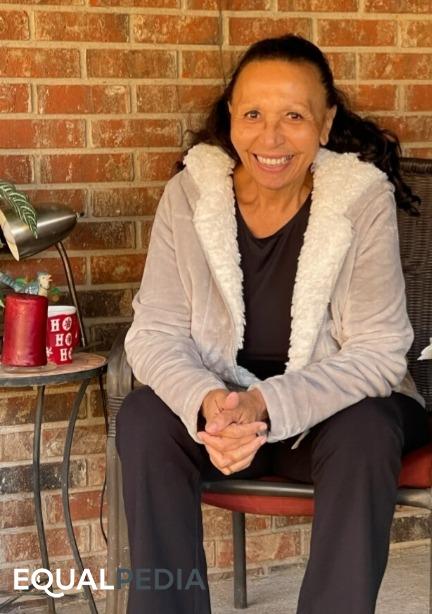
Helga Emde (born March 1946 in Bingen am Rhein) is a Black German political activist, psychologist, child therapist and co-founder of the anti-racist Initiative Schwarze Menschen in Deutschland (ISD; Initiative of Black People in Germany).1Emde, Helga (2015): Brücken. In: Kraft, Marion (ed.): Kinder der Befreiung. Transatlantische Erfahrungen und Perspektiven Schwarzer Deutscher der Nachkriegsgeneration. Münster: Unrast Verlag, ISBN 978-3-89771-592-9, pp. 168–181, here p. 168.
Career
Helga Emde was born in Bingen am Rhein in March 1946. Her mother was a white German, her father an African American soldier with whom she was never able to make contact.2Emde, Helga (1986/2020): Als »Besatzungskind« im Nachkriegsdeutschland. In: Ayim, May/Oguntoye, Katharina/Schultz, Dagmar (eds.): Farbe bekennen. Afro-deutsche Frauen auf den Spuren ihrer Geschichte. Berlin: Orlanda Frauenverlag, ISBN 978-3-922166-20-4, pp. 143–156, here p. 143. Emde has a white sister. Her childhood and youth were marked by frequent moves and changes of school. As a so-called “Besatzungskind” (“occupation child”), Emde was repeatedly confronted with prejudice, racism and exclusion; her mother, too, was socially isolated and discriminated against.3More on the history of the “Besatzungskinder”: Kraft, Marion (ed.): Kinder der Befreiung. Transatlantische Erfahrungen und Perspektiven Schwarzer Deutscher der Nachkriegsgeneration. Münster: Unrast Verlag, ISBN 978-3-89771-592-9; Roos, Julia (2022): Die „farbigen Besatzungskinder“ der zwei Weltkriege. In: Aus Politik und Zeitgeschichte, 72(12): Schwarz und Deutsch, pp. 11–18. Available online at: https://www.bpb.de/system/files/dokument_pdf/APuZ_2022-12_online.pdf (accessed on 11 March 2025); Siek, Stephanie (2009): Germany’s ‚Brown Babies‘. The Difficult Identities of Post-War Black Children of GIs. In: Spiegel, article of 13 October. Available online at: https://www.spiegel.de/international/germany/germany-s-brown-babies-the-difficult-identities-of-post-war-black-children-of-gis-a-651989.html (accessed on 11 March 2025).
After elementary school in Wiesbaden and Bad Schwalbach in the Taunus, Emde was a home economics pupil at a Catholic children’s home in Wiesbaden and, at the age of 18, began training as a nurse, also in Wiesbaden, at a hospital run by Catholic nuns.
Emde had a son with her first partner, a Black soldier. At 23 she married a white man; her second son was born a year and a half later. When her two children were still small, Emde felt trapped in her role as mother and housewife and longed for education. Her family and her circle of friends and acquaintances met this with incomprehension. She received no support for it. Nevertheless, she prepared for a so-called “Begabten-Sonderabitur” (a special university entrance examination for gifted adults without a regular school-leaving certificate) and, on that basis, studied education at the Johann Wolfgang Goethe University in Frankfurt am Main.4Emde, Helga (1986/2020): Als »Besatzungskind« im Nachkriegsdeutschland. In: Ayim, May/Oguntoye, Katharina/Schultz, Dagmar (eds.): Farbe bekennen. Afro-deutsche Frauen auf den Spuren ihrer Geschichte. Berlin: Orlanda Frauenverlag, ISBN 978-3-922166-20-4, pp. 143–156, here p. 149. 5Emde, Helga (2015): Brücken. In: Kraft, Marion (ed.): Kinder der Befreiung. Transatlantische Erfahrungen und Perspektiven Schwarzer Deutscher der Nachkriegsgeneration. Münster: Unrast Verlag, ISBN 978-3-89771-592-9, pp. 168–181, here p. 171.
Since Emde knew no other Black people in her surroundings, she felt largely isolated. The racism she experienced at the same time in the 1970s, for example when looking for an apartment, together with this isolation, left her with an inner restlessness that strongly fuelled her desire to travel. In 1983 she travelled to Zimbabwe for the first time; two further trips there were to follow, as well as trips to Tunisia and Egypt.6Emde, Helga (1986/2020): Als »Besatzungskind« im Nachkriegsdeutschland. In: Ayim, May/Oguntoye, Katharina/Schultz, Dagmar (eds.): Farbe bekennen. Afro-deutsche Frauen auf den Spuren ihrer Geschichte. Berlin: Orlanda Frauenverlag, ISBN 978-3-922166-20-4, pp. 143–156, here p. 151. In Frankfurt am Main, Emde founded an exchange programme for young people from Frankfurt and Ghana, which was supported by the umbrella organisation of the Evangelical Church in Germany.
Emde completed her studies with a Diplom degree and additionally completed a master’s programme in Education and Counseling for the USA. After graduating, she worked with international young people in Frankfurt am Main.7Emde, Helga (2015): Brücken. In: Kraft, Marion (ed.): Kinder der Befreiung. Transatlantische Erfahrungen und Perspektiven Schwarzer Deutscher der Nachkriegsgeneration. Münster: Unrast Verlag, ISBN 978-3-89771-592-9, pp. 168–181, here p. 168 ff.
In the late 1980s/early 1990s, Emde published a number of poems in which she processed her experiences.8Kron, Stefanie (n.d.): Afrikanische Diaspora und Literatur Schwarzer Frauen in Deutschland. In: Heinrich Böll Stiftung, Heimatkunde, Migrationspolitisches Portal. Available online at: https://heimatkunde.boell.de/de/2009/02/18/afrikanische-diaspora-und-literatur-schwarzer-frauen-deutschland (accessed on 7 March 2025). In her texts she “bears impressive witness to the Afro-German ‘longing for a Black family’, shaped by experiences of isolation and white heteronomy and by exclusion, and to the genesis of an Afro-German virulence collective”.9Klug, Nina-Maria (2021): (Afro)Deutschsein. Eine linguistische Analyse der multimodalen Konstruktion von Identität. Berlin: De Gruyter, ISBN 978-3-11-072727-2, p. 386. In “Der Tanz” (“The Dance”), however, Emde also criticises “feminist notions of solidarity that are based on a narcissistic desire for the self in the other. In the process, alterity, differences and foreignness are not permitted or are colonised in the form of assimilation”.10Mertlitsch, Kirstin (2016): Sisters – Cyborgs – Drags: Das Denken in Begriffspersonen der Gender Studies. Berlin: transcript, ISBN 978-3-8376-3349-8, p. 66.
Women’s movement and Black movement in Germany
In 1984, through her work at the Evangelischer Regionalverband (Protestant Regional Association) in Frankfurt am Main, Emde took part in a conference on racism in Tutzing near Munich. There, first contacts were made with the “Programme to Combat Racism” (PCR) of the World Council of Churches in Geneva, which made Emde its contact person for Black Germans.11Parbey, Cecilia (2021): Helga Emde: „Zukunft heißt für mich, eindeutig, klar und kompromisslos Stellung zu beziehen.“ SPECIAL: 5 Fragen an 5 Frauen über 50: Helga Emde. In: RosaMag, post of 1 July. Available online at: https://rosa-mag.de/helga-emde-zukunft-heisst-fuer-mich-eindeutig-klar-und-kompromisslos-stellung-zu-beziehen/ (accessed on 6 March 2025). Emde was commissioned by the “Programme to Combat Racism” to put together a group of her own with an anti-racist programme. Its members – besides Emde, Eleonore Wiedenroth-Coulibaly, Marie-Theres Aden, Austen Brand and Flois Knolle-Hicks – were themselves trained as anti-racism trainers by international trainers in order to work with white participants in workshops and seminars.12Emde, Helga (2015): Brücken. In: Kraft, Marion (ed.): Kinder der Befreiung. Transatlantische Erfahrungen und Perspektiven Schwarzer Deutscher der Nachkriegsgeneration. Münster: Unrast Verlag, ISBN 978-3-89771-592-9, pp. 168–181, here p. 172. 13Parbey, Cecilia (2021): Helga Emde: „Zukunft heißt für mich, eindeutig, klar und kompromisslos Stellung zu beziehen.“ SPECIAL: 5 Fragen an 5 Frauen über 50: Helga Emde. In: RosaMag, post of 1 July. Available online at: https://rosa-mag.de/helga-emde-zukunft-heisst-fuer-mich-eindeutig-klar-und-kompromisslos-stellung-zu-beziehen/ (accessed on 6 March 2025). It was also through the World Council of Churches that Emde met the African American academic and activist Jean Sindab (1944–1996). Sindab was the first coordinator of the World Council of Churches programme Women Under Racism (WUR) and campaigned throughout her life for ecological and social justice and against racism.14Ohene-Nyako, Pamela (2019): Black Women’s Transnational Activism and the World Council of Churches. In: Open Cultural Studies, 3, pp. 219–231. Available online at: https://www.researchgate.net/publication/333316189_Black_Women’s_Transnational_Activism_and_the_World_Council_of_Churches (accessed on 29 April 2025).
In 1985, Emde was interviewed by Christel Priemer for a documentary about Black Germans. She hoped that it would help her make contact with other Black Germans. After the documentary, calls were made via radio, television and newspapers. Together with Eleonore Wiedenroth-Coulibaly and other fellow campaigners, including Christiana Ampedu and the Wiesbaden pastor Sunny Panitz, Emde organised private meetings in Wiesbaden, Frankfurt and Mainz and thus became a co-founder of the Initiative Schwarze Menschen.15Adomako, Abenaa Agyeiwaa/Eding, Jasmin (2021): Siraad Wiedenroth & Eleonore Wiedenroth-Coulibaly (Tochter & Mutter) / 80er Schwarze Bewegung. In: YouTube, video of 23 October. Available online at: https://www.youtube.com/watch?v=6os6EOnEC8o (accessed on 16 October 2022). 16Gutiérrez Rodríguez, Encarnación (2021): Laudatio von Prof. Dr. Encarnación Gutiérrez Rodríguez auf Eleonore Wiedenroth-Coulibaly. In: Frauenreferat der Stadt Frankfurt am Main: Tony Sender Preis 2021. Dokumentation. Available online at: https://frankfurt.de/-/media/frankfurtde/service-und-rathaus/verwaltung/aemter-und-institutionen/frauenreferat/pdf/tony-sender-preis-dokumentationen/2021-eleonore-wiedenroth-coulibaly.pdf (accessed on 7 March 2025). Around 100 people took part in the first meeting in Wiesbaden.17Strübbe, Ella (2024): Pionierin – Katharina Oguntoye. In: Veto Magazin, article of 22 April. Available online at: https://veto-mag.de/katharina-oguntoye/ (accessed on 7 March 2025). Vera Holzer also took part in the meetings in Wiesbaden; she built up the library of the Initiative Schwarze Menschen in Deutschland.18In conversation with Helga Emde on 29 April 2025. After various regional gatherings, a nationwide meeting was decided upon. The initiative was “a small, strong movement with the will to change”, according to Emde.19Emde, Helga (2015): Brücken. In: Kraft, Marion (ed.): Kinder der Befreiung. Transatlantische Erfahrungen und Perspektiven Schwarzer Deutscher der Nachkriegsgeneration. Münster: Unrast Verlag, ISBN 978-3-89771-592-9, pp. 168–181, here p. 173. They campaigned, for example, against racist language and for positive images in books, school materials, etc.
This anti-racism work also gave rise to interest groups of mothers of Black (adopted or biological) children. As a result of social isolation and experiences of discrimination, Black children were frequently affected by psychosocial and psychological disorders and illnesses, such as early childhood depression, speech disorders (from stuttering to refusal to speak) and self-harm (in the form of rubbing their skin raw). These initiatives enabled the mothers and children to support one another, so that they did not have to fight prejudice and racism in isolation.20Emde, Helga (2015): Brücken. In: Kraft, Marion (ed.): Kinder der Befreiung. Transatlantische Erfahrungen und Perspektiven Schwarzer Deutscher der Nachkriegsgeneration. Münster: Unrast Verlag, ISBN 978-3-89771-592-9, pp. 168–181, here p. 174. Later, Emde worked for the Amt für Multikulturelle Angelegenheiten (Office for Multicultural Affairs) of the City of Frankfurt as a mediator for parents of Black adopted children.21Emde, Helga (2015): Brücken. In: Kraft, Marion (ed.): Kinder der Befreiung. Transatlantische Erfahrungen und Perspektiven Schwarzer Deutscher der Nachkriegsgeneration. Münster: Unrast Verlag, ISBN 978-3-89771-592-9, pp. 168–181, here p. 174 f.
At the same time as the ISD Rhine-Main group, May Ayim, Dagmar Schultz, Katharina Oguntoye and other women in Berlin were inspired by the Caribbean American feminist theorist, poet and activist Audre Lorde to found ADEFRA – Schwarze Frauen in Deutschland (Black Women in Germany).22ADEFRA (n.d.): Welcome. In: Webseite von Adefra. Available online at: http://www.adefra.com/index.php (accessed on 16 October 2022). In 1986, the book Farbe bekennen. Afro-deutsche Frauen auf den Spuren ihrer Geschichte (published in English as “Showing Our Colors: Afro-German Women Speak Out”) by Ayim, Schultz and Oguntoye was published; today it is a classic of the Afro-German movement, and Helga Emde is also represented in it with a contribution.23Emde, Helga (1986/2020): Als »Besatzungskind« im Nachkriegsdeutschland. In: Ayim, May/Oguntoye, Katharina/Schultz, Dagmar (eds.): Farbe bekennen. Afro-deutsche Frauen auf den Spuren ihrer Geschichte. Berlin: Orlanda Frauenverlag, ISBN 978-3-922166-20-4, pp. 143–156. Protagonists of Black German feminism such as May Ayim or Katharina Oguntoye, but also Helga Emde and Ika Hügel-Marshall, drew on their experiences with the new women’s movement and expanded its knowledge and practices by addressing racism and antisemitism.24Florvil, Tiffany N./Speit, Sina (2021): Intellektuelle des Alltags. Die afro-deutsche Frauenbewegung – ein Gespräch. In: Geschichte der Gegenwart, conversation of 18 July. Available online at: https://geschichtedergegenwart.ch/intellektuelle-des-alltags-die-afro-deutsche-frauenbewegung-ein-gespraech/ (accessed on 7 March 2025). “They built and sustained a modern diaspora movement that emphasised their different identities while at the same time enabling them to confront discrimination and to resist their exclusion as well as their othering, or being made into others, within the two German states.”25Florvil, Tiffany N. (2023): Black Germany. Schwarz, deutsch, feministisch – die Geschichte einer Bewegung. Berlin: Ch. Links Verlag, ISBN 978-3-96289-176-3, p. 18.
Emde herself describes this time as follows:
“Developing a community was not easy for us. After all, we had internalised living in isolation, not being seen, being invisible, not attracting attention. Early on we learned to look past each other, to avoid eye contact, to knowingly avoid one another in order to escape a double visibility. That is why it was important for us to move together from invisibility into visibility. It was desirable to demonstrate that we were equal or better, that we knew more about German history than many others. We were concerned not only with recognition and acceptance by white society, but also with our identity and our cohesion.”26Emde, Helga (2015): Brücken. In: Kraft, Marion (ed.): Kinder der Befreiung. Transatlantische Erfahrungen und Perspektiven Schwarzer Deutscher der Nachkriegsgeneration. Münster: Unrast Verlag, ISBN 978-3-89771-592-9, pp. 168–181, here p. 174 f.
Emde was also active at the international level. In 1988, for example, she took part with Marion Kraft in the 3rd International Feminist Book Fair in Montreal.27Ohene-Nyako, Pamela (2019): Black Women’s Transnational Activism and the World Council of Churches. In: Open Cultural Studies, 3, pp. 219–231, here p. 225. Available online at: https://www.researchgate.net/publication/333316189_Black_Women’s_Transnational_Activism_and_the_World_Council_of_Churches (accessed on 29 April 2025). In a letter to Jean Sindab, Emde wrote about the significance of this international exchange:
“[The 3rd International book fair] was a very important event for us Black German women, because we could establish contacts to women from all parts of the world, exchange experiences, information and ideas and convey a sense of the particularities of our lives in Germany to our Black sisters from other countries … we think it very important to continue the exchange of experiences and ideas with Black women from other parts of the world and to set forth the dialogue with our Black sisters who are leading different social and political struggles.” 28WCCArch 4223.7.18 Letter from Helga Emde to Jean Sindab, February 7, 1989 (quoted from: Ohene-Nyako, Pamela (2019): Black Women’s Transnational Activism and the World Council of Churches. In: Open Cultural Studies, 3, pp. 219–231, here p. 225. Available online at: https://www.researchgate.net/publication/333316189_Black_Women’s_Transnational_Activism_and_the_World_Council_of_Churches (accessed on 29 April 2025).).
In 1989, Emde took part with other Black German women in the “International Cross-Cultural Black Women’s Studies Summer Institute” in Zimbabwe. The next meeting was to take place in Germany: as co-director of the institute in Germany, Emde organised the fifth Summer Institute on the theme “Schwarze Menschen und die Europäische Gemeinschaft” (“Black People and the European Community”) in Frankfurt am Main. The first week of the event was supported by the Women’s Department of the City of Frankfurt and opened by the then Women’s Commissioner Margarethe Nimsch. The second week was coordinated by Marion Kraft in Bielefeld, the third week in Berlin by Katharina Oguntoye.29Florvil, Tiffany N. (2017): Transnational feminist solidarity, Black German women and the politics of belonging. In: Falola, Toyin/Yacob-Haliso, Olajumoke (eds.): Gendering Knowledge in Africa and the African Diaspora. Contesting History and Power. London/New York: Routledge, ISBN 978-1-138-03770-0, pp. 87–110, here p. 93.
In May 1990, Emde took part in the preliminary talks of the World Council of Churches programme “Women Under Racism” in Paris and Chantilly and gave a lecture there on the struggles of Black women in Germany, in which she drew attention to everyday racism, sexism, isolation and marginalisation and emphasised how important international networking and exchange were.30Ohene-Nyako, Pamela (2019): Black Women’s Transnational Activism and the World Council of Churches. In: Open Cultural Studies, 3, pp. 219–231, here p. 225. Available online at: https://www.researchgate.net/publication/333316189_Black_Women’s_Transnational_Activism_and_the_World_Council_of_Churches (accessed on 29 April 2025).
In October 1992, Emde, together with Jean Sindab among others, took part in the second worldwide WUR meeting in Port of Spain/Trinidad and Tobago. There the global network SISTER (Sisters in Struggle to Eliminate Racism) was founded, which made it its task to fight the triple oppression of women through racism, sexism and classism.31Ohene-Nyako, Pamela (2019): Black Women’s Transnational Activism and the World Council of Churches. In: Open Cultural Studies, 3, pp. 219–231, here p. 228. Available online at: https://www.researchgate.net/publication/333316189_Black_Women’s_Transnational_Activism_and_the_World_Council_of_Churches (accessed on 29 April 2025).
Emde’s statements in the letter quoted above and her participation in international meetings illustrate how much Afro-German women at that time were searching for transnational spaces that offered encounters, awareness, networks and self-reflection and built a Black global sisterhood.
When a massive wave of right-wing violence and racist attacks occurred in the late 1980s/early 1990s, Emde no longer felt safe and left Germany in 1992. She moved to the USA and worked as a medical social worker in Brooklyn, New York, from 1992 to 1997.32Kraft, Marion (2015): Autorinnen und Autoren. In: Id. (ed.): Kinder der Befreiung. Transatlantische Erfahrungen und Perspektiven Schwarzer Deutscher der Nachkriegsgeneration. Münster: Unrast Verlag, ISBN 978-3-89771-592-9, pp. 364–369, p. 364 f. In the USA, she contributed an essay to Leroy Hopkins’ publication Who is a German? Historical and Modern Perspectives on Africans in Germany.33Emde, Helga (1999): I too am German – An Afro-German Perspective. In: Hopkins, Leroy (ed.): Who is a German? Historical and Modern Perspectives on Africans in Germany. Washington, DC: American Institute for Contemporary German Studies, Harry & Helen Gray Humanities Program Series Volume 5, pp. 33–42. Available online at: https://aicgs.org/wp-content/uploads/2011/11/hopkins.pdf (accessed on 29 April 2025). After two more years in Germany, Emde emigrated in 1999 to the Caribbean island of St. Croix (U.S. Virgin Islands), where until 2020 she worked as a child therapist for the local non-profit organisation Women’s Coalition with children and young people who had become victims of domestic and sexualised violence.34Kraft, Marion (2015): Autorinnen und Autoren. In: Id. (ed.): Kinder der Befreiung. Transatlantische Erfahrungen und Perspektiven Schwarzer Deutscher der Nachkriegsgeneration. Münster: Unrast Verlag, ISBN 978-3-89771-592-9, pp. 364–369, p. 364 f.
Until the latter’s death in 2019, Emde lived together on St. Croix with her partner, the writer, activist and educator Gloria Joseph.35Simmons, Aishah Shahidah (2014): Feminists We Love: Gloria I. Joseph, Ph.D. In: The Feminist Wire, article of 28 February. Available online at: https://thefeministwire.com/2014/02/feminists-love-gloria-joseph-ph-d/ (accessed on 29 April 2025).
Today Emde has found her spirituality and is a Reiki master and teacher,36Kraft, Marion (2015): Autorinnen und Autoren. In: Id. (ed.): Kinder der Befreiung. Transatlantische Erfahrungen und Perspektiven Schwarzer Deutscher der Nachkriegsgeneration. Münster: Unrast Verlag, ISBN 978-3-89771-592-9, pp. 364–369, p. 364 f. as well as a “Dream Coach” and an active member of the Council of Elders on St. Croix, which is used for conflict resolution based on an African concept. She also leads a “Healing Circle” for the community on St. Croix. Emde found members of her Black family in Georgia, USA.37In conversation with Helga Emde on 29 April 2025.
Publications (selection)
- Emde, Helga (1986/2020): Als »Besatzungskind« im Nachkriegsdeutschland. In: Ayim, May/Oguntoye, Katharina/Schultz, Dagmar (eds.): Farbe bekennen. Afro-deutsche Frauen auf den Spuren ihrer Geschichte. Berlin: Orlanda Frauenverlag, ISBN 978-3-922166-20-4, pp. 143–156.
- Emde, Helga (1988): Gefunden. In: afrolook, 2, p. 11.
- Emde, Helga (1988): Der Tanz. In: beiträge zur feministischen theorie und praxis, 11(23), p. 148.
- Emde, Helga (1990): Veränderungen. In: beiträge zur feministischen theorie und praxis, 13(27), p. 58.
- Emde, Helga (1999): I too am German – An Afro-German Perspective. In: Hopkins, Leroy (ed.): Who is a German? Historical and Modern Perspectives on Africans in Germany. Washington, DC: American Institute for Contemporary German Studies, Harry & Helen Gray Humanities Program Series Volume 5, pp. 33–42. Available online at: https://aicgs.org/wp-content/uploads/2011/11/hopkins.pdf (accessed on 29 April 2025).
- Emde, Helga (2015): Brücken. In: Kraft, Marion (ed.): Kinder der Befreiung. Transatlantische Erfahrungen und Perspektiven Schwarzer Deutscher der Nachkriegsgeneration. Münster: Unrast Verlag, ISBN 978-3-89771-592-9, pp. 168–181.
Machine translation: This article was translated automatically from the German original.
- 1Emde, Helga (2015): Brücken. In: Kraft, Marion (ed.): Kinder der Befreiung. Transatlantische Erfahrungen und Perspektiven Schwarzer Deutscher der Nachkriegsgeneration. Münster: Unrast Verlag, ISBN 978-3-89771-592-9, pp. 168–181, here p. 168. ↩︎
- 2Emde, Helga (1986/2020): Als »Besatzungskind« im Nachkriegsdeutschland. In: Ayim, May/Oguntoye, Katharina/Schultz, Dagmar (eds.): Farbe bekennen. Afro-deutsche Frauen auf den Spuren ihrer Geschichte. Berlin: Orlanda Frauenverlag, ISBN 978-3-922166-20-4, pp. 143–156, here p. 143. ↩︎
- 3More on the history of the “Besatzungskinder”: Kraft, Marion (ed.): Kinder der Befreiung. Transatlantische Erfahrungen und Perspektiven Schwarzer Deutscher der Nachkriegsgeneration. Münster: Unrast Verlag, ISBN 978-3-89771-592-9; Roos, Julia (2022): Die „farbigen Besatzungskinder“ der zwei Weltkriege. In: Aus Politik und Zeitgeschichte, 72(12): Schwarz und Deutsch, pp. 11–18. Available online at: https://www.bpb.de/system/files/dokument_pdf/APuZ_2022-12_online.pdf (accessed on 11 March 2025); Siek, Stephanie (2009): Germany’s ‚Brown Babies‘. The Difficult Identities of Post-War Black Children of GIs. In: Spiegel, article of 13 October. Available online at: https://www.spiegel.de/international/germany/germany-s-brown-babies-the-difficult-identities-of-post-war-black-children-of-gis-a-651989.html (accessed on 11 March 2025). ↩︎
- 4Emde, Helga (1986/2020): Als »Besatzungskind« im Nachkriegsdeutschland. In: Ayim, May/Oguntoye, Katharina/Schultz, Dagmar (eds.): Farbe bekennen. Afro-deutsche Frauen auf den Spuren ihrer Geschichte. Berlin: Orlanda Frauenverlag, ISBN 978-3-922166-20-4, pp. 143–156, here p. 149. ↩︎
- 5Emde, Helga (2015): Brücken. In: Kraft, Marion (ed.): Kinder der Befreiung. Transatlantische Erfahrungen und Perspektiven Schwarzer Deutscher der Nachkriegsgeneration. Münster: Unrast Verlag, ISBN 978-3-89771-592-9, pp. 168–181, here p. 171. ↩︎
- 6Emde, Helga (1986/2020): Als »Besatzungskind« im Nachkriegsdeutschland. In: Ayim, May/Oguntoye, Katharina/Schultz, Dagmar (eds.): Farbe bekennen. Afro-deutsche Frauen auf den Spuren ihrer Geschichte. Berlin: Orlanda Frauenverlag, ISBN 978-3-922166-20-4, pp. 143–156, here p. 151. ↩︎
- 7Emde, Helga (2015): Brücken. In: Kraft, Marion (ed.): Kinder der Befreiung. Transatlantische Erfahrungen und Perspektiven Schwarzer Deutscher der Nachkriegsgeneration. Münster: Unrast Verlag, ISBN 978-3-89771-592-9, pp. 168–181, here p. 168 ff. ↩︎
- 8Kron, Stefanie (n.d.): Afrikanische Diaspora und Literatur Schwarzer Frauen in Deutschland. In: Heinrich Böll Stiftung, Heimatkunde, Migrationspolitisches Portal. Available online at: https://heimatkunde.boell.de/de/2009/02/18/afrikanische-diaspora-und-literatur-schwarzer-frauen-deutschland (accessed on 7 March 2025). ↩︎
- 9Klug, Nina-Maria (2021): (Afro)Deutschsein. Eine linguistische Analyse der multimodalen Konstruktion von Identität. Berlin: De Gruyter, ISBN 978-3-11-072727-2, p. 386. ↩︎
- 10Mertlitsch, Kirstin (2016): Sisters – Cyborgs – Drags: Das Denken in Begriffspersonen der Gender Studies. Berlin: transcript, ISBN 978-3-8376-3349-8, p. 66. ↩︎
- 11Parbey, Cecilia (2021): Helga Emde: „Zukunft heißt für mich, eindeutig, klar und kompromisslos Stellung zu beziehen.“ SPECIAL: 5 Fragen an 5 Frauen über 50: Helga Emde. In: RosaMag, post of 1 July. Available online at: https://rosa-mag.de/helga-emde-zukunft-heisst-fuer-mich-eindeutig-klar-und-kompromisslos-stellung-zu-beziehen/ (accessed on 6 March 2025). ↩︎
- 12Emde, Helga (2015): Brücken. In: Kraft, Marion (ed.): Kinder der Befreiung. Transatlantische Erfahrungen und Perspektiven Schwarzer Deutscher der Nachkriegsgeneration. Münster: Unrast Verlag, ISBN 978-3-89771-592-9, pp. 168–181, here p. 172. ↩︎
- 13Parbey, Cecilia (2021): Helga Emde: „Zukunft heißt für mich, eindeutig, klar und kompromisslos Stellung zu beziehen.“ SPECIAL: 5 Fragen an 5 Frauen über 50: Helga Emde. In: RosaMag, post of 1 July. Available online at: https://rosa-mag.de/helga-emde-zukunft-heisst-fuer-mich-eindeutig-klar-und-kompromisslos-stellung-zu-beziehen/ (accessed on 6 March 2025). ↩︎
- 14Ohene-Nyako, Pamela (2019): Black Women’s Transnational Activism and the World Council of Churches. In: Open Cultural Studies, 3, pp. 219–231. Available online at: https://www.researchgate.net/publication/333316189_Black_Women’s_Transnational_Activism_and_the_World_Council_of_Churches (accessed on 29 April 2025). ↩︎
- 15Adomako, Abenaa Agyeiwaa/Eding, Jasmin (2021): Siraad Wiedenroth & Eleonore Wiedenroth-Coulibaly (Tochter & Mutter) / 80er Schwarze Bewegung. In: YouTube, video of 23 October. Available online at: https://www.youtube.com/watch?v=6os6EOnEC8o (accessed on 16 October 2022). ↩︎
- 16Gutiérrez Rodríguez, Encarnación (2021): Laudatio von Prof. Dr. Encarnación Gutiérrez Rodríguez auf Eleonore Wiedenroth-Coulibaly. In: Frauenreferat der Stadt Frankfurt am Main: Tony Sender Preis 2021. Dokumentation. Available online at: https://frankfurt.de/-/media/frankfurtde/service-und-rathaus/verwaltung/aemter-und-institutionen/frauenreferat/pdf/tony-sender-preis-dokumentationen/2021-eleonore-wiedenroth-coulibaly.pdf (accessed on 7 March 2025). ↩︎
- 17Strübbe, Ella (2024): Pionierin – Katharina Oguntoye. In: Veto Magazin, article of 22 April. Available online at: https://veto-mag.de/katharina-oguntoye/ (accessed on 7 March 2025). ↩︎
- 18In conversation with Helga Emde on 29 April 2025. ↩︎
- 19Emde, Helga (2015): Brücken. In: Kraft, Marion (ed.): Kinder der Befreiung. Transatlantische Erfahrungen und Perspektiven Schwarzer Deutscher der Nachkriegsgeneration. Münster: Unrast Verlag, ISBN 978-3-89771-592-9, pp. 168–181, here p. 173. ↩︎
- 20Emde, Helga (2015): Brücken. In: Kraft, Marion (ed.): Kinder der Befreiung. Transatlantische Erfahrungen und Perspektiven Schwarzer Deutscher der Nachkriegsgeneration. Münster: Unrast Verlag, ISBN 978-3-89771-592-9, pp. 168–181, here p. 174. ↩︎
- 21Emde, Helga (2015): Brücken. In: Kraft, Marion (ed.): Kinder der Befreiung. Transatlantische Erfahrungen und Perspektiven Schwarzer Deutscher der Nachkriegsgeneration. Münster: Unrast Verlag, ISBN 978-3-89771-592-9, pp. 168–181, here p. 174 f. ↩︎
- 22ADEFRA (n.d.): Welcome. In: Webseite von Adefra. Available online at: http://www.adefra.com/index.php (accessed on 16 October 2022). ↩︎
- 23Emde, Helga (1986/2020): Als »Besatzungskind« im Nachkriegsdeutschland. In: Ayim, May/Oguntoye, Katharina/Schultz, Dagmar (eds.): Farbe bekennen. Afro-deutsche Frauen auf den Spuren ihrer Geschichte. Berlin: Orlanda Frauenverlag, ISBN 978-3-922166-20-4, pp. 143–156. ↩︎
- 24Florvil, Tiffany N./Speit, Sina (2021): Intellektuelle des Alltags. Die afro-deutsche Frauenbewegung – ein Gespräch. In: Geschichte der Gegenwart, conversation of 18 July. Available online at: https://geschichtedergegenwart.ch/intellektuelle-des-alltags-die-afro-deutsche-frauenbewegung-ein-gespraech/ (accessed on 7 March 2025). ↩︎
- 25Florvil, Tiffany N. (2023): Black Germany. Schwarz, deutsch, feministisch – die Geschichte einer Bewegung. Berlin: Ch. Links Verlag, ISBN 978-3-96289-176-3, p. 18. ↩︎
- 26Emde, Helga (2015): Brücken. In: Kraft, Marion (ed.): Kinder der Befreiung. Transatlantische Erfahrungen und Perspektiven Schwarzer Deutscher der Nachkriegsgeneration. Münster: Unrast Verlag, ISBN 978-3-89771-592-9, pp. 168–181, here p. 174 f. ↩︎
- 27Ohene-Nyako, Pamela (2019): Black Women’s Transnational Activism and the World Council of Churches. In: Open Cultural Studies, 3, pp. 219–231, here p. 225. Available online at: https://www.researchgate.net/publication/333316189_Black_Women’s_Transnational_Activism_and_the_World_Council_of_Churches (accessed on 29 April 2025). ↩︎
- 28WCCArch 4223.7.18 Letter from Helga Emde to Jean Sindab, February 7, 1989 (quoted from: Ohene-Nyako, Pamela (2019): Black Women’s Transnational Activism and the World Council of Churches. In: Open Cultural Studies, 3, pp. 219–231, here p. 225. Available online at: https://www.researchgate.net/publication/333316189_Black_Women’s_Transnational_Activism_and_the_World_Council_of_Churches (accessed on 29 April 2025).). ↩︎
- 29Florvil, Tiffany N. (2017): Transnational feminist solidarity, Black German women and the politics of belonging. In: Falola, Toyin/Yacob-Haliso, Olajumoke (eds.): Gendering Knowledge in Africa and the African Diaspora. Contesting History and Power. London/New York: Routledge, ISBN 978-1-138-03770-0, pp. 87–110, here p. 93. ↩︎
- 30Ohene-Nyako, Pamela (2019): Black Women’s Transnational Activism and the World Council of Churches. In: Open Cultural Studies, 3, pp. 219–231, here p. 225. Available online at: https://www.researchgate.net/publication/333316189_Black_Women’s_Transnational_Activism_and_the_World_Council_of_Churches (accessed on 29 April 2025). ↩︎
- 31Ohene-Nyako, Pamela (2019): Black Women’s Transnational Activism and the World Council of Churches. In: Open Cultural Studies, 3, pp. 219–231, here p. 228. Available online at: https://www.researchgate.net/publication/333316189_Black_Women’s_Transnational_Activism_and_the_World_Council_of_Churches (accessed on 29 April 2025). ↩︎
- 32Kraft, Marion (2015): Autorinnen und Autoren. In: Id. (ed.): Kinder der Befreiung. Transatlantische Erfahrungen und Perspektiven Schwarzer Deutscher der Nachkriegsgeneration. Münster: Unrast Verlag, ISBN 978-3-89771-592-9, pp. 364–369, p. 364 f. ↩︎
- 33Emde, Helga (1999): I too am German – An Afro-German Perspective. In: Hopkins, Leroy (ed.): Who is a German? Historical and Modern Perspectives on Africans in Germany. Washington, DC: American Institute for Contemporary German Studies, Harry & Helen Gray Humanities Program Series Volume 5, pp. 33–42. Available online at: https://aicgs.org/wp-content/uploads/2011/11/hopkins.pdf (accessed on 29 April 2025). ↩︎
- 34Kraft, Marion (2015): Autorinnen und Autoren. In: Id. (ed.): Kinder der Befreiung. Transatlantische Erfahrungen und Perspektiven Schwarzer Deutscher der Nachkriegsgeneration. Münster: Unrast Verlag, ISBN 978-3-89771-592-9, pp. 364–369, p. 364 f. ↩︎
- 35Simmons, Aishah Shahidah (2014): Feminists We Love: Gloria I. Joseph, Ph.D. In: The Feminist Wire, article of 28 February. Available online at: https://thefeministwire.com/2014/02/feminists-love-gloria-joseph-ph-d/ (accessed on 29 April 2025). ↩︎
- 36Kraft, Marion (2015): Autorinnen und Autoren. In: Id. (ed.): Kinder der Befreiung. Transatlantische Erfahrungen und Perspektiven Schwarzer Deutscher der Nachkriegsgeneration. Münster: Unrast Verlag, ISBN 978-3-89771-592-9, pp. 364–369, p. 364 f. ↩︎
- 37In conversation with Helga Emde on 29 April 2025. ↩︎