
The Women’s Department of the City of Frankfurt am Main serves as a specialist office advising the city’s political bodies and administration on all relevant women’s policy issues and preparing decisions of the city executive. Activists in the new women’s movement secured its establishment through political campaigning, and it has existed since 1989.
History

Political groups and organisations arose from women’s political activities and debates within the student movement after 1968, initially mainly in academic circles. Examples included the Frankfurter Weiberrat and autonomous women’s departments1Wischermann, Ulla (2018): Vom Weiberrat zur Frauenprofessur. Die Neue Frauenbewegung und der 1968er Aufbruch. In: Goethe-Universität (Hg.): Die 68er: Forschung Frankfurt. Das Wissenschaftsmagazin der Goethe-Universität. Nr. 1. Frankfurt/M., S. 62 ff. Online unter: https://www.forschung-frankfurt.uni-frankfurt.de/72047849/fofra_2018_01_gesamt.pdf (Zugriff am 14.07.2021). within student representative bodies at German universities. As the new women’s movement expanded, first informal and later formal networks and institutions developed in many areas of society. The broad protest movement against section 218 of the abortion law gave rise in the 1970s to neighbourhood women’s centres focused on women’s health, their bodies, self-determined sexuality and violence against women. Other feminist projects, including those for single mothers and unemployed women and projects for women’s education, emerged in many parts of Germany.2Hitz, Julia (2019): Aktion 2018. In: Digitales Deutsches Frauenarchiv. Online unter: https://www.digitales-deutsches-frauenarchiv.de/akteurinnen/aktion-218 (Zugriff am 19.07.2021).3Hamm, Sabine (unter Mitwirkung von Stephanie Junk) (2010): Die Frauengesundheitsbewegung. Ein Beispiel für Netzwerkbildung. In: Exzellenzcluster der Universität Trier und Mainz (Hg.): „Gesellschaftliche Abhängigkeiten und soziale Netzwerke“. Trier: Universität Trier, Juli, S. 7–8. Online unter: https://www.yumpu.com/de/document/view/6209631/dossier-frauengesundheit-gesellschaftliche-abhangigkeiten-und- (Zugriff am 19.07.2021).4Wischermann, Ulla (2018): Vom Weiberrat zur Frauenprofessur. Die Neue Frauenbewegung und der 1968er Aufbruch. In: Goethe-Universität (Hg.): Die 68er: Forschung Frankfurt. Das Wissenschaftsmagazin der Goethe-Universität. Nr. 1. Frankfurt/M., S. 62 ff. Online unter: https://www.forschung-frankfurt.uni-frankfurt.de/72047849/fofra_2018_01_gesamt.pdf (Zugriff am 14.07.2021).
In this second phase of the women’s movement, feminist politics focused largely on autonomy: women wanted to act according to their own interests, independently of state influence, and reshape the circumstances of their lives. From the mid-1970s, around 30 autonomous projects, institutions and women’s networks developed in Frankfurt am Main, some of which still existed as of 2021.5Frauenreferat der Stadt Frankfurt am Main (Hg.) (2002): Wirsindso*frei. 3 Jahrzehnte neue Frauenbewegung in Frankfurt. 58 Frankfurter Frauenprojekte schlagen den Bogen gestern – heute – morgen. Meilensteine aus Recht und Geschichte der Frankfurter Frauenbewegung. Frankfurt/M., S. 49. Online unter: https://frankfurt.de/service-und-rathaus/verwaltung/publikationen/frauenreferat/dokumentation-wir-sind-so-frei (Zugriff am 19.07.2021).
From the mid-1980s, activists in the new women’s movement, in Frankfurt and elsewhere, made concrete demands of municipalities and political parties to embed women’s concerns in local politics and public budgets, for example by establishing women’s policy programmes and increasing the proportion of women in political office.6Lenz, Ilse (Hg.) (2010): Die Neue Frauenbewegung in Deutschland. Abschied vom kleinen Unterschied. Eine Quellensammlung. 2. aktualisierte Auflage. Wiesbaden: VS Verlag für Sozialwissenschaften, ISBN 978-3-531-17436-5, S. 355 ff. The founding of Frankfurt’s Women’s Department in 1989 was an outcome of these demands.7Hamm, Sabine (unter Mitwirkung von Stephanie Junk) (2010): Die Frauengesundheitsbewegung. Ein Beispiel für Netzwerkbildung. In: Exzellenzcluster der Universität Trier und Mainz (Hg.): „Gesellschaftliche Abhängigkeiten und soziale Netzwerke“. Trier: Universität Trier, Juli, S. 7–8. Online unter: https://www.yumpu.com/de/document/view/6209631/dossier-frauengesundheit-gesellschaftliche-abhangigkeiten-und- (Zugriff am 19.07.2021).8Flügge, Sibylla (1998): Vom Weiberrat zum Frauenprojekt. Ein persönlicher Bericht über den Beginn der neuen Frauenbewegung in Frankfurt am Main. In: Beuth, Kirsten/Plötz, Kirsten (Hg.): Ein Austausch über Frauengeschichte(n) in zwei deutschen Staaten. Gelnhausen: Triga Verlag, ISBN 3-931559-95-5, S. 147.9Jung, Dörthe (2017): Wie die Frauenbewegung Frankfurt bewegte. Aufbruch und Rebellion: Die neue Frauenbewegung in Frankfurt 1968–1990. Vortrag im Deutschen Architekturmuseum Frankfurt am Main. In: Vortragsreihe „STADTplus. Die Stadt und der Feminismus“ sowie der Ausstellung „Frau Architekt“, 04.10., S. 9 ff. Online unter: http://www.doerthejung-consult.com/WEB/content/texte/Doerthe%20Jung%20im%20 Deutschen%20Architekturmuseum%202017.pdf (Zugriff am 09.12.2019).10Frauenreferat der Stadt Frankfurt am Main (Hg.) (2002): Wirsindso*frei. 3 Jahrzehnte neue Frauenbewegung in Frankfurt. 58 Frankfurter Frauenprojekte schlagen den Bogen gestern – heute – morgen. Meilensteine aus Recht und Geschichte der Frankfurter Frauenbewegung. Frankfurt/M., S. 49. Online unter: https://frankfurt.de/service-und-rathaus/verwaltung/publikationen/frauenreferat/dokumentation-wir-sind-so-frei (Zugriff am 19.07.2021).
Founding of the Frankfurt Women’s Department
Margarethe Nimsch was elected the first city councillor responsible for women and health in June 1989. Representing the autonomous women’s movement, she had been elected to Frankfurt’s city council on the Green Party list in the 1985 local elections in Hesse and was confirmed in 1989 as part of the first red-green coalition in Frankfurt’s city executive.11Harting, Mechthild (2014): „Der Wind weht den Frauen in die Segel“. In: Frankfurter Allgemeine Zeitung, Artikel vom 28.11. Online unter: https://www.faz.net/aktuell/rhein-main/frauenreferat-in-frankfurt-besteht-seit-25-jahren-13286751.html (Zugriff am 19.07.2021).
After taking office, the councillor for women and health and her then office manager Dörthe Jung designed Frankfurt’s first municipal department for women’s policy. Established as an office working across the municipal administration, the Women’s Department opened on 1 September 1989. It took over the duties of the city administration’s existing equal opportunities office.12Jung, Dörthe (1990): Ein Jahr Frauenpolitik im Frankfurter Magistrat. In: Frankfurter Frauenblatt, Nr. 4, S. 16–17.13Institut für Stadtgeschichte (Hg.) (o. J.): 11. September 1989. In: Stadtchronik. Online unter: https://www.stadtgeschichte-ffm.de/de/info-und-service/frankfurter-geschichte/stadtchronik/1989 (Zugriff am 13.07.2021).
The Women’s Department was to begin work with a total of 17 planned positions: one head of department, eight specialist officers for municipal policy fields and nine administrative staff members.14Frauenreferat der Stadt Frankfurt am Main (Hg.) (1992): Drei Jahre Kommunale Frauenpolitik in Frankfurt. Frankfurt/M. Because Frankfurt imposed a hiring freeze, only 11 positions could initially be filled by 1991.15Bucaille, Agnes/Menger, Beate (1991): Ein Tag im Frauenreferat. In: Frankfurter Frauenblatt, Nr. 4, S. 12–17.

The Women’s Department’s annual budget was around DM 4.5 million in 1989.16Frauenreferat der Stadt Frankfurt am Main (Hg.) (2002): Wirsindso*frei. 3 Jahrzehnte neue Frauenbewegung in Frankfurt. 58 Frankfurter Frauenprojekte schlagen den Bogen gestern – heute – morgen. Meilensteine aus Recht und Geschichte der Frankfurter Frauenbewegung. Frankfurt/M., S. 58. Online unter: https://frankfurt.de/service-und-rathaus/verwaltung/publikationen/frauenreferat/dokumentation-wir-sind-so-frei (Zugriff am 19.07.2021). In the first years after its establishment, the office’s existence was repeatedly called into question in public and in the city parliament. Despite these doubts, the councillor’s office and the Women’s Department secured an increase in the annual budget to DM 5 million in 1991.17Frauenreferat der Stadt Frankfurt am Main (Hg.) (2002): Wirsindso*frei. 3 Jahrzehnte neue Frauenbewegung in Frankfurt. 58 Frankfurter Frauenprojekte schlagen den Bogen gestern – heute – morgen. Meilensteine aus Recht und Geschichte der Frankfurter Frauenbewegung. Frankfurt/M., S. 49. Online unter: https://frankfurt.de/service-und-rathaus/verwaltung/publikationen/frauenreferat/dokumentation-wir-sind-so-frei (Zugriff am 19.07.2021).18o. A. (1993): Keine Mehrheit für die Auflösung des Frauenreferats. In: Frankfurter Allgemeine Zeitung, Artikel vom 07.07., S. 32.19Bucaille, Agnes/Menger, Beate (1991): Ein Tag im Frauenreferat. In: Frankfurter Frauenblatt, Nr. 4, S. 12–17.20Harting, Mechthild (2014): „Der Wind weht den Frauen in die Segel“. In: Frankfurter Allgemeine Zeitung, Artikel vom 28.11. Online unter: https://www.faz.net/aktuell/rhein-main/frauenreferat-in-frankfurt-besteht-seit-25-jahren-13286751.html (Zugriff am 19.07.20201).
The Women’s Department was initially located at Walter-Kolb-Straße 9–11. In 2007 it moved to Hasengasse 4, the building housing the Frankfurt city library.
Responsibilities
Institutional women’s policy: development and fields of work
The Women’s Department’s responsibilities and influence extended beyond equal opportunities policy into all eight fields of municipal policy: urban planning; culture and education; social affairs; girls’ policy; health policy; advancement of women within the administration; and economic and labour market policy. The specialist officers’ positions corresponded to these fields.
The Women’s Department’s aim was, and remains, to examine measures and decisions in every department and provide impetus “to improve the living and working conditions of the women citizens of this city and eliminate the neglect of women’s interests in municipal politics.”21Frauenreferat der Stadt Frankfurt am Main (Hg.) (1992): Drei Jahre Kommunale Frauenpolitik in Frankfurt. Frankfurt/M.

the city Women’s Department’s office on the third floor above the city library
Campaigns, cooperation projects and institutional initiatives of the Women’s Department (selection)22Frauenreferat der Stadt Frankfurt am Main (Hg.) (2002): Wirsindso*frei. 3 Jahrzehnte neue Frauenbewegung in Frankfurt. 58 Frankfurter Frauenprojekte schlagen den Bogen gestern – heute – morgen. Meilensteine aus Recht und Geschichte der Frankfurter Frauenbewegung. Frankfurt/M. Online unter: https://frankfurt.de/service-und-rathaus/verwaltung/publikationen/frauenreferat/dokumentation-wir-sind-so-frei (Zugriff am 19.07.2021).
From 1989 to 1994, the Women’s Department held several neighbourhood discussions with women on different aspects of women’s lives in the city. The publication Frauen nehmen sich die Stadt documented the results of these discussions on women’s safety and freedom of movement in public urban space. The Leitlinien zur frauengerechten Bauleitplanung followed in 1996 and attracted attention throughout Germany and internationally.23„Im Weiteren fällt auf, dass sieben der zehn größten Städte in Deutschland Kriterienkataloge hervorgebracht haben (…): Berlin, Bremen, Dortmund, Frankfurt a. M., Hamburg, München, Stuttgart. Damit bestätigt sich die allgemeine stadtsoziologische Erkenntnis, dass Großstädte eine wesentliche Voraussetzung für Emanzipation und Innovation darstellen. Der Rückgang frauenspezifischer Aktivitäten seit Ende der 1990er Jahre fällt mit der Einführung des Gender Mainstreaming in der EU und ihren Mitgliedsländern zusammen.“ Aus: Zibell, Barbara/Schröder, Anke (2007): Frauen mischen mit: Qualitätskriterien für die Stadt- und Bauleitplanung. Beiträge zur Planungs- und Architektursoziologie, Bd. 5, Frankfurt/M./Berlin/Bern et al.: Peter Lang, ISBN 978-3-631-56741-8, S. 207.24„Die Sicherheit gilt als ein Qualitätsmerkmal des Städtebaus im 21. Jahrhundert, obwohl sie von den Frauen der Frauenbewegung bereits ab Ende der 70er Jahre des letzten Jahrhunderts vehement eingefordert wurde und Bestandteil eines jeden Kriterienkatalogs für frauenspezifische Belange in der Stadtplanung war.“ (Siehe Anmerkung 2: z. B. Kriterienkatalog Magistrat der Stadt Frankfurt am Main, Frauenreferat) Aus: Marks, Erich/Steffen, Wiebke (Hg.) (2013): Sicher leben in Stadt und Land: Ausgewählte Beiträge des 17. Deutschen Präventionstages 2012 in München, Mönchengladbach: Forum Verlag Godesberg, ISBN 978-3-942865-15-9, S. 347.
From 1990, around 20 service-providing projects that had emerged from the new women’s movement received municipal funding, including the Feminist Women’s Health Centre (FFGZ), the Autonomes Frauenhaus (Frauen helfen Frauen e. V.), the Frauennotruf advice centre, the German-Iranian Counselling Centre for Women and Girls e. V., the Frauen-Softwarehaus, the Women’s Cultural Centre Frankfurt am Main, Frauenbetriebe e. V. (now jumpp. Ihr Sprungbrett in die Selbständigkeit) and FEM – Feministische Mädchenarbeit e. V.

Photo by Ursula Hillmann
In 1991, Frankfurt adopted a plan to promote women within the city administration. It included provisions to increase the proportion of women among new appointees and to appoint women’s representatives in every municipal office. When the Hessian Equal Rights Act (HGlG) came into force in 1994, Frankfurt implemented the plan and established an administrative unit with two citywide women’s representatives.
Since 1992, Frankfurt has awarded the Tony Sender Prize, named after the trade unionist and journalist Tony Sender (1888–1964), every two years. The prize carries €10,000 and is presented by the city councillor responsible for women. It honours individual women or projects, institutions and associations in Frankfurt am Main that have made a particular contribution to equality between women and men and to combating disadvantage and discrimination.25Stadt Frankfurt am Main (Hg.) (o. J.): Tony Sender Preis. In: Frankfurt.de. Online unter: https://frankfurt.de/service-und-rathaus/verwaltung/preise-und-ehrungen/tony-sender-preis (Zugriff am 19.07.2021).
In 1993, the Women’s Department published a study and documentation entitled Untersuchungen über die Arbeitsbedingungen der Arbeiterinnen in den öffentlichen Bedürfnisanstalten der Stadt Frankfurt am Main .
At the initiative of the Women’s Department and the Frankfurt employment office, the non-profit Gemeinnützige Frankfurter Frauenbeschäftigungsgesellschaft (GFFB) was founded in 1994 to train and place around 100 long-term unemployed women.26Bundesanzeiger (Hg.) (1994): Handelsregister-Bekanntmachungen vom 27. August.
In 1995, Frankfurt’s city council adopted the Leitlinien zur Förderung der Mädchenarbeit in der kommunalen Jugendhilfe.
In 1996, the Infobörse für Gründerinnen was established at the initiative of Frauenbetriebe e. V. (now jumpp e. V.), the Chamber of Industry and Commerce (IHK) and the Women’s Department. In 1998, the same partners launched Das Netz. Rhein- Main-Verbund für Existenzgründerinnen .
In 1998 and 1999, the Women’s Department organised a series of events on municipal cultural and women’s policy. The results appeared in the documentation die weiberwirtschaft: Frauen im Frankfurter Kunst- und Kulturbetrieb .27Gramann, Karola (Red.) (1999): die weiberwirtschaft. frauen in kunst und kultur. Dokumentation der Anhörung vom 17. Mai 1999 und der Runden Tische vom November 1998 bis März 1999. Hg. vom Frauenreferat der Stadt Frankfurt am Main. Frankfurt/M.
The public event series Forum Zukunft Frankfurt , organised by the Women’s Department in 1998 and 1999, invited Frankfurt residents to discuss ways to shape the city from the perspectives of all genders.28Institut für Stadtgeschichte (Hg.) (o. J.): 20. April 1999. In: Stadtchronik. Online unter: https://www.stadtgeschichte-ffm.de/de/info-und-service/frankfurter-geschichte/stadtchronik/1999 (Zugriff am 13.07.2021).
In 2002, around 60 women’s projects presented their work in Frankfurt’s Römer city hall to mark 30 years of the new women’s movement in Frankfurt am Main.
Since 2007, the Women’s Department has supported the Frankfurter Kranz platform for women working in culture. It promotes networking and interdisciplinary cooperation through professional development and continuing education.
According to its own description, as of 2021 the Women’s Department was above all a service partner on all gender issues. It cooperates with municipal offices and city executive departments and helps implement gender mainstreaming in administration and politics. The Women’s Department reviews all municipal plans with regard to women and men, girls and boys, and people with and without a migration background. It advocates equal opportunities and equal pay and opposes every form of violence and discrimination. It supports and advises various Frankfurt women’s institutions and funds projects. It is a cooperation and network partner for Frankfurt women and for offices, organisations, institutions and projects at regional, national and international levels.29Frauenreferat der Stadt Frankfurt am Main (o. J.): Wir über uns. In: Frankfurt.de. Online unter: https://frankfurt.de/service-und-rathaus/verwaltung/aemter-und-institutionen/frauenreferat/wir-ueber-uns (Zugriff am 19.07.2021).30Frauenreferat der Stadt Frankfurt am Main (o. J.): Chronik des Frauenreferats. In: Frankfurt.de. Online unter: https://frankfurt.de/service-und-rathaus/verwaltung/aemter-und-institutionen/frauenreferat/wir-ueber-uns/chronik-des-frauenreferats (Zugriff am 19.07.2021).
In recent years, the Women’s Department has run campaigns on the themes of “Armut ist eine Frau”, sexism and “Frauen-Macht-Politik”.
In 2020, the Women’s Department launched the Klischeefreie Zone campaign to reduce gender stereotypes as part of the EU project Gendered Landscape.31Frauenreferat der Stadt Frankfurt am Main (o. J.): Klischeefreie Zone Frankfurt. Online unter: http://klischeefreie-zone-ffm.de/ (Zugriff am 19.07.2021).
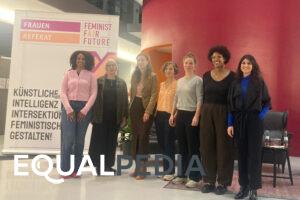
From left to right: Saba Afeworki (Women’s Department project manager), Gabriele Wenner (head of the Women’s Department), Tina Zapf-Rodríguez (city councillor for climate, the environment and women), Alexandra Lechner (managing director of Fotografie Forum Frankfurt), Levke Burfeind (lawyer at HateAid), Justine Müssig (project participant and activist), Zamina Ahmad (AI expert, speaker and founder)
Photo: Karin Kraus
In May 2025, the launch event for Frankfurt’s fourth action plan, “FEMINIST FAIR FUTURE”, took place as part of the European Charter for Equality. After the first three action plans—“Women in Work – Frauen im Erwerbsleben”, “Frauen.Macht.Politik” and “Klischeefreie Zone Frankfurt”—the fourth focuses on the effects of artificial intelligence (AI) on gender equality and social participation.32Der Magistrat Stadt Frankfurt am Main/Dezernat X – Klima, Umwelt und Frauen/Frauenreferat (2025): Website von FEMINIST FAIR FUTURE. Online unter: https://www.feministfairfuture.de/event/auftaktveranstaltung (Zugriff am 02.06.2025). Its initial aim is to “raise awareness of the problem and draw attention to the dangers of an unjust digital transformation”.33cpap (2025): „KI ist nicht neutral“. Frauenreferat weist auf Ungleichheit hin. In: Frankfurter Allgemeine Zeitung, Artikel vom 10.5. Over the following three to four years, the plan is to investigate where women face structural discrimination in digital spaces and then find solutions to that disadvantage.34o. A. (2025): Für digitale Gleichstellung. In: Frankfurter Rundschau, Artikel vom 09.05. Online unter: https://www.fr.de/frankfurt/das-frauenreferat-entwickelt-einen-neuen-aktionsplan-fuer-die-gleichstellung-von-frauen-im-digitalen-bereich-und-macht-auf-diskriminierung-durch-den-93724485.html (Zugriff am 02.06.2025). Also as part of the fourth action plan, the exhibition “Prompted Realities – Sichtbarkeit im digitalen Spiegel” opened at Frankfurt’s Central Library on 4 November 2025. It juxtaposes portraits of women taken by photographer Katharina Dubno with AI-generated images of the same people. “The comparison shows how digital technologies distort reality, make people invisible or reinforce stereotypes. The exhibition aims to examine critically questions of power, visibility and exclusion in digital spaces with regard to participation and gender equality.”35Der Magistrat Stadt Frankfurt am Main/Dezernat X – Klima, Umwelt und Frauen/Frauenreferat (2025): Prompted Realities – Sichtbarkeit im Digitalen Spiegel. In: Website von FEMINIST FAIR FUTURE. Online unter: https://www.feministfairfuture.de/event/prompted-realities—sichtbarkeit-im-digitalen-spiegel (Zugriff am 10.11.2025). It also shows that AI produces a middle ground, an average of everything the data-hungry system has previously collected from images online. […] Anyone absent from the datasets does not exist in AI’s data world either. Representation of all population groups does not happen automatically. The new artificial reality is shaped by stereotypes, not originality.”36Ganster, Monika (2025): „Deepfakes sind keine Privatsache.“ In: Frankfurter Allgemeine Zeitung, Artikel vom 7. November, Nr. 259, S. 2.
City councillors and heads of department
City councillors

Margarethe Nimsch (1989–1995), Sylvia Schenk (1995–2001), Jutta Ebeling (2001–2012), Sarah Sorge (2012–2016), Rosemarie Heilig (2016–2024), Tina Zapf-Rodríguez (2024–)
Heads of department
The first head of the Women’s Department was Renate Krauß-Pötz (1989–2000). Initially, the specialist positions were held by Sibylla Flügge (health), Gisela Kraut (culture), Christa Hecht (the future of the public service), Beate Weißmann (girls’ policy and municipal social policy for women), Gabriele Wibelitz (public relations), Monika Selke-Krüger (office administration), Barbara Broser (library), and Ingrid Sanyal, Ulrike Jakob and Martina Mai (administrative support).37Agnes Bucaille, Beate Menger: Ein Tag im Frauenreferat. In: Frankfurter Frauenblatt, Nr. 4, 1991, S. 12–17.
Since 2002, Gabriele Wenner has been head of the department.38Ilse Romahn: 30 Jahre städtisches Frauenreferat und kein bisschen leise. In: Frankfurt Live, 14. November 2019.
Award
In 2018, the City of Frankfurt am Main, the Hanover region and the City of Düsseldorf received the Gender Award – Kommune mit Zukunft from the Federal Ministry for Family Affairs, Senior Citizens, Women and Youth (BMFSFJ). The explanation stated: “The City of Frankfurt am Main runs its own campaigns against women’s poverty and sexism and has made extensive capacity available for municipal equality work through internal equality offices and an external Women’s Department.”39Bundesministerium für Familie, Senioren, Frauen, Kinder und Jugend (Hg.) (2018): Gender Award zeichnet Kommunen mit vorbildlicher Gleichstellungsarbeit aus. In: bmfsfj.de, aktuelle Meldung vom 11.06. Online unter: https://www.bmfsfj.de/bmfsfj/gender-award-zeichnet-kommunen-mit-vorbildlicher-gleichstellungsarbeit-aus-123762 (Zugriff am 13.07.2021). The award was presented to Frankfurt’s city councillor responsible for women, Rosemarie Heilig; deputy head of the Women’s Department Beate Herzog; and head of the Equal Rights Office Ulrike Jakob.40o. A. (2018): Frankfurt stärkt Frauen in preiswürdiger Weise. In: Frankfurter Neue Presse, Artikel vom 13.06., S. 10.
Publications of the Women’s Department (selection)
- Amt für Multikulturelle Angelegenheiten, Dezernat Frauen und Gesundheit, Frauenreferat (Hg.) (o. J.): Frankfurter Anhörung zur Situation der Migrantinnen. Frankfurt/M.
- Frauenreferat der Stadt Frankfurt am Main (1990): Prostitution als Dienstleistungsbranche und Wirtschaftsfaktor in Frankfurt. Öffentliche Anhörung, 27.09. Online unter: https://frankfurt.de/service-und-rathaus/verwaltung/publikationen/frauenreferat/dokumentation-prostitution-als-dienstleistungsbranche-und-wirtschaftsfaktor-in-frankfurt (Zugriff am 19.07.2021).
- Stadt Frankfurt am Main, Dezernat Frauen und Gesundheit, Frauenreferat (Hg.) (1992): Feminisierung des Öffentlichen Dienstes – Bürokratisierung der Dokumentation der Fachtagung „Die Zukunft des öffentlichen Dienstes“. Frankfurt/M.
- Müller, Sigrid/Fuchs, Claudia (1993): Handbuch zur nichtsexistischen Sprachverwendung in öffentlichen Texten. Im Auftrag des Magistrats der Stadt Frankfurt am Main, Dezernat Frauen und Gesundheit, Frauenreferat. Frankfurt/M.
- Stadt Frankfurt am Main, Dezernat Frauen und Gesundheit, Frauenreferat und Dezernat Soziales, Jugend, Personal und Organisation, Jugendamt (Hg.) (1995): Frankfurter Leitlinien zur Förderung der Mädchenarbeit in der Kinder- und Jugendhilfe. Frankfurt/M.
- Stadt Frankfurt am Main, Dezernat Frauen und Gesundheit, Frauenreferat (Hg.) (1996): Frauenbelange in der verbindlichen Bauleitplanung. Grundsätze bei der Berücksichtigung der Belange von Leitfaden für die Praxis. Frankfurt/M.
- Frauenreferat der Stadt Frankfurt am Main (Hg.) (1999): die Dokumentation der Runden Tische zu Förderung von Frauen in der Kultur 1998/1999. Frankfurt/M.
- Frauenreferat der Stadt Frankfurt am Main (Hg.) (2002): Wirsindso*frei. 3 Jahrzehnte neue Frauenbewegung in Frankfurt. 58 Frankfurter Frauenprojekte schlagen den Bogen gestern – heute – morgen. Meilensteine aus Recht und Geschichte der Frankfurter Frauenbewegung. Frankfurt/M. Online unter: https://frankfurt.de/service-und-rathaus/verwaltung/publikationen/frauenreferat/dokumentation-wir-sind-so-frei (Zugriff am 19.07.2021).
- Frauen-Guide Frankfurt, updated at irregular intervals since 2006, also available as an app from spring 202041Stadt Frankfurt am Main, Frauenreferat (Hg.): Frauen-Guide. In: Frankfurt.de. Online unter: https://frankfurt.de/service-und-rathaus/verwaltung/publikationen/frauenreferat/frauen-guide (Zugriff am 19.07.2021).
- Kasper, Birgit/Schubert, Steffi (2013): Nach Frauen benannt. 127 Straßen in Frankfurt am Main. Hg. von der Stadt Frankfurt am Main. Frankfurt/M.: Nizza Verlag, ISBN 978-3-940599-06-3.
- Frauenreferat der Stadt Frankfurt am Main (Hg.) (2017): Mein NEIN meint NEIN. Frankfurt/M. Online unter: https://frankfurt.de/service-und-rathaus/verwaltung/publikationen/frauenreferat/mein-nein-meint-nein-comic-2017 (Zugriff am 19.07.2021)
- Wenner, Gabriele/Kagerbauer, Linda/Linnemann, Dorothee/Jung, Jenny/Koblitz, Katja (Red.) (2018): 100 Jahre Frauenwahlrecht. Katalog der 49 porträtierten Frauen im Kaisersaal des Frankfurter Römers. Hg. vom Frauenreferat der Stadt Frankfurt am Main und dem Historischen Museum Frankfurt. März. Online unter: https://docplayer.org/73718294-100-jahre-frauenwahlrecht-katalog-der-49-portraetierten-frauen-im-kaisersaal-frankfurt.html (Zugriff am 19.07.2021).42Frauen. Macht. Politik.
- Frauenreferat der Stadt Frankfurt am Main (Hg.) (2020): This is what a feminist looks like – Frankfurter Porträts in Zusammenarbeit mit der Fotografin Katharina Dubno. In: Frauen. Macht. Politik. Online unter: http://frauen-macht-politik-ffm.de/frankfurter-portraits/ (Zugriff am 19.07.2021).
- Mann, Sandra (2020): Ich will mein Leben extrem verändern. Fünf geflüchtete Frauen in Frankfurt. Hg. vom Frauenreferat der Stadt Frankfurt am Main. Frankfurt/M.: Nizza Verlag, ISBN 978-3-940599-09-4.
Further reading on the history of women’s departments
- Stolterfoht, Barbara (1988): Macht für Frauen in der Kommunalpolitik: Vom Frauenbüro zum Frauendezernat. In: Weg, Marianne/Stein, Otti: MACHT Frauen stark: Frauenpolitik für die 90er Jahre. Hamburg: VSA-Verlag, S. 62–67. ISBN 387975456X.
- Vollmer, Christine (1988): Das Netzwerk der kommunalen Frauenbüros. In: Weg, Marianne/Stein, Otti: MACHT Frauen stark: Frauenpolitik für die 90er Jahre. Hamburg: VSA-Verlag, , S. 46–52. ISBN 387975456X.
- Stolterfoht, Barbara/Rhiemeier, Dorothée (1994): Kommunale Frauenpolitik. In: Roth, Roland/Wollmann, Hellmut (Hg.) (1994): Politisches Handeln in den Gemeinden. Wiesbaden: VS Verlag für Sozialwissenschaften, S. 538–554. ISBN 978-3-322-93826-8.
- Cordes, Mechthild (1996): Gleichstellungsstellen. In: Dies: Frauenpolitik: Gleichstellung oder Gesellschaftsveränderung. Analysen (Politik – Gesellschaft – Wirtschaft. Eine Buchreihe). Vol. 53. Wiesbaden: VS Verlag für Sozialwissenschaften. S. 85–104. ISBN 978-3-322-97318-4.
- Rudolph, Clarissa/Schirmer, Uta (2004): Zwischen Verwaltung und Frauenbewegung? Frauen- und Gleichstellungsbeauftragte im Kontext lokaler Frauennetzwerke. In: Dies.: Gestalten oder verwalten? Kommunale Frauenpolitik zwischen Verrechtlichung, Modernisierung und Frauenbewegung. Politik und Geschlecht, Vol. 14. Wiesbaden: VS Verlag für Sozialwissenschaften, S. 145–198. ISBN 978-3-663-01245-0.
- Lüders, Marie Elisabeth (2014): Aufbau und Aufgaben der Frauenreferate im Kriegsamt. In: Hering, Sabine/Münchmeyer, Richard (Hg.): Geschichte der Sozialen Arbeit – Quellentexte. Weinheim/Basel: Beltz Juventa, S. 122–123. ISBN 978-3-7799-1448-8.
External links
- Website of the Frauenreferats der Stadt Frankfurt am Main
Machine translation: This article was translated automatically from the German original.
- 1Wischermann, Ulla (2018): Vom Weiberrat zur Frauenprofessur. Die Neue Frauenbewegung und der 1968er Aufbruch. In: Goethe-Universität (Hg.): Die 68er: Forschung Frankfurt. Das Wissenschaftsmagazin der Goethe-Universität. Nr. 1. Frankfurt/M., S. 62 ff. Online unter: https://www.forschung-frankfurt.uni-frankfurt.de/72047849/fofra_2018_01_gesamt.pdf (Zugriff am 14.07.2021). ↩︎
- 2Hitz, Julia (2019): Aktion 2018. In: Digitales Deutsches Frauenarchiv. Online unter: https://www.digitales-deutsches-frauenarchiv.de/akteurinnen/aktion-218 (Zugriff am 19.07.2021). ↩︎
- 3Hamm, Sabine (unter Mitwirkung von Stephanie Junk) (2010): Die Frauengesundheitsbewegung. Ein Beispiel für Netzwerkbildung. In: Exzellenzcluster der Universität Trier und Mainz (Hg.): „Gesellschaftliche Abhängigkeiten und soziale Netzwerke“. Trier: Universität Trier, Juli, S. 7–8. Online unter: https://www.yumpu.com/de/document/view/6209631/dossier-frauengesundheit-gesellschaftliche-abhangigkeiten-und- (Zugriff am 19.07.2021). ↩︎
- 4Wischermann, Ulla (2018): Vom Weiberrat zur Frauenprofessur. Die Neue Frauenbewegung und der 1968er Aufbruch. In: Goethe-Universität (Hg.): Die 68er: Forschung Frankfurt. Das Wissenschaftsmagazin der Goethe-Universität. Nr. 1. Frankfurt/M., S. 62 ff. Online unter: https://www.forschung-frankfurt.uni-frankfurt.de/72047849/fofra_2018_01_gesamt.pdf (Zugriff am 14.07.2021). ↩︎
- 5Frauenreferat der Stadt Frankfurt am Main (Hg.) (2002): Wirsindso*frei. 3 Jahrzehnte neue Frauenbewegung in Frankfurt. 58 Frankfurter Frauenprojekte schlagen den Bogen gestern – heute – morgen. Meilensteine aus Recht und Geschichte der Frankfurter Frauenbewegung. Frankfurt/M., S. 49. Online unter: https://frankfurt.de/service-und-rathaus/verwaltung/publikationen/frauenreferat/dokumentation-wir-sind-so-frei (Zugriff am 19.07.2021). ↩︎
- 6Lenz, Ilse (Hg.) (2010): Die Neue Frauenbewegung in Deutschland. Abschied vom kleinen Unterschied. Eine Quellensammlung. 2. aktualisierte Auflage. Wiesbaden: VS Verlag für Sozialwissenschaften, ISBN 978-3-531-17436-5, S. 355 ff. ↩︎
- 7Hamm, Sabine (unter Mitwirkung von Stephanie Junk) (2010): Die Frauengesundheitsbewegung. Ein Beispiel für Netzwerkbildung. In: Exzellenzcluster der Universität Trier und Mainz (Hg.): „Gesellschaftliche Abhängigkeiten und soziale Netzwerke“. Trier: Universität Trier, Juli, S. 7–8. Online unter: https://www.yumpu.com/de/document/view/6209631/dossier-frauengesundheit-gesellschaftliche-abhangigkeiten-und- (Zugriff am 19.07.2021). ↩︎
- 8Flügge, Sibylla (1998): Vom Weiberrat zum Frauenprojekt. Ein persönlicher Bericht über den Beginn der neuen Frauenbewegung in Frankfurt am Main. In: Beuth, Kirsten/Plötz, Kirsten (Hg.): Ein Austausch über Frauengeschichte(n) in zwei deutschen Staaten. Gelnhausen: Triga Verlag, ISBN 3-931559-95-5, S. 147. ↩︎
- 9Jung, Dörthe (2017): Wie die Frauenbewegung Frankfurt bewegte. Aufbruch und Rebellion: Die neue Frauenbewegung in Frankfurt 1968–1990. Vortrag im Deutschen Architekturmuseum Frankfurt am Main. In: Vortragsreihe „STADTplus. Die Stadt und der Feminismus“ sowie der Ausstellung „Frau Architekt“, 04.10., S. 9 ff. Online unter: http://www.doerthejung-consult.com/WEB/content/texte/Doerthe%20Jung%20im%20 Deutschen%20Architekturmuseum%202017.pdf (Zugriff am 09.12.2019). ↩︎
- 10Frauenreferat der Stadt Frankfurt am Main (Hg.) (2002): Wirsindso*frei. 3 Jahrzehnte neue Frauenbewegung in Frankfurt. 58 Frankfurter Frauenprojekte schlagen den Bogen gestern – heute – morgen. Meilensteine aus Recht und Geschichte der Frankfurter Frauenbewegung. Frankfurt/M., S. 49. Online unter: https://frankfurt.de/service-und-rathaus/verwaltung/publikationen/frauenreferat/dokumentation-wir-sind-so-frei (Zugriff am 19.07.2021). ↩︎
- 11Harting, Mechthild (2014): „Der Wind weht den Frauen in die Segel“. In: Frankfurter Allgemeine Zeitung, Artikel vom 28.11. Online unter: https://www.faz.net/aktuell/rhein-main/frauenreferat-in-frankfurt-besteht-seit-25-jahren-13286751.html (Zugriff am 19.07.2021). ↩︎
- 12Jung, Dörthe (1990): Ein Jahr Frauenpolitik im Frankfurter Magistrat. In: Frankfurter Frauenblatt, Nr. 4, S. 16–17. ↩︎
- 13Institut für Stadtgeschichte (Hg.) (o. J.): 11. September 1989. In: Stadtchronik. Online unter: https://www.stadtgeschichte-ffm.de/de/info-und-service/frankfurter-geschichte/stadtchronik/1989 (Zugriff am 13.07.2021). ↩︎
- 14Frauenreferat der Stadt Frankfurt am Main (Hg.) (1992): Drei Jahre Kommunale Frauenpolitik in Frankfurt. Frankfurt/M. ↩︎
- 15Bucaille, Agnes/Menger, Beate (1991): Ein Tag im Frauenreferat. In: Frankfurter Frauenblatt, Nr. 4, S. 12–17. ↩︎
- 16Frauenreferat der Stadt Frankfurt am Main (Hg.) (2002): Wirsindso*frei. 3 Jahrzehnte neue Frauenbewegung in Frankfurt. 58 Frankfurter Frauenprojekte schlagen den Bogen gestern – heute – morgen. Meilensteine aus Recht und Geschichte der Frankfurter Frauenbewegung. Frankfurt/M., S. 58. Online unter: https://frankfurt.de/service-und-rathaus/verwaltung/publikationen/frauenreferat/dokumentation-wir-sind-so-frei (Zugriff am 19.07.2021). ↩︎
- 17Frauenreferat der Stadt Frankfurt am Main (Hg.) (2002): Wirsindso*frei. 3 Jahrzehnte neue Frauenbewegung in Frankfurt. 58 Frankfurter Frauenprojekte schlagen den Bogen gestern – heute – morgen. Meilensteine aus Recht und Geschichte der Frankfurter Frauenbewegung. Frankfurt/M., S. 49. Online unter: https://frankfurt.de/service-und-rathaus/verwaltung/publikationen/frauenreferat/dokumentation-wir-sind-so-frei (Zugriff am 19.07.2021). ↩︎
- 18o. A. (1993): Keine Mehrheit für die Auflösung des Frauenreferats. In: Frankfurter Allgemeine Zeitung, Artikel vom 07.07., S. 32. ↩︎
- 19Bucaille, Agnes/Menger, Beate (1991): Ein Tag im Frauenreferat. In: Frankfurter Frauenblatt, Nr. 4, S. 12–17. ↩︎
- 20Harting, Mechthild (2014): „Der Wind weht den Frauen in die Segel“. In: Frankfurter Allgemeine Zeitung, Artikel vom 28.11. Online unter: https://www.faz.net/aktuell/rhein-main/frauenreferat-in-frankfurt-besteht-seit-25-jahren-13286751.html (Zugriff am 19.07.20201). ↩︎
- 21Frauenreferat der Stadt Frankfurt am Main (Hg.) (1992): Drei Jahre Kommunale Frauenpolitik in Frankfurt. Frankfurt/M. ↩︎
- 22Frauenreferat der Stadt Frankfurt am Main (Hg.) (2002): Wirsindso*frei. 3 Jahrzehnte neue Frauenbewegung in Frankfurt. 58 Frankfurter Frauenprojekte schlagen den Bogen gestern – heute – morgen. Meilensteine aus Recht und Geschichte der Frankfurter Frauenbewegung. Frankfurt/M. Online unter: https://frankfurt.de/service-und-rathaus/verwaltung/publikationen/frauenreferat/dokumentation-wir-sind-so-frei (Zugriff am 19.07.2021). ↩︎
- 23„Im Weiteren fällt auf, dass sieben der zehn größten Städte in Deutschland Kriterienkataloge hervorgebracht haben (…): Berlin, Bremen, Dortmund, Frankfurt a. M., Hamburg, München, Stuttgart. Damit bestätigt sich die allgemeine stadtsoziologische Erkenntnis, dass Großstädte eine wesentliche Voraussetzung für Emanzipation und Innovation darstellen. Der Rückgang frauenspezifischer Aktivitäten seit Ende der 1990er Jahre fällt mit der Einführung des Gender Mainstreaming in der EU und ihren Mitgliedsländern zusammen.“ Aus: Zibell, Barbara/Schröder, Anke (2007): Frauen mischen mit: Qualitätskriterien für die Stadt- und Bauleitplanung. Beiträge zur Planungs- und Architektursoziologie, Bd. 5, Frankfurt/M./Berlin/Bern et al.: Peter Lang, ISBN 978-3-631-56741-8, S. 207. ↩︎
- 24„Die Sicherheit gilt als ein Qualitätsmerkmal des Städtebaus im 21. Jahrhundert, obwohl sie von den Frauen der Frauenbewegung bereits ab Ende der 70er Jahre des letzten Jahrhunderts vehement eingefordert wurde und Bestandteil eines jeden Kriterienkatalogs für frauenspezifische Belange in der Stadtplanung war.“ (Siehe Anmerkung 2: z. B. Kriterienkatalog Magistrat der Stadt Frankfurt am Main, Frauenreferat) Aus: Marks, Erich/Steffen, Wiebke (Hg.) (2013): Sicher leben in Stadt und Land: Ausgewählte Beiträge des 17. Deutschen Präventionstages 2012 in München, Mönchengladbach: Forum Verlag Godesberg, ISBN 978-3-942865-15-9, S. 347. ↩︎
- 25Stadt Frankfurt am Main (Hg.) (o. J.): Tony Sender Preis. In: Frankfurt.de. Online unter: https://frankfurt.de/service-und-rathaus/verwaltung/preise-und-ehrungen/tony-sender-preis (Zugriff am 19.07.2021). ↩︎
- 26Bundesanzeiger (Hg.) (1994): Handelsregister-Bekanntmachungen vom 27. August. ↩︎
- 27Gramann, Karola (Red.) (1999): die weiberwirtschaft. frauen in kunst und kultur. Dokumentation der Anhörung vom 17. Mai 1999 und der Runden Tische vom November 1998 bis März 1999. Hg. vom Frauenreferat der Stadt Frankfurt am Main. Frankfurt/M. ↩︎
- 28Institut für Stadtgeschichte (Hg.) (o. J.): 20. April 1999. In: Stadtchronik. Online unter: https://www.stadtgeschichte-ffm.de/de/info-und-service/frankfurter-geschichte/stadtchronik/1999 (Zugriff am 13.07.2021). ↩︎
- 29Frauenreferat der Stadt Frankfurt am Main (o. J.): Wir über uns. In: Frankfurt.de. Online unter: https://frankfurt.de/service-und-rathaus/verwaltung/aemter-und-institutionen/frauenreferat/wir-ueber-uns (Zugriff am 19.07.2021). ↩︎
- 30Frauenreferat der Stadt Frankfurt am Main (o. J.): Chronik des Frauenreferats. In: Frankfurt.de. Online unter: https://frankfurt.de/service-und-rathaus/verwaltung/aemter-und-institutionen/frauenreferat/wir-ueber-uns/chronik-des-frauenreferats (Zugriff am 19.07.2021). ↩︎
- 31Frauenreferat der Stadt Frankfurt am Main (o. J.): Klischeefreie Zone Frankfurt. Online unter: http://klischeefreie-zone-ffm.de/ (Zugriff am 19.07.2021). ↩︎
- 32Der Magistrat Stadt Frankfurt am Main/Dezernat X – Klima, Umwelt und Frauen/Frauenreferat (2025): Website von FEMINIST FAIR FUTURE. Online unter: https://www.feministfairfuture.de/event/auftaktveranstaltung (Zugriff am 02.06.2025). ↩︎
- 33cpap (2025): „KI ist nicht neutral“. Frauenreferat weist auf Ungleichheit hin. In: Frankfurter Allgemeine Zeitung, Artikel vom 10.5. ↩︎
- 34o. A. (2025): Für digitale Gleichstellung. In: Frankfurter Rundschau, Artikel vom 09.05. Online unter: https://www.fr.de/frankfurt/das-frauenreferat-entwickelt-einen-neuen-aktionsplan-fuer-die-gleichstellung-von-frauen-im-digitalen-bereich-und-macht-auf-diskriminierung-durch-den-93724485.html (Zugriff am 02.06.2025). ↩︎
- 35Der Magistrat Stadt Frankfurt am Main/Dezernat X – Klima, Umwelt und Frauen/Frauenreferat (2025): Prompted Realities – Sichtbarkeit im Digitalen Spiegel. In: Website von FEMINIST FAIR FUTURE. Online unter: https://www.feministfairfuture.de/event/prompted-realities—sichtbarkeit-im-digitalen-spiegel (Zugriff am 10.11.2025). ↩︎
- 36Ganster, Monika (2025): „Deepfakes sind keine Privatsache.“ In: Frankfurter Allgemeine Zeitung, Artikel vom 7. November, Nr. 259, S. 2. ↩︎
- 37Agnes Bucaille, Beate Menger: Ein Tag im Frauenreferat. In: Frankfurter Frauenblatt, Nr. 4, 1991, S. 12–17. ↩︎
- 38Ilse Romahn: 30 Jahre städtisches Frauenreferat und kein bisschen leise. In: Frankfurt Live, 14. November 2019. ↩︎
- 39Bundesministerium für Familie, Senioren, Frauen, Kinder und Jugend (Hg.) (2018): Gender Award zeichnet Kommunen mit vorbildlicher Gleichstellungsarbeit aus. In: bmfsfj.de, aktuelle Meldung vom 11.06. Online unter: https://www.bmfsfj.de/bmfsfj/gender-award-zeichnet-kommunen-mit-vorbildlicher-gleichstellungsarbeit-aus-123762 (Zugriff am 13.07.2021). ↩︎
- 40o. A. (2018): Frankfurt stärkt Frauen in preiswürdiger Weise. In: Frankfurter Neue Presse, Artikel vom 13.06., S. 10. ↩︎
- 41Stadt Frankfurt am Main, Frauenreferat (Hg.): Frauen-Guide. In: Frankfurt.de. Online unter: https://frankfurt.de/service-und-rathaus/verwaltung/publikationen/frauenreferat/frauen-guide (Zugriff am 19.07.2021). ↩︎
- 42
