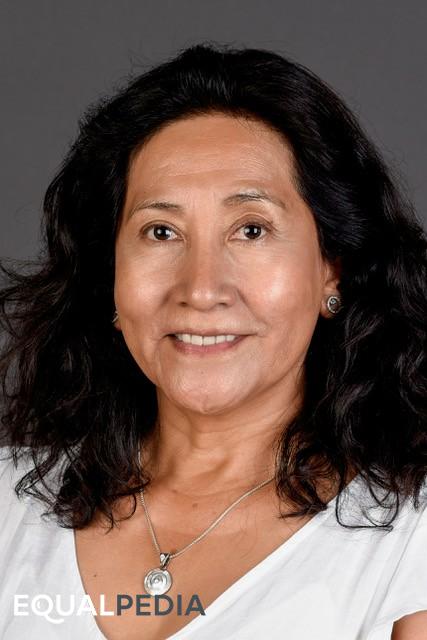
Jael Bueno (*1959 in Bolivia) is a Swiss sociologist, feminist and author. She is an expert on violence against women, gender and migration.1Zulauf, Fränzi (2009): „Häusliche Gewalt betrifft uns alle“. In: Aargauer Zeitung, article of 18 June. Available online at: https://www.aargauerzeitung.ch/schweiz/hausliche-gewalt-betrifft-alle-ld.1977152 (accessed on 24 July 2025). Since 2021 she has been co-founder and co-director of the Zentrum für Care Kooperativen (Centre for Care Cooperatives), from which a cooperative for women working in the cleaning sector has emerged.2cf. Zentrum für Care Kooperativen (n.d.): Website des Zentrums. Available online at: https://www.zentrumcarekooperativen.ch/ (accessed on 23 July 2025). 3cf. Autonomía. Die Plattformkooperative (n.d.): Website der Plattform. Available online at: https://autonomia-kooperative.ch/ (accessed on 23 July 2025).
Education, career
Jael Bueno grew up in Bolivia and has lived in Switzerland since 1991.4Zulauf, Fränzi (2009): „Häusliche Gewalt betrifft uns alle“. In: Aargauer Zeitung, article of 18 June. Available online at: https://www.aargauerzeitung.ch/schweiz/hausliche-gewalt-betrifft-alle-ld.1977152 (accessed on 24 July 2025). She is the mother of two adult children. She studied sociology from 1978 to 1984 at the Universidad Mayor de San Simon in Cochabamba (Bolivia). Her research areas were “family violence” and “intimate partner violence”.5Zulauf, Fränzi (2009): „Häusliche Gewalt betrifft uns alle“. In: Aargauer Zeitung, article of 18 June. Available online at: https://www.aargauerzeitung.ch/schweiz/hausliche-gewalt-betrifft-alle-ld.1977152 (accessed on 24 July 2025).
Shortly after her arrival in Switzerland, she became a co-editor of the journal Olympe. Feministische Arbeitshefte für Politik.6Olympe. Feministische Arbeitshefte zur Politik (1994–2012). Issues 1–33. Oberlunkofen: Olympe. According to her own account, working with the editor-in-chief Elisabeth Joris – a historian and one of the formative figures of the Swiss women’s movement – and with the other editors helped her to integrate, and she was able to continue pursuing her passion, writing.7Senn, Bernard (2019): „Hilfe zur Selbsthilfe?“ Jael Bueno und Lina Rasheed im Gespräch mit Bernard Senn. In: SRF Kultur, broadcast of 24 November. Available online at: https://www.srf.ch/audio/kontext/hilfe-zur-selbsthilfe?partId=37ac95f9-a5e5-4e1e-ad32-7269e0fc20f9 (accessed on 23 July 2025). From 1995 until 2012, when the journal series was discontinued, she was a co-editor of and author for Olympe.
In 2004 Jael Bueno completed a postgraduate programme8Today: Executive Master of Gender-Management. in gender management at the Fachhochschule Nordwestschweiz (University of Applied Sciences and Arts Northwestern Switzerland).
From 2009 to 2017 she worked as operations manager of the Frauenhaus Aarau-Solothurn (Aarau-Solothurn women’s shelter).9Zulauf, Fränzi (2009): „Häusliche Gewalt betrifft uns alle“. In: Aargauer Zeitung, article of 18 June. Available online at: https://www.aargauerzeitung.ch/schweiz/hausliche-gewalt-betrifft-alle-ld.1977152 (accessed on 24 July 2025). From 2018 to 2020 she worked freelance in newplacement.10cf. Caprez, Christina (2022): Wann, wenn nicht jetzt. Das Frauenhaus in Zürich. Zürich: Limmatverlag, ISBN 978-3-03926-036-2, p. 288.
In 2019 Jael Bueno founded the association Frauen50plus (Women 50 plus)11https://frauen50plus.ch/ueber-uns (accessed 2 February 2025). The website is no longer available, as it has been replaced by: Zentrum für Care Kooperativen (n.d.): Website des Zentrums. Available online at: https://www.zentrumcarekooperativen.ch/ (accessed on 23 July 2025). and was its president. As a further development of this, the Zentrum für Care Kooperativen was established in 2024, where she now works as co-director.
Areas of work and their development
Feminist, empowerment for migrant women
Jael Bueno was already active as a feminist in Bolivia and took a prominent stand for the Latin American women’s movement.12cf. review by Elaine Carey (1986) of Kupper, Gaby (1994): Companeras: Voices from Latin American Woman’s Movement. London: Latin American Bureau, ISBN 978-0-906156-86-5. Available online at: https://www.h-net.org/reviews/showpdf.php?id=496 (accessed on 11 August 2025). In Switzerland, in 1992 she founded and coordinated the migrant women’s self-organisation “NOSOTRAS – wir Frauen” (NOSOTRAS – we women).13cf. Schweizerisches Sozialarchiv (2023): Eintrag NOSOTRAS – WIR FRAUEN. In: Website des Schweizerischen Sozialarchivs. Available online at: https://www.findmittel.ch/archive/archNeu/Ar94.html (accessed on 23 July 2025). This gave rise to a career guidance centre in Zurich for women with a migration background. It was important to the women to make the resources of Swiss society accessible to migrant women. NOSOTRAS reversed the perspective on migration, says Jael Bueno: it was not the migrants who needed integration measures, but the host society.14Senn, Bernard (2019): „Hilfe zur Selbsthilfe?“ Jael Bueno und Lina Rasheed im Gespräch mit Bernard Senn. In: SRF Kultur, broadcast of 24 November. Available online at: https://www.srf.ch/audio/kontext/hilfe-zur-selbsthilfe?partId=37ac95f9-a5e5-4e1e-ad32-7269e0fc20f9 (accessed on 23 July 2025). For the skills and competences of these women, whether acquired in their countries of origin or here, had been ignored.15Senn, Bernard (2019): „Hilfe zur Selbsthilfe?“ Jael Bueno und Lina Rasheed im Gespräch mit Bernard Senn. In: SRF Kultur, broadcast of 24 November. Available online at: https://www.srf.ch/audio/kontext/hilfe-zur-selbsthilfe?partId=37ac95f9-a5e5-4e1e-ad32-7269e0fc20f9 (accessed on 23 July 2025). 16The NOSOTRAS archive was handed over to the Schweizerisches Sozialarchiv (Swiss Social Archives) in 2003. Cf. Schweizerisches Sozialarchiv (2023): Eintrag NOSOTRAS – WIR FRAUEN. In: Website des Schweizerischen Sozialarchivs. Available online at: https://www.findmittel.ch/archive/archNeu/Ar94.html (accessed on 23 July 2025). She co-founded the Forum der Migrantinnen und Migranten der Stadt Bern (Forum of Migrants of the City of Bern) in 2000.17The NOSOTRAS archive was handed over to the Schweizerisches Sozialarchiv (Swiss Social Archives) in 2003. Cf. Schweizerisches Sozialarchiv (2023): Eintrag NOSOTRAS – WIR FRAUEN. In: Website des Schweizerischen Sozialarchivs. Available online at: https://www.findmittel.ch/archive/archNeu/Ar94.html (accessed on 23 July 2025). 18Internationaler Onlinedienst der Schweizerischen Radio- und Fernsehgesellschaft SRG SSR (2000): Forum für Migrantinnen und Migranten. In: swissinfo.ch, item of 11 November. Available online at: https://www.swissinfo.ch/ger/schweizer-politik/forum-fuer-migrantinnen-und-migranten/1750054 (accessed on 24 July 2025). The forum is still held annually today; at it, migrants address their integration-policy concerns directly to the experts present.19n.a. (2016): Das bietet die Stadt Bern ihren Migranten. In: Berner Zeitung BZ, article of 27 December. Available online at: https://www.bernerzeitung.ch/das-bietet-die-stadt-bern-ihren-migranten-533967466269 (accessed on 15 April 2024). At the same time, Jael Bueno joined the Migrantinnen Koordinationsstelle Schweiz (MKS, Swiss Coordination Office for Migrant Women) and became a member of its coordination group. MKS was an umbrella organisation for networking and coordinating existing migrant women’s organisations. Eight women were elected to the coordination group. One of them was Jael Bueno. The aim of the coordination office was to make visible the structural disadvantages faced by migrant women, such as the non-recognition of vocational qualifications. They relied on participatory cooperation instead of the paternalistic “integration work” practised until then.20Bueno, Jael/Mayinger Bahadi, Comelia (2000): Gründung der MKS – Migrantinnen Koordinationsstelle Schweiz. In: Bueno, Jael et al. (ed.): Olympe, Feministische Arbeitshefte zur Politik. Männer – Gewalt gegen Frauen:gesellschaftlich-grenzenlos-grauenhaft, 12. Ottenbach: Autorinnenverlag, ISBN 3-905087-26-X, p. 130.
Violence against women
Jael Bueno has been working in the field of violence against women for more than twenty years.21Senn, Bernard (2019): „Hilfe zur Selbsthilfe?“ Jael Bueno und Lina Rasheed im Gespräch mit Bernard Senn. In: SRF Kultur, broadcast of 24 November. Available online at: https://www.srf.ch/audio/kontext/hilfe-zur-selbsthilfe?partId=37ac95f9-a5e5-4e1e-ad32-7269e0fc20f9 (accessed on 23 July 2025). From 2004 to 2007 she worked at the counselling centre Nottelefon für Frauen gegen sexuelle Gewalt (Emergency Helpline for Women against Sexual Violence) in Zurich.22Zulauf, Fränzi (2009): „Häusliche Gewalt betrifft uns alle“. In: Aargauer Zeitung, article of 18 June. Available online at: https://www.aargauerzeitung.ch/schweiz/hausliche-gewalt-betrifft-alle-ld.1977152 (accessed on 24 July 2025). During this time she developed and led “LUNA”, a project for the prevention of sexual violence in the context of migration.23Bueno, Jael (2006): Projekt Luna. Präventionskonzept. In: Olympe. Feministische Arbeitshefte zur Politik. Sexuelle Gewalt. Präventionsansätze in transnationalen Räumen, (24), pp. 60–68. Jael Bueno’s aim was to establish a new model of socialisation for young people with migration experience – taking into account structural violence, gender roles and boundary violations. The prevention project “Luna” gave rise to prevention courses for apprentices and further training for teachers, which Jael Bueno ran at various schools.
The Frauenhaus Aarau-Solothurn has been operating since 1983 to protect women from domestic violence. Switzerland’s women’s shelters had put their founding phase and disputes over direction behind them, but still had to fight for recognition and adequate funding. With the entry into force of the Istanbul Convention in Switzerland in 2018, the situation improved: the state was now obliged to provide independent funding for stays in women’s shelters.24cf. Caprez, Christina (2022): Wann, wenn nicht jetzt. Das Frauenhaus in Zürich. Zürich: Limmatverlag, ISBN 978-3-03926-036-2, pp. 110–129. As operations manager of the Frauenhaus Aarau-Solothurn, Jael Bueno initiated a change of system in 2014 whereby the address of the women’s shelter was no longer kept secret.25Marti, Barbara (ed.) (2014): Frauenhausadresse nicht mehr geheim. In: FrauenSicht, article of 14 November. Available online at: https://frauensicht.ch/gewalt/gewalt1/frauenhaus-adresse-nicht-mehr-geheim/ (accessed on 23 July 2025). The shelter was to become publicly accessible, and victims of domestic violence were no longer to have to hide. The board of trustees of the Frauenhaus Aarau-Solothurn decided to take this step in order to “break the spiral of violence” and also to confront the perpetrators and work with them.26Marti, Barbara (ed.) (2014): Frauenhausadresse nicht mehr geheim. In: FrauenSicht, article of 14 November. Available online at: https://frauensicht.ch/gewalt/gewalt1/frauenhaus-adresse-nicht-mehr-geheim/ (accessed on 23 July 2025). Professionals disagreed about disclosing the locations, and only a few women’s shelters adopted the concept.27Zürcher, Sascha (2014): Frauenhäuser: Uneinigkeit über Geheimhaltung der Standorte. In: SRF, item of 25 November. Available online at: https://www.srf.ch/news/schweiz/schweiz-frauenhaeuser-uneinigkeit-ueber-geheimhaltung-der-standorte. (accessed on 23 July 2025). Over the past twenty years, the legal instruments for dealing with violence in close social relationships in Switzerland have been considerably improved, and the various victim counselling centres in the cantons have been further expanded.28Kägi-Diener, Regula: Schutz vor Gewalt: Rechtliches. In: Caprez, Christina (2024): Wann, wenn nicht jetzt. Das Frauenhaus in Zürich. Zürich: Limmatverlag, ISBN 978-3-03926-036-2, pp. 222–232. Today, all women’s shelter addresses are kept secret for women who need a secret place of refuge.29cf. Dachorgansiation Frauenhäuser Schweiz und Liechtenstein (n.d.): Website der DAO. Available online at: https://www.frauenhaeuser.ch/de (accessed on 4 September 2025).
Self-determined working conditions for women
With the association Frauen50plus, Jael Bueno campaigned from 2019 onwards for unemployed women over fifty. Through various support courses302020 project „Nie – ist zu spät!“ (Never is too late!): language support for women 50+; 2019 project „Recht auf Arbeit“ (Right to work): counselling and coaching for women 50+; 2021 project „Meine Rechte“ (My rights); 2021 project „Gründungskurs“ (Start-up course); 2022 project „Frauengenossenschaft Autonomìa“ (Autonomìa women’s cooperative). Available online at: https://frauen50plus.ch/ueber-uns (accessed 2 February 2025). in the areas of language, law and business, the association empowered older women with or without migration experience in their search for work.31cf. Gendercampus (n.d.): FRAUEN 50Plus. In: Website des Gendercampus. Available online at: https://www.gendercampus.ch/de/hochschulen/institutionen/detail/frauen-50plus (accessed on 8 September 2025). 32Forrer, Sarah (2022): Wenn die Chefinnen selber putzen. In: work. Die Zeitung der Gewerkschaft, article of 14 April. Available online at: https://www.workzeitung.ch/2022/04/wenn-die-chefinnen-selber-putzen/ (accessed on 8 September 2025). In a reorientation of Frauen50plus, the Zentrum für Care Kooperativen was established in 2024, standing for fair and self-determined working conditions in the care sector. As co-director of the centre, Jael Bueno shares responsibility, together with co-initiator Sabri Schuhmacher, for the further development of conceptual structures, operational management, administration and the further training of the cooperative members. In 2022 the platform cooperative Autonomìa was launched. The first cooperative started in 2022 as the second platform cooperative for cleaners in Switzerland.33cf. Gendercampus (n.d.): FRAUEN 50Plus. In: Website des Gendercampus. Available online at: https://www.gendercampus.ch/de/hochschulen/institutionen/detail/frauen-50plus (accessed on 8 September 2025). 34Forrer, Sarah (2022): Wenn die Chefinnen selber putzen. In: work. Die Zeitung der Gewerkschaft, article of 14 April. Available online at: https://www.workzeitung.ch/2022/04/wenn-die-chefinnen-selber-putzen/ (accessed on 8 September 2025). Autonomìa offers cleaning services for private households and commercial businesses. The cooperative is organised according to a social franchising model. The Zentrum für Care Kooperativen acts as franchisor, and the cleaners run the cooperative in a self-organised way – they elect their own management and are employed by it. They receive an appropriate hourly wage, have good social security, a say in the organisation of their working hours, and receive language and vocational training. Using an app, they can schedule their jobs with customers. In the platform economy, through which cleaners are mostly placed today, the working situation is often precarious: wages below the minimum wage, work on call, no guaranteed volume of work, i.e. no stable income.35Schwitter, Karin/Keller, Marisol (2020): Die digitale Plattform als Chefin: Arbeiten für die Gig-Economy. In: Frauenfragen | Questions au féminin | Questioni femminili. Available online at: https://www.geo.uzh.ch/dam/jcr:190ad712-7aac-4f64-a64d-07a742987d82/2020%20Schwiter_Keller_Frauenfragen.pdf (accessed on 11 August 2025). Autonomìa’s vision is to establish a cooperative of cleaners throughout Switzerland. With her initiative, Jael Bueno has succeeded in making a decisive contribution to a fair working model for women, most of them with migration experience.
Award, prizes
In 2002 the members of NOSOTRAS jointly received the Förderpreis der Stadt Zürich für die Gleichstellung von Frau und Mann (City of Zurich Award for the Promotion of Equality between Women and Men).36Stadt Zürich Medienmitteilungen (2002): Förderpreis der Stadt Zürich für NOSOTRAS – WIR FRAUEN. In: Website der Stadt Zürich, press release of 20 November. Available online at: https://stored-data.stadt-zuerich.ch/internet/mm/home/mm_02/nov_02/mm_09.html (accessed on 23 July 2025).
Publications
Publications and edited volumes
- Bueno, Jael (co-editor and member of the editorial team) (1995–2012): Redaktion Olympe (1995–2012): Olympe. Feministische Arbeitshefte zur Politik. Issues 4–33.
- Bueno, Jael et al. (ed.) (1997): Migrantinnen vernetzen sich, um die Integration mitzugestalten: Tagungsdokumentation. Bern: Migrantinnenforum, no ISBN.
- Grütter, Karin/Ryter, Annamarie with the collaboration of Jael Bueno (2008): Persönliche Grenzen respektieren: Module rund um das Thema sexuelle Belästigung für die Lernbereiche Sprache und Kommunikation. Bern: Hep-Verlag, ISBN 9783039054091.
- Bueno, Jael (2008): Mit mir nicht. Mit dir nicht: Jugendliche und sexuelle Gewalt: informieren, hinterfragen, schützen. Zürich: Verlag Pestalozzianum, ISBN 3037550791.
- Bueno, Jael (2011): N’insiste pas! Où commence la violence sexuelle? Information: refléxion: prevention. Le Mont sur Lausanne: LEP, ISBN 9782606013813.
Articles in journals
- Bueno, Jael (1995): Kein Recht auf individuelle Lebensgestaltung. In: Olympe. Feministische Arbeitshefte zur Politik. Wir leben hier. Frauen in der Fremde, (4). Zürich München: Autorinnen Verlag, ISBN 3-905087-06-5, pp. 30–39.
- Bueno, Jael (1997): Veränderungen im Briefversand Zürich von 1992 bis heute. Lateinamerikanerinnen in der Migration. In: Olympe. Feministische Arbeitshefte zur Politik. Typisch atypisch. Frauenarbeit in der Deregulierung, (7). Zürich/München: Autorinnen Verlag, ISBN 3-905087-20-0, pp. 14–17.
- Bueno, Jael (1998): Integration als Thema für die „moderne“ Schweiz. Zum Leitbildentwurf zur Integrationspolitik der Stadt Zürich. In: Olympe. Feministische Arbeitshefte zur Politik. Einflussnehmen auf Makroökonomie!, (9). Zürich/München: Autorinnen Verlag, ISBN 3-905087-23-5, pp. 114–116.
- Bueno, Jael (1998): Lateinamerikanische Migrantinnen in Europa. In: Europa-Magazin. Forum für direkte Demokratie: EU-kritisch, ökologisch, sozial. Available online at: https://europa-magazin.ch/.ee6bf41/cmd.14/audience.D (accessed on 15 February 2024).
- Bueno, Jael (1999): Differenz und Gleichstellung In: Olympe. Feministische Arbeitshefte zur Politik. Aufbruch im Widerspruch. Feminismen und die Sozialdemokratie in Europa, (11). Zürich/München: Autorinnen Verlag, ISBN 3-905087-20-0, pp. 74–77.
- Bueno, Jael (2000): Der 25. November in Lateinamerika: Tag gegen Gewalt an Frauen und Mädchen. In: Olympe. Feministische Arbeitshefte zur Politik. Männer – Gewalt gegen Frauen: gesellschaftlich-grenzenlos-grauenhaft, (12). Zürich/München: Autorinnen Verlag, ISBN 3-905087-26-X, pp. 80–85.
- Bueno, Jael (2000): Die Schmetterlinge: Die Schwestern Mirabal. In: Olympe. Feministische Arbeitshefte zur Politik. Männer – Gewalt gegen Frauen: gesellschaftlich-grenzenlos-grauenhaft, (12). Zürich/München: Autorinnen Verlag, ISBN 3-905087-26-X, pp. 8–10.
- Bueno, Jael (2000): Lateinamerika: Vom Sinn des Marschierens. Fiktive Gespräche und ein Kommentar. In: Olympe. Feministische Arbeitshefte zur Politik. Marche mondiale des femmes. Exploration – ein Mosaik, (13). Zürich/München: Autorinnen Verlag, ISBN 3-905087-27-8, pp. 82–85.
- Bueno, Jael (2004): Von Gleich zu Gleich? Widersprüche im Umgang mit Vielfalt in der feministischen Frauenarbeit. In: Olympe. Feministische Arbeitshefte zur Politik. Provokation: Personen-Debatten-Fakten. Jubiläumsausgabe, (20). Zürich/München: Autorinnen Verlag, ISBN 390508743X, pp. 196–203
- Bueno, Jael (2005): Zwischen Utopie und Wirklichkeit: Frauen mit Migrationserfahrung in der Schweiz. In: Olympe. Feministische Arbeitshefte zur Politik, Secondas. Sichtbar vielfältig, (22). Zürich/München: Autorinnen Verlag, ISBN 3905087456 (paperback), pp. 34–46.
- Bueno , Jael (2006): Die zwei Marias. Fruchtbarkeitssymbolik in Europa und Lateinamerika als kulturelles Referenzsystem. In: Olympe. Feministische Arbeitshefte zur Politik. Elternschaft: Die neue Geschlechterdifferenz?, (23). Zürich/München: Autorinnen Verlag, ISBN 3-905087-46-4, pp. 86–92.
- Bueno, Jael (2006): Projekt Luna. Präventionskonzept. In: Olympe. Feministische Arbeitshefte zur Politik. Sexuelle Gewalt. Präventionsansätze in transnationalen Räumen, (24). Zürich/München: Autorinnen Verlag, ISBN 3-905087-47-2, pp. 60–68.
- Bueno, Jael (2007): Produzentinnen werden Politikerinnen. Frauen greifen in den Demokratisierungsprozess in Bolivien ein. In: Olympe. Feministische Arbeitshefte zur Politik. Fokus: Demokratie. Partizipieren – Intervenieren – Analysieren, (25/26). Zürich/München: Autorinnen Verlag, ISBN 3-905087-48-0, pp. 56–63.
- Bueno, Jael (2008): Differenzierung und Hierarchisierung in der Entwicklungspolitik. In: Olympe: Feministische Arbeitshefte zur Politik. Postkolonialismus. Logik und Perspektiven, (27). Zürich/München: Autorinnen Verlag, ISBN 3-905087-49-9, pp. 88–99.
- Bueno, Jael (2009): Jugendliche und Sexualität im Spannungsfeld der Kulturen. In: (ed.) Eidgenössische Kommission für Jugendfragen. Jugendsexualität im Wandel der Zeit. Veränderungen, Einflüsse, Perspektiven. Bern: Eidgenössische Kommission für Kinder- und Jugendfragen, EKKJ, no ISBN, pp. 63–72.
External links
- Jael Bueno in the Deutsche Digitale Bibliothek (German Digital Library)
- Literature by Jael Bueno in META of i.d.a. – Dachverband deutschsprachiger Frauen / Lesbenarchive, -bibliotheken und -dokumentationsstellen (umbrella organisation of German-language women’s/lesbian archives, libraries and documentation centres)
- Olympe: feministische Arbeitshefte zur Politik in META of i.d.a. – Dachverband deutschsprachiger Frauen / Lesbenarchive, -bibliotheken und -dokumentationsstellen
Machine translation: This article was translated automatically from the German original.
- 1Zulauf, Fränzi (2009): „Häusliche Gewalt betrifft uns alle“. In: Aargauer Zeitung, article of 18 June. Available online at: https://www.aargauerzeitung.ch/schweiz/hausliche-gewalt-betrifft-alle-ld.1977152 (accessed on 24 July 2025). ↩︎
- 2cf. Zentrum für Care Kooperativen (n.d.): Website des Zentrums. Available online at: https://www.zentrumcarekooperativen.ch/ (accessed on 23 July 2025). ↩︎
- 3cf. Autonomía. Die Plattformkooperative (n.d.): Website der Plattform. Available online at: https://autonomia-kooperative.ch/ (accessed on 23 July 2025). ↩︎
- 4Zulauf, Fränzi (2009): „Häusliche Gewalt betrifft uns alle“. In: Aargauer Zeitung, article of 18 June. Available online at: https://www.aargauerzeitung.ch/schweiz/hausliche-gewalt-betrifft-alle-ld.1977152 (accessed on 24 July 2025). ↩︎
- 5Zulauf, Fränzi (2009): „Häusliche Gewalt betrifft uns alle“. In: Aargauer Zeitung, article of 18 June. Available online at: https://www.aargauerzeitung.ch/schweiz/hausliche-gewalt-betrifft-alle-ld.1977152 (accessed on 24 July 2025). ↩︎
- 6Olympe. Feministische Arbeitshefte zur Politik (1994–2012). Issues 1–33. Oberlunkofen: Olympe. ↩︎
- 7Senn, Bernard (2019): „Hilfe zur Selbsthilfe?“ Jael Bueno und Lina Rasheed im Gespräch mit Bernard Senn. In: SRF Kultur, broadcast of 24 November. Available online at: https://www.srf.ch/audio/kontext/hilfe-zur-selbsthilfe?partId=37ac95f9-a5e5-4e1e-ad32-7269e0fc20f9 (accessed on 23 July 2025). ↩︎
- 8Today: Executive Master of Gender-Management. ↩︎
- 9Zulauf, Fränzi (2009): „Häusliche Gewalt betrifft uns alle“. In: Aargauer Zeitung, article of 18 June. Available online at: https://www.aargauerzeitung.ch/schweiz/hausliche-gewalt-betrifft-alle-ld.1977152 (accessed on 24 July 2025). ↩︎
- 10cf. Caprez, Christina (2022): Wann, wenn nicht jetzt. Das Frauenhaus in Zürich. Zürich: Limmatverlag, ISBN 978-3-03926-036-2, p. 288. ↩︎
- 11https://frauen50plus.ch/ueber-uns (accessed 2 February 2025). The website is no longer available, as it has been replaced by: Zentrum für Care Kooperativen (n.d.): Website des Zentrums. Available online at: https://www.zentrumcarekooperativen.ch/ (accessed on 23 July 2025). ↩︎
- 12cf. review by Elaine Carey (1986) of Kupper, Gaby (1994): Companeras: Voices from Latin American Woman’s Movement. London: Latin American Bureau, ISBN 978-0-906156-86-5. Available online at: https://www.h-net.org/reviews/showpdf.php?id=496 (accessed on 11 August 2025). ↩︎
- 13cf. Schweizerisches Sozialarchiv (2023): Eintrag NOSOTRAS – WIR FRAUEN. In: Website des Schweizerischen Sozialarchivs. Available online at: https://www.findmittel.ch/archive/archNeu/Ar94.html (accessed on 23 July 2025). ↩︎
- 14Senn, Bernard (2019): „Hilfe zur Selbsthilfe?“ Jael Bueno und Lina Rasheed im Gespräch mit Bernard Senn. In: SRF Kultur, broadcast of 24 November. Available online at: https://www.srf.ch/audio/kontext/hilfe-zur-selbsthilfe?partId=37ac95f9-a5e5-4e1e-ad32-7269e0fc20f9 (accessed on 23 July 2025). ↩︎
- 15Senn, Bernard (2019): „Hilfe zur Selbsthilfe?“ Jael Bueno und Lina Rasheed im Gespräch mit Bernard Senn. In: SRF Kultur, broadcast of 24 November. Available online at: https://www.srf.ch/audio/kontext/hilfe-zur-selbsthilfe?partId=37ac95f9-a5e5-4e1e-ad32-7269e0fc20f9 (accessed on 23 July 2025). ↩︎
- 16The NOSOTRAS archive was handed over to the Schweizerisches Sozialarchiv (Swiss Social Archives) in 2003. Cf. Schweizerisches Sozialarchiv (2023): Eintrag NOSOTRAS – WIR FRAUEN. In: Website des Schweizerischen Sozialarchivs. Available online at: https://www.findmittel.ch/archive/archNeu/Ar94.html (accessed on 23 July 2025). ↩︎
- 17The NOSOTRAS archive was handed over to the Schweizerisches Sozialarchiv (Swiss Social Archives) in 2003. Cf. Schweizerisches Sozialarchiv (2023): Eintrag NOSOTRAS – WIR FRAUEN. In: Website des Schweizerischen Sozialarchivs. Available online at: https://www.findmittel.ch/archive/archNeu/Ar94.html (accessed on 23 July 2025). ↩︎
- 18Internationaler Onlinedienst der Schweizerischen Radio- und Fernsehgesellschaft SRG SSR (2000): Forum für Migrantinnen und Migranten. In: swissinfo.ch, item of 11 November. Available online at: https://www.swissinfo.ch/ger/schweizer-politik/forum-fuer-migrantinnen-und-migranten/1750054 (accessed on 24 July 2025). ↩︎
- 19n.a. (2016): Das bietet die Stadt Bern ihren Migranten. In: Berner Zeitung BZ, article of 27 December. Available online at: https://www.bernerzeitung.ch/das-bietet-die-stadt-bern-ihren-migranten-533967466269 (accessed on 15 April 2024). ↩︎
- 20Bueno, Jael/Mayinger Bahadi, Comelia (2000): Gründung der MKS – Migrantinnen Koordinationsstelle Schweiz. In: Bueno, Jael et al. (ed.): Olympe, Feministische Arbeitshefte zur Politik. Männer – Gewalt gegen Frauen:gesellschaftlich-grenzenlos-grauenhaft, 12. Ottenbach: Autorinnenverlag, ISBN 3-905087-26-X, p. 130. ↩︎
- 21Senn, Bernard (2019): „Hilfe zur Selbsthilfe?“ Jael Bueno und Lina Rasheed im Gespräch mit Bernard Senn. In: SRF Kultur, broadcast of 24 November. Available online at: https://www.srf.ch/audio/kontext/hilfe-zur-selbsthilfe?partId=37ac95f9-a5e5-4e1e-ad32-7269e0fc20f9 (accessed on 23 July 2025). ↩︎
- 22Zulauf, Fränzi (2009): „Häusliche Gewalt betrifft uns alle“. In: Aargauer Zeitung, article of 18 June. Available online at: https://www.aargauerzeitung.ch/schweiz/hausliche-gewalt-betrifft-alle-ld.1977152 (accessed on 24 July 2025). ↩︎
- 23Bueno, Jael (2006): Projekt Luna. Präventionskonzept. In: Olympe. Feministische Arbeitshefte zur Politik. Sexuelle Gewalt. Präventionsansätze in transnationalen Räumen, (24), pp. 60–68. ↩︎
- 24cf. Caprez, Christina (2022): Wann, wenn nicht jetzt. Das Frauenhaus in Zürich. Zürich: Limmatverlag, ISBN 978-3-03926-036-2, pp. 110–129. ↩︎
- 25Marti, Barbara (ed.) (2014): Frauenhausadresse nicht mehr geheim. In: FrauenSicht, article of 14 November. Available online at: https://frauensicht.ch/gewalt/gewalt1/frauenhaus-adresse-nicht-mehr-geheim/ (accessed on 23 July 2025). ↩︎
- 26Marti, Barbara (ed.) (2014): Frauenhausadresse nicht mehr geheim. In: FrauenSicht, article of 14 November. Available online at: https://frauensicht.ch/gewalt/gewalt1/frauenhaus-adresse-nicht-mehr-geheim/ (accessed on 23 July 2025). ↩︎
- 27Zürcher, Sascha (2014): Frauenhäuser: Uneinigkeit über Geheimhaltung der Standorte. In: SRF, item of 25 November. Available online at: https://www.srf.ch/news/schweiz/schweiz-frauenhaeuser-uneinigkeit-ueber-geheimhaltung-der-standorte. (accessed on 23 July 2025). ↩︎
- 28Kägi-Diener, Regula: Schutz vor Gewalt: Rechtliches. In: Caprez, Christina (2024): Wann, wenn nicht jetzt. Das Frauenhaus in Zürich. Zürich: Limmatverlag, ISBN 978-3-03926-036-2, pp. 222–232. ↩︎
- 29cf. Dachorgansiation Frauenhäuser Schweiz und Liechtenstein (n.d.): Website der DAO. Available online at: https://www.frauenhaeuser.ch/de (accessed on 4 September 2025). ↩︎
- 302020 project „Nie – ist zu spät!“ (Never is too late!): language support for women 50+; 2019 project „Recht auf Arbeit“ (Right to work): counselling and coaching for women 50+; 2021 project „Meine Rechte“ (My rights); 2021 project „Gründungskurs“ (Start-up course); 2022 project „Frauengenossenschaft Autonomìa“ (Autonomìa women’s cooperative). Available online at: https://frauen50plus.ch/ueber-uns (accessed 2 February 2025). ↩︎
- 31cf. Gendercampus (n.d.): FRAUEN 50Plus. In: Website des Gendercampus. Available online at: https://www.gendercampus.ch/de/hochschulen/institutionen/detail/frauen-50plus (accessed on 8 September 2025). ↩︎
- 32Forrer, Sarah (2022): Wenn die Chefinnen selber putzen. In: work. Die Zeitung der Gewerkschaft, article of 14 April. Available online at: https://www.workzeitung.ch/2022/04/wenn-die-chefinnen-selber-putzen/ (accessed on 8 September 2025). ↩︎
- 33cf. Gendercampus (n.d.): FRAUEN 50Plus. In: Website des Gendercampus. Available online at: https://www.gendercampus.ch/de/hochschulen/institutionen/detail/frauen-50plus (accessed on 8 September 2025). ↩︎
- 34Forrer, Sarah (2022): Wenn die Chefinnen selber putzen. In: work. Die Zeitung der Gewerkschaft, article of 14 April. Available online at: https://www.workzeitung.ch/2022/04/wenn-die-chefinnen-selber-putzen/ (accessed on 8 September 2025). ↩︎
- 35Schwitter, Karin/Keller, Marisol (2020): Die digitale Plattform als Chefin: Arbeiten für die Gig-Economy. In: Frauenfragen | Questions au féminin | Questioni femminili. Available online at: https://www.geo.uzh.ch/dam/jcr:190ad712-7aac-4f64-a64d-07a742987d82/2020%20Schwiter_Keller_Frauenfragen.pdf (accessed on 11 August 2025). ↩︎
- 36Stadt Zürich Medienmitteilungen (2002): Förderpreis der Stadt Zürich für NOSOTRAS – WIR FRAUEN. In: Website der Stadt Zürich, press release of 20 November. Available online at: https://stored-data.stadt-zuerich.ch/internet/mm/home/mm_02/nov_02/mm_09.html (accessed on 23 July 2025). ↩︎